What is composite grating and why is it replacing steel grating?
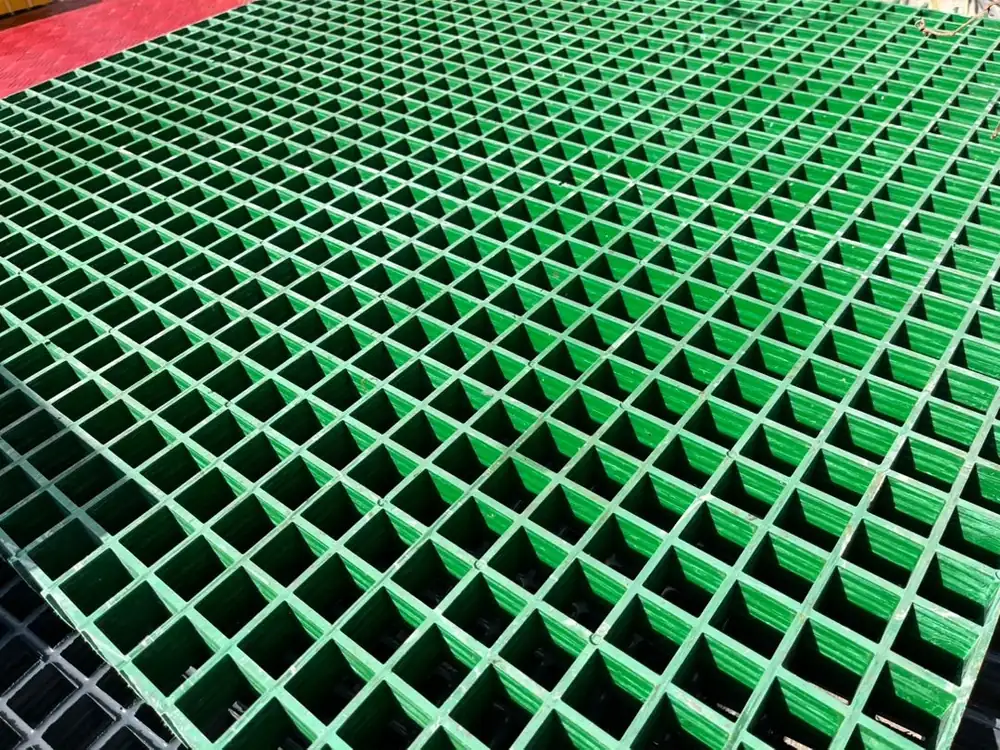
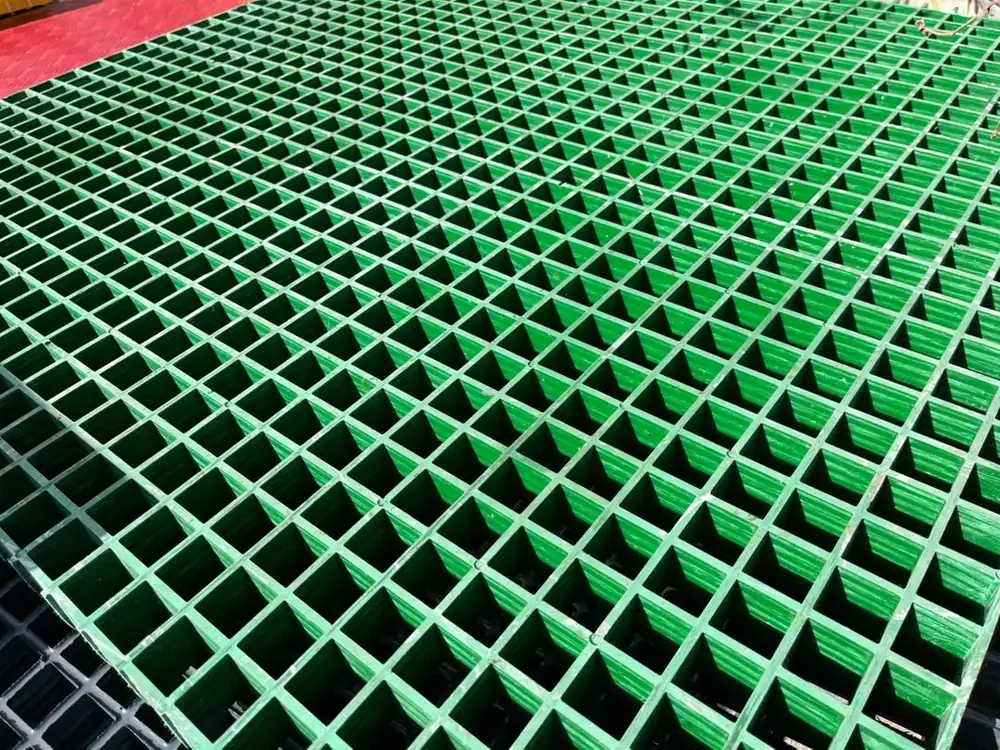
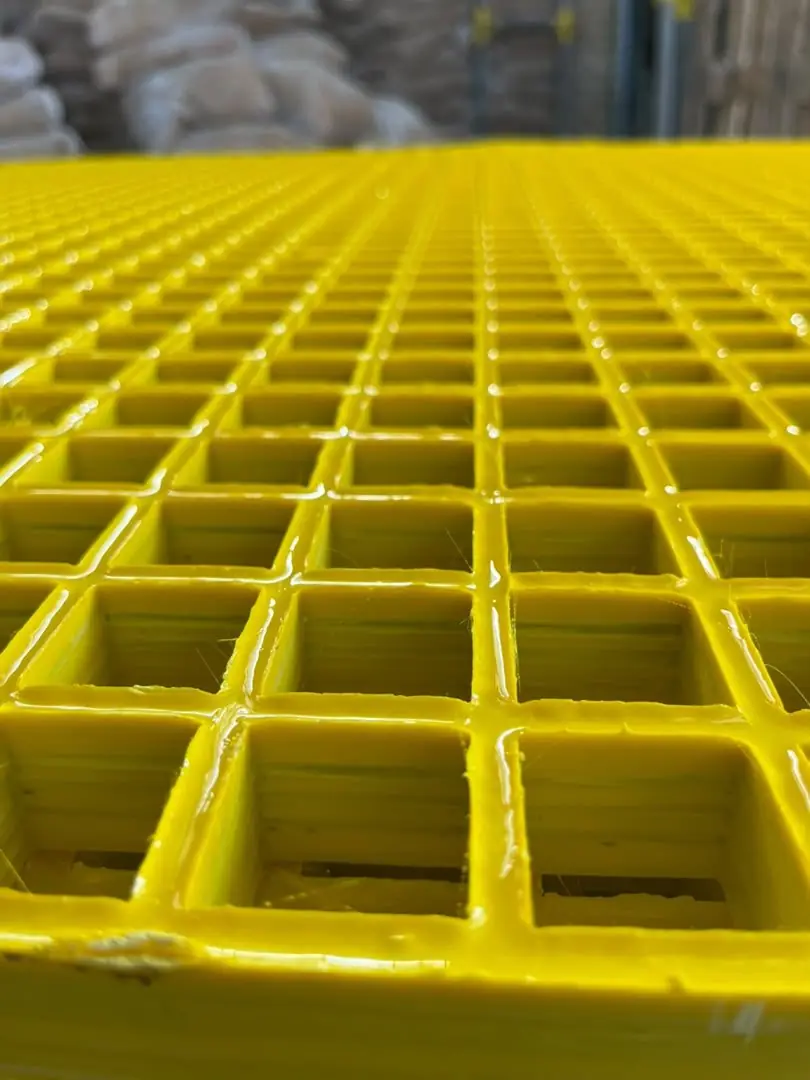
Composite grating (FRP grating or fiberglass grating) is an open-mesh panel of glass fiber and polymer resin used for platform flooring, walkways, stairs, channel covers and hatches. A polymer composite is made from a combination of resin and fibers, and the resin formulation, fiber-to-resin ratio and production method determine the properties of the final product; these are the very variables that distinguish the types of composite grating. For a basic introduction to composites, see what is a composite.

Advantages shared by composite gratings, both molded and pultruded, over steel and wood:
- Corrosion resistance: steel grating rusts in moisture, salt water and chemicals, and wood rots in moisture; composite grating works for years without maintenance in a water park with chlorinated water or a battery plant with sulfuric acid. Details in chemical resistance of composites.
- Light weight: composite has about a quarter of the density of steel, and grating is installed without a crane.
- Electrical insulation: FRP grating is non-conductive and reduces the risk of electric shock in substations and refineries.
- Transparent to waves: non-metallic and non-magnetic, it does not disturb radio and radar waves.
- Anti-slip and non-sparking: a gritted or meniscus surface, and no sparks when struck by tools.
- Open mesh: light, air and water pass through the grating mesh, and liquids do not collect on the platform.
Types of composite grating
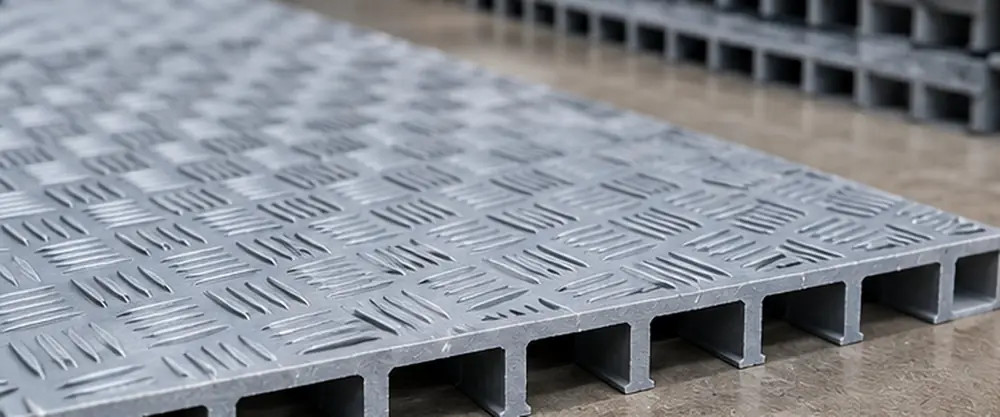
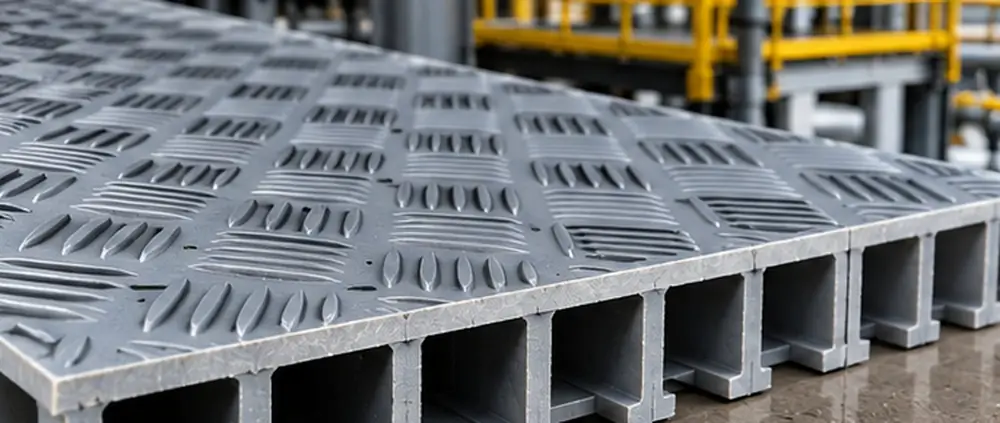
The two main types of composite grating in industry are molded grating and pultruded grating. Besides these two, checker plate grating (covered molded grating) is a widely used third type, made by bonding a patterned composite plate onto molded grating to create a closed surface.
Common names for composite grating types
On the market, composite gratings are sold under different names, which sometimes confuses buyers. The table below puts the equivalent names side by side:
| Type | Common names | English name |
|---|---|---|
| Molded grating | Molded composite grating, molded FRP grating, molded GRP grating, molded fiberglass grating | Molded FRP grating |
| Pultruded grating | Pultruded FRP grating, pultruded fiberglass grating, pultruded composite grating | Pultruded FRP grating |
| Covered grating | Checker plate grating, covered molded grating, grating with a patterned surface | Covered grating / Checker plate |
| General names | Fiberglass grating, FRP grating, GRP grating, plastic grating | FRP / GRP grating |
The name "plastic grating" is not accurate; unlike PVC or polypropylene gratings without fibers, composite gratings are reinforced with continuous glass fibers and have several times the load capacity.
How molded and pultruded grating are made
Molded composite grating
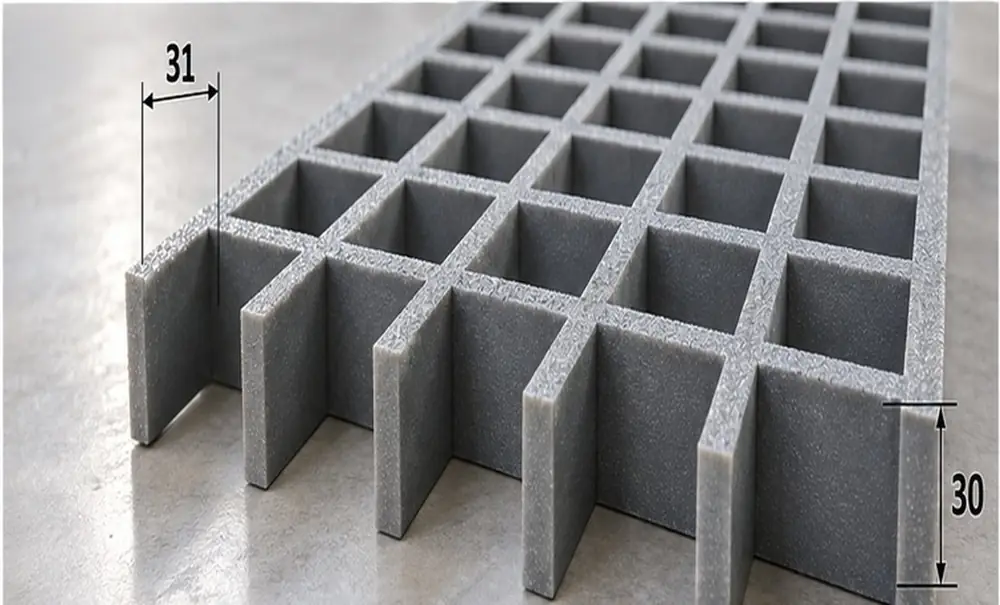
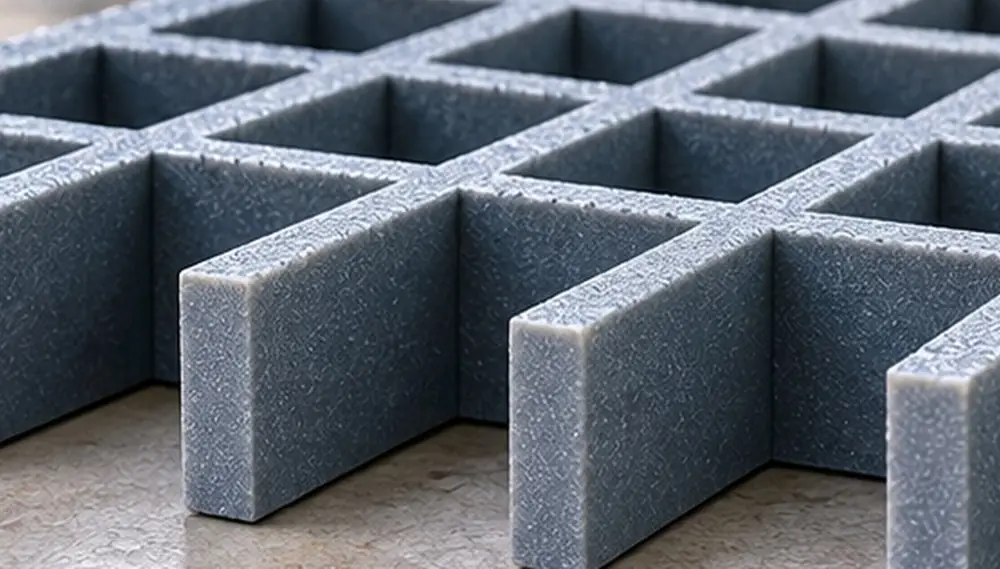
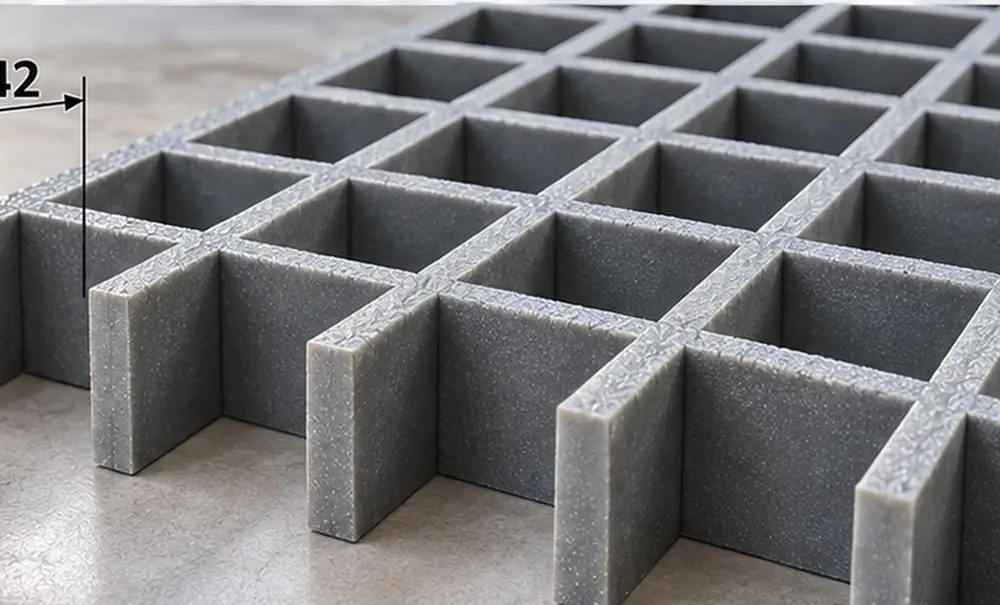
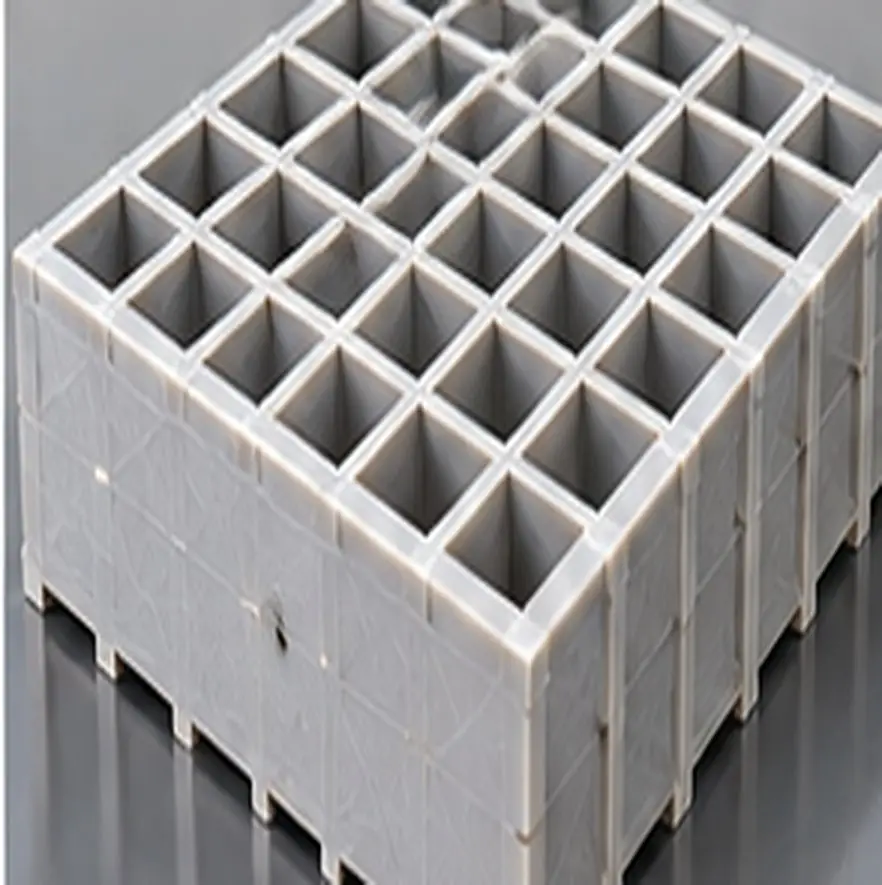
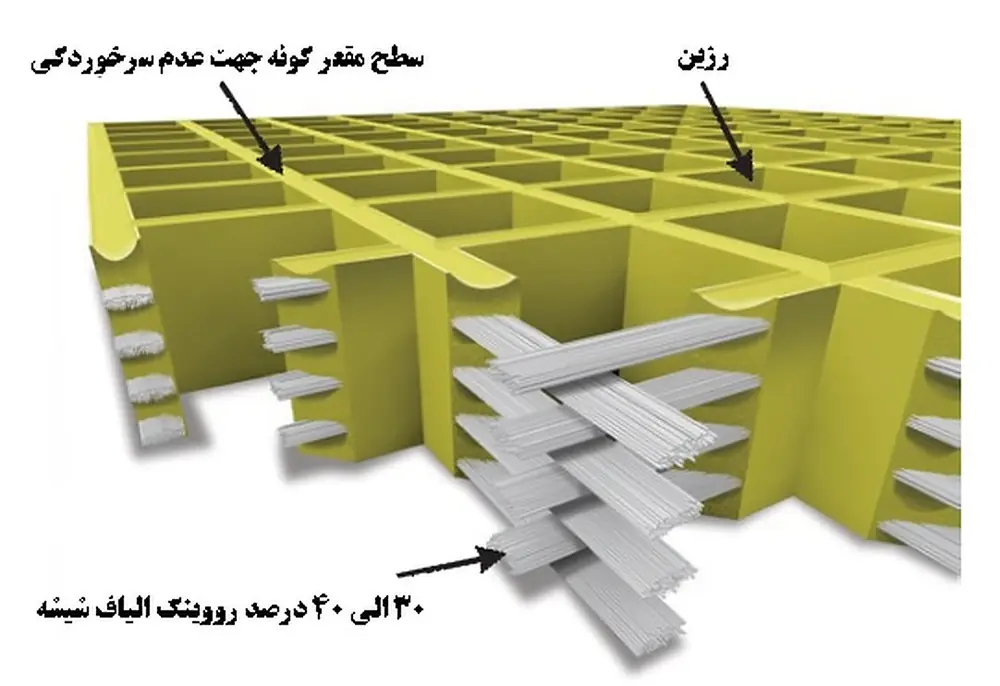
Molded composite grating is made in an open grid mold: continuous glass fiber rovings are laid alternately in two perpendicular directions in the mold slots and wetted with liquid resin at the same time, until the grating reaches the required height (25, 30, 38 or 50 mm). After curing, the one-piece panel is removed from the mold. Because the fibers in both directions are interwoven at the intersections, the panel is "one piece" with no mechanical or adhesive joints. About 30 to 40 percent of its weight is fiber and the rest is resin. Read the details in how composite grating is made.
Pultruded fiberglass grating
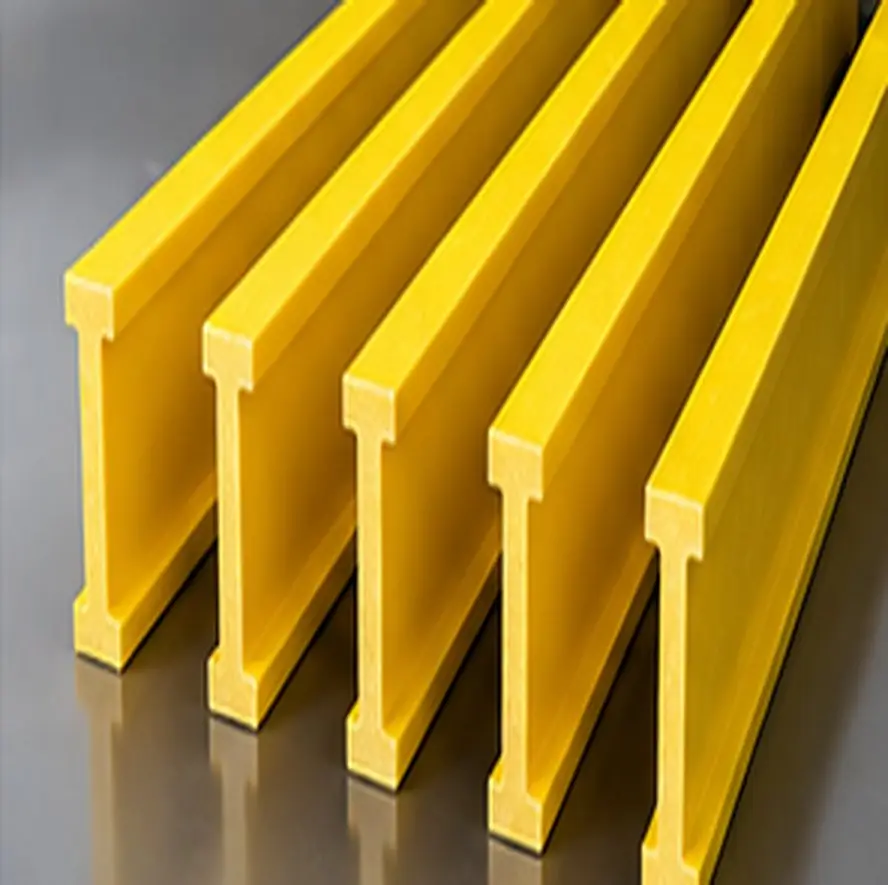
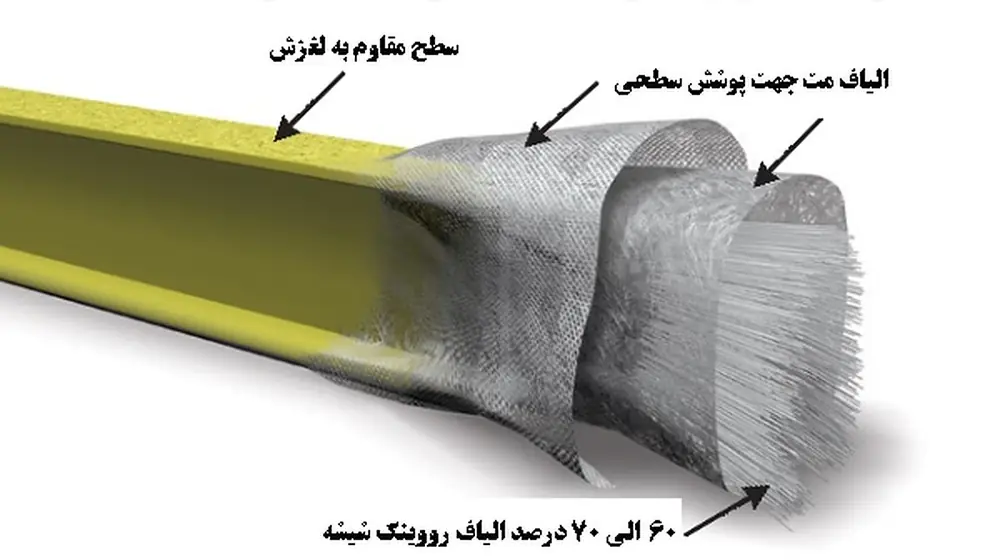
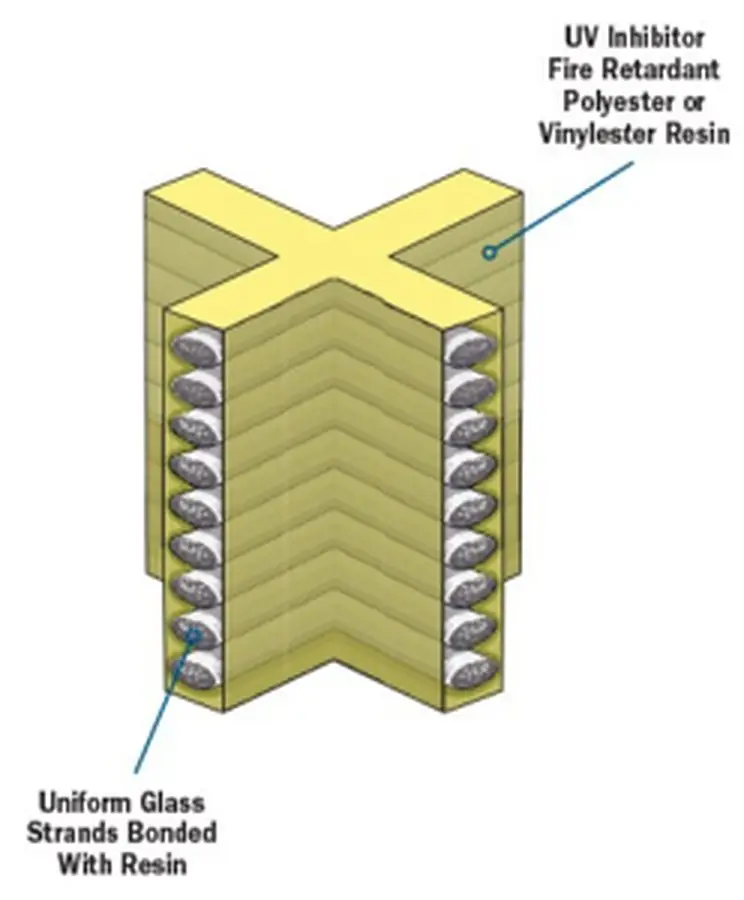
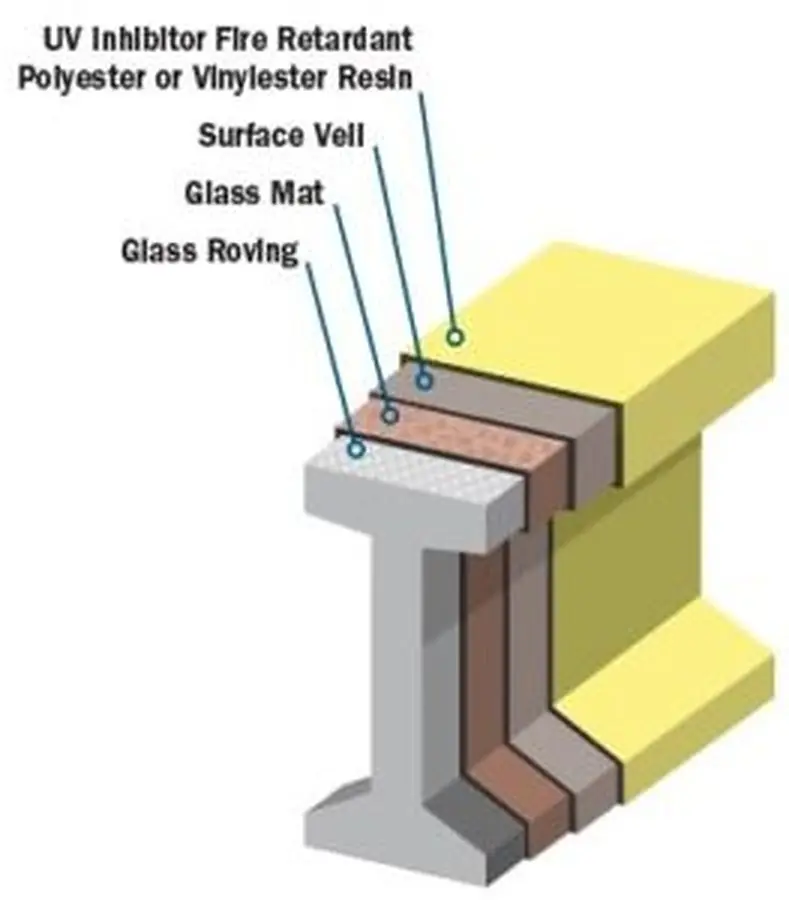
Pultruded fiberglass grating is made in two stages. First, the load-bearing I-bars (or T-bars) and the cross rods are produced by pultrusion: continuous longitudinal rovings (about 60 to 70 percent fiber), together with mat and surface veil, are pulled through a hot die and cured. The bars are then laid side by side at a set spacing and assembled mechanically and with adhesive using cross rods that pass through holes in the bar webs. Because pultruded grating is assembled, almost any panel size and bar spacing can be produced, and very long panels in the bar direction are possible.
Comparison table: molded grating vs pultruded grating
| Criterion | Molded grating | Pultruded grating |
|---|---|---|
| Manufacturing method | One-piece molding in an open mold | Pultrusion of bars + assembly |
| Fiber / resin ratio (by weight) | ~35 / 65 | ~65 / 35 |
| Fiber direction | Two directions, interwoven | Mainly longitudinal in the bars |
| Direction of strength | Bidirectional (same behavior in both directions) | One-way (along the bars) |
| Suitable span | Short to medium (usually up to about 1000 mm) | Medium to long (up to 1500 mm and more) |
| Stiffness (less deflection) | Moderate | High |
| Corrosion resistance | Very high (more resin, one piece) | High |
| Impact resistance and flexibility | High; no permanent damage | Good |
| Cutting on site | Free in any direction, without losing integrity | Simple cut across the bars; edge needs an end bar |
| Panel size | Limited to mold size (e.g. 1220×3660) | Flexible; any length and width |
| Open area | ~68 to 72 percent | ~38 to 60 percent (depending on bar spacing) |
| Surface options | More (smooth, meniscus, gritted, checker plate) | Grooved, smooth, gritted |
| Typical use | Chemical environments, short-span platforms, flooring | Footbridges, long-span platforms, heavy loads |
Grating loading: a numerical comparison of load capacity
Both molded and pultruded composite grating can be selected for various loads; but as support spacing increases, their behavior diverges sharply. The reason is fiber content: the continuous longitudinal fibers in pultruded grating make the flexural modulus of the bars about two to three times that of molded grating, and because grating is designed for deflection (L/200), stiffness governs. The chart below compares the allowable uniform loads from the load tables in Nabak's technical articles:
| Grating type | Weight (kg/m²) | 800 span | 1000 span | 1200 span | 1400 span |
|---|---|---|---|---|---|
| Molded grating 25 | 11.4 | 201 | 103 | 60 | — |
| Molded grating 38 | 18.4 | 750 | 400 | 250 | 150 |
| Molded grating 50 | 20.8 | 1250 | 650 | 400 | 250 |
| Pultruded grating 25×15 | 14.5 | 1600 | 850 | 550 | 350 |
| Pultruded grating 38×23 | 16.5 | 1900 | 990 | 570 | 360 |
| Pultruded grating 38×10 | 24 | 2800 | 1450 | 870 | 550 |
| Pultruded grating 50×23 | 19 | 3700 | 1850 | 1000 | 650 |
| Pultruded grating 50×10 | 27.5 | 5540 | 2650 | 1450 | 1000 |
The table values are the allowable uniform load (kg/m²) at L/200 deflection. The full load tables for each product, including concentrated load and ultimate load, are on that product's page and in FRP grating load tables.
The square one-piece mesh of molded composite grating gives bidirectional strength: the panel carries load almost equally regardless of the direction of travel or how it is placed on the supports, and it spreads concentrated loads over several bars. Pultruded grating has one-way strength: the I-bars must be installed perpendicular to the supports, and the cross rods only hold the bars and provide limited load distribution. This makes pultruded grating ideal for heavy loads and long spans, provided it is installed the right way round. To choose the right height, see the grating selection guide.
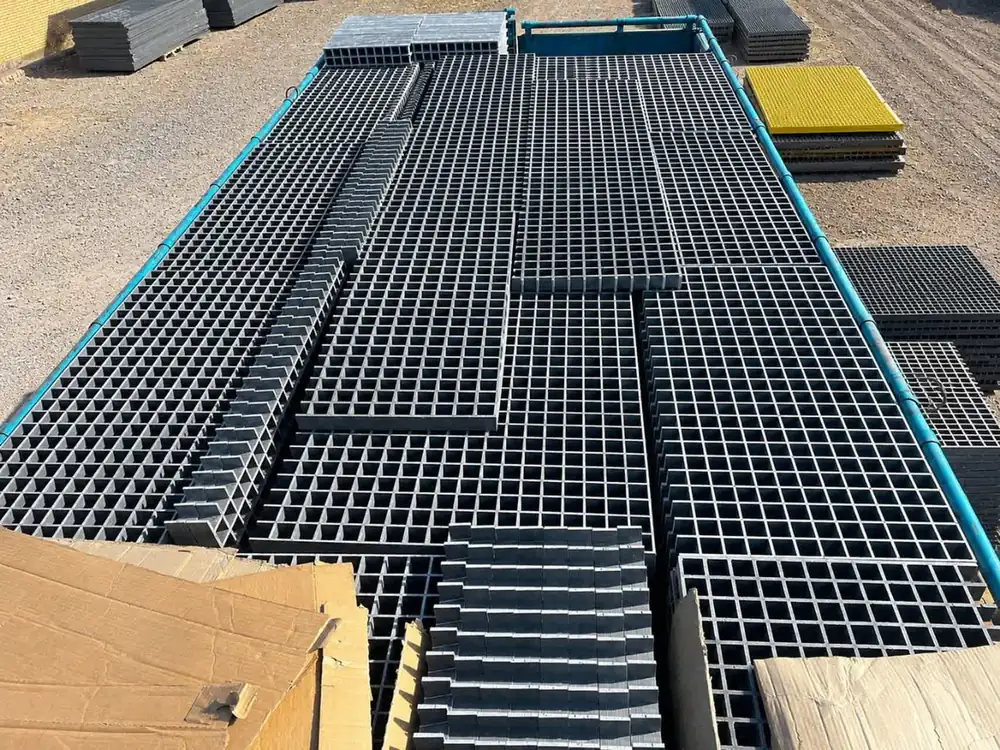
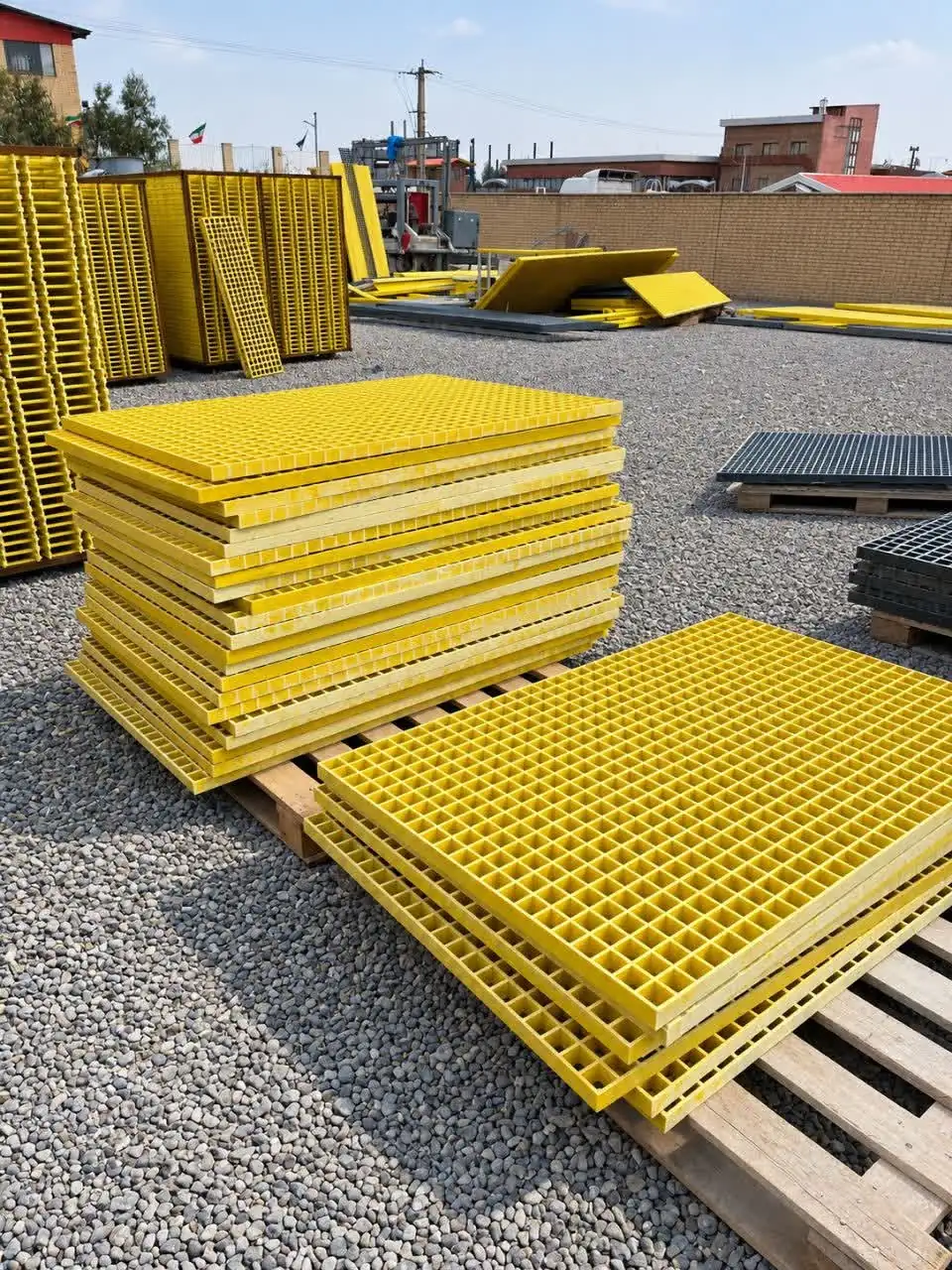
Composite grating versus steel grating
Both types of composite grating compete directly with galvanized steel grating. The main difference is in life and maintenance cost: steel grating corrodes after a few years in wet, coastal and chemical environments and needs painting or replacement, while composite gratings work without corrosion or painting.
| Feature | Molded grating | Pultruded grating | Galvanized steel grating |
|---|---|---|---|
| Corrosion | None | None | Yes, once the zinc coating is damaged |
| Electrical conductivity | Insulating | Insulating | Conductive |
| Installation and cutting | Simple tools, no welding | Simple tools, no welding | Hot cutting, re-galvanizing of edges |
| Stiffness at long spans | Moderate | Good | Excellent |
| Life-cycle cost in a corrosive environment | Low | Low | High |
See the full comparison of composite and steel in advantages of composite products. At very long spans and very heavy loads, steel still has greater stiffness; but in corrosive environments, composite gratings — even at a greater height — are superior in total cost and safety.
Grating surfaces: surface types for molded and pultruded grating
Molded composite grating and pultruded grating are produced with different surfaces to match the safety, cleaning and traffic needs of each application. Molded fiberglass grating offers more surface variety than pultruded grating, because the surface is formed in the mold itself and is easier to coat.
Uncovered molded composite grating
Uncovered molded composite grating is supplied in three surface options — smooth, meniscus and gritted:

Covered molded composite grating
In covered grating, a composite plate is bonded onto the molded grating, and its surface is produced in three forms — patterned (checker plate), smooth and gritted:
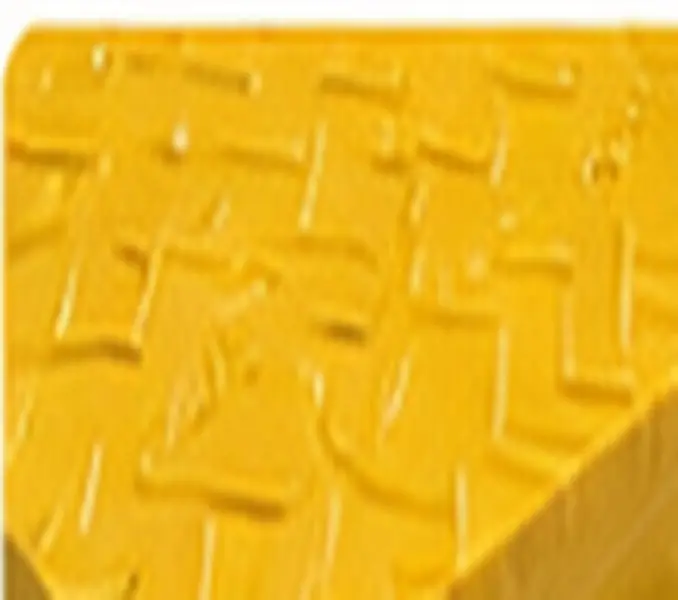


Pultruded grating
The surface of pultruded fiberglass grating is formed on the top flange of the I-bars and is produced as grooved, smooth or gritted:
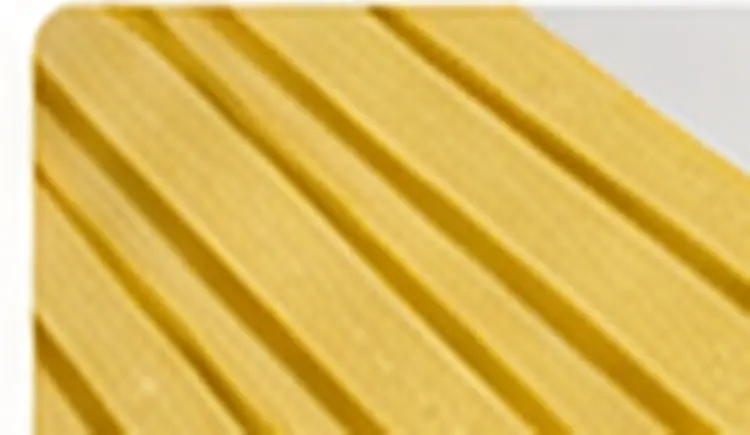
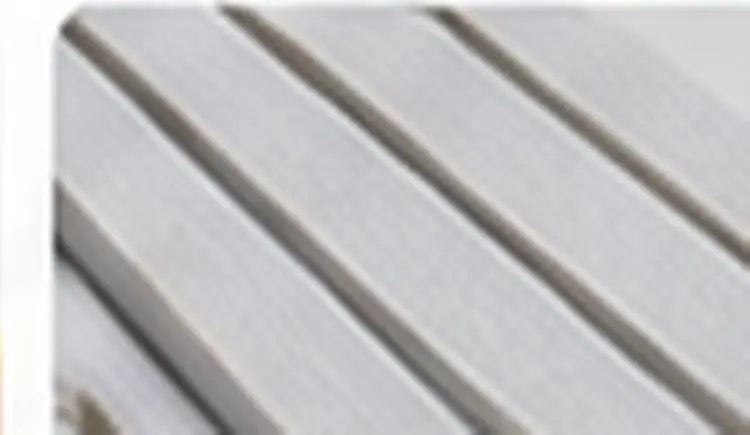
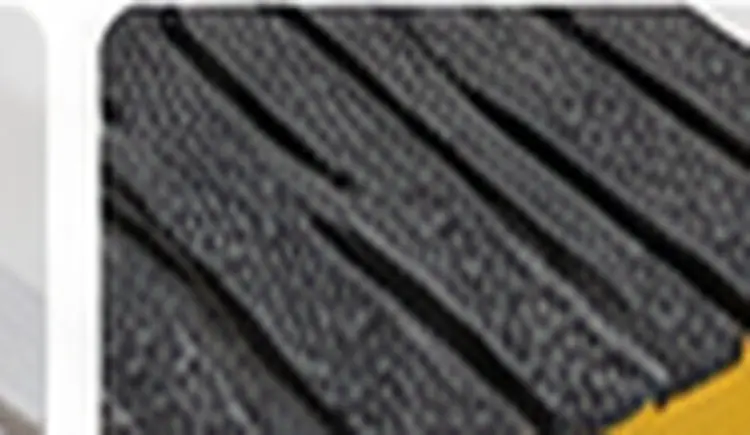
| Surface type | Uncovered molded grating | Covered molded grating | Pultruded grating | Application |
|---|---|---|---|---|
| Smooth surface | ✓ | ✓ | ✓ | Dry environment, easy cleaning, trolleys |
| Meniscus surface | ✓ | — | — | General anti-slip without coating |
| Gritted surface | ✓ | ✓ | ✓ | Oily, wet and sloping areas |
| Patterned surface (checker plate) | — | ✓ | — | Closed surface; stops objects falling through |
| Grooved surface | — | — | ✓ | Directional anti-slip on pultruded grating |
Comparing grating surfaces for safety and maintenance
| Surface | Slip resistance | Cleaning | Comfort for bare feet / knees | Suitable for |
|---|---|---|---|---|
| Smooth surface | Low to medium | Excellent | Excellent | Dry environments, food industry, indoor pools |
| Meniscus surface | Good | Good | Good | General industrial platforms |
| Gritted surface | Excellent | Moderate | Low | Oily environments, offshore platforms, slopes |
| Patterned surface (checker plate) | Good | Good | Good | Closed surface, trolleys, clean rooms |
| Grooved surface | Good (across the grooves) | Good | Good | Footbridges and walkways with pultruded grating |
A smooth surface is slippery in an oily environment; in those conditions a gritted surface is the best choice. The meniscus surface of molded grating gives good slip resistance at no coating cost, and the grooved surface of pultruded grating should be laid across the direction of pedestrian travel. On covered grating with a smooth or gritted surface, the open area is zero, and liquids and objects cannot fall to the level below.
To choose a grating color, see composite grating colors.
Guide to choosing between composite grating types
| Project conditions | Recommended for | Reason |
|---|---|---|
| Severe chemical environment, acid or alkali splash | Molded composite grating with vinyl ester resin | More resin, one piece, no joints |
| Support span up to about 800 to 1000 mm | Molded grating 38 or 50 | Sufficient capacity, bidirectional, economical |
| Long span (1200 mm and more) | Pultruded grating 38 or 50 | High stiffness, low deflection |
| Heavy load, light vehicles or hand pallet trucks | Pultruded grating with a small bar gap (10 mm) | High capacity and small openings |
| Many cuts and irregular shapes on site | Molded composite grating | Free cutting in any direction without losing integrity |
| Closed surface, trolleys, preventing tools from falling | Checker plate grating with a patterned or smooth surface | Closed patterned surface on molded grating |
| Very long panels in one direction | Pultruded grating | Flexible panel sizes |
See the industrial applications of each type in applications of composite grating.

Frequently asked questions about comparing composite grating types
What is the main difference between molded and pultruded grating?
Molded grating is made in one piece in an open mold from interwoven layers of roving and resin; it has about 35 percent fiber and 65 percent resin and offers bidirectional strength and high corrosion resistance. Pultruded grating is assembled from pultruded I-bars and cross rods; it has about 65 percent fiber and very high one-way strength, suited to long spans.
Which composite grating is better for long spans?
Pultruded grating. For example, at a 1000 mm span the allowable uniform load of 38 mm molded grating is about 400 kg/m², whereas 38×23 pultruded grating, at a lower weight, allows about 990 and 50×23 pultruded grating about 1850 kg/m².
Which grating is more corrosion resistant?
Because of its higher resin content and one-piece construction (no mechanical joints and fewer cut edges), molded grating usually has higher corrosion and chemical resistance, especially when made with vinyl ester resin. Pultruded grating with the right resin and a surface veil also has good resistance.
What surfaces does composite grating come with?
Uncovered molded grating is produced with smooth, meniscus (concave) and gritted surfaces; covered molded grating with patterned (checker plate), smooth and gritted surfaces; and pultruded grating with grooved, smooth and gritted surfaces.
Is composite grating electrically conductive?
No. FRP composite grating is an electrical insulator (non-conductive), which is why it reduces the risk of electric shock in substations, refineries and electrical environments. It is also non-magnetic and does not disturb radio waves.
Summary
Comparing the types of composite grating and the gratings common on the market shows that the choice between molded and pultruded grating depends on span, load, environment and the surface required — there is no absolute "best". Molded grating, with about 65 percent resin, a one-piece structure and bidirectional strength, is the best option for short to medium spans, chemical environments and projects with many changes, and it has the widest choice of surfaces (smooth, meniscus, gritted and checker plate). Pultruded grating, with about 65 percent longitudinal fiber, has very high one-way stiffness and strength and, at long spans and heavy loads, carries several times the load of molded grating at a lower weight. Both types of Nabak composite grating are corrosion resistant, electrically insulating and light, and when chosen correctly they work for decades without maintenance.

This article was prepared by the technical team of Nabak Composite, a manufacturer of grating, pultruded profiles, sheets and composite products.