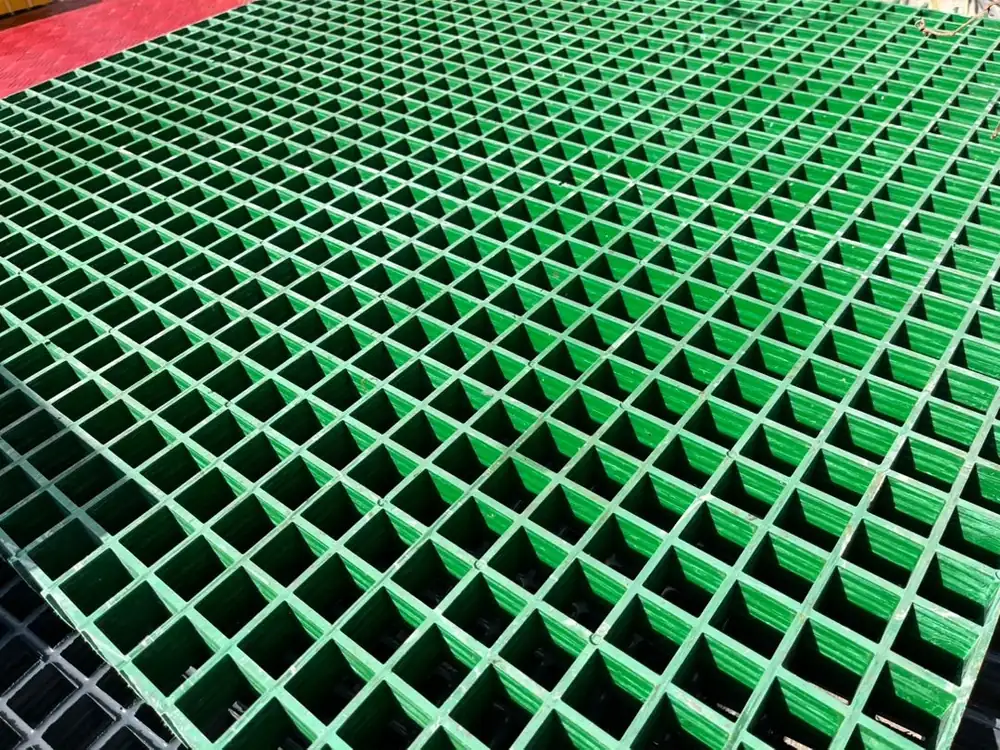
What is 38×23 pultruded composite grating?
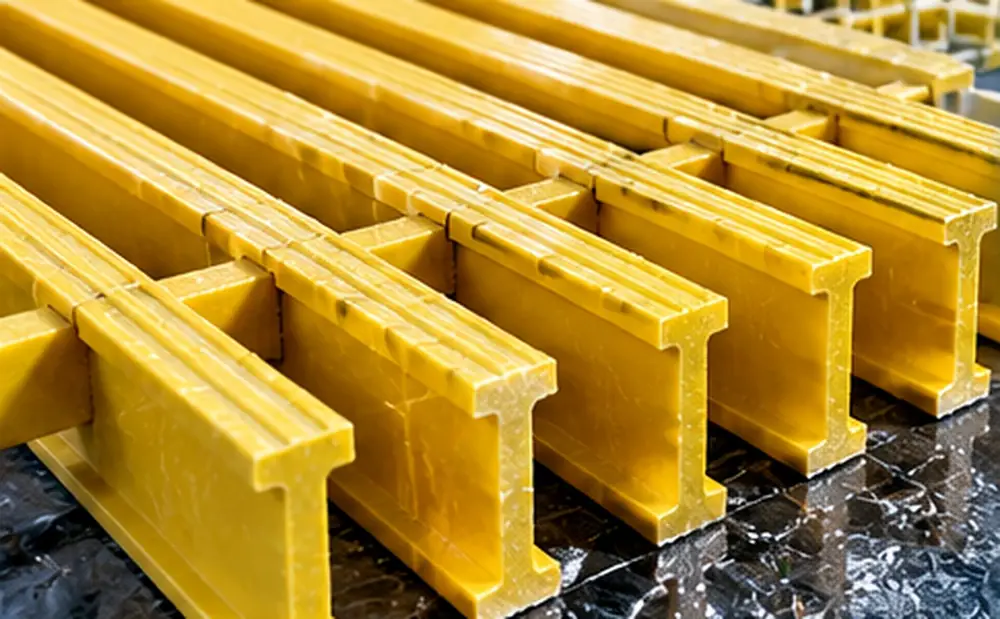
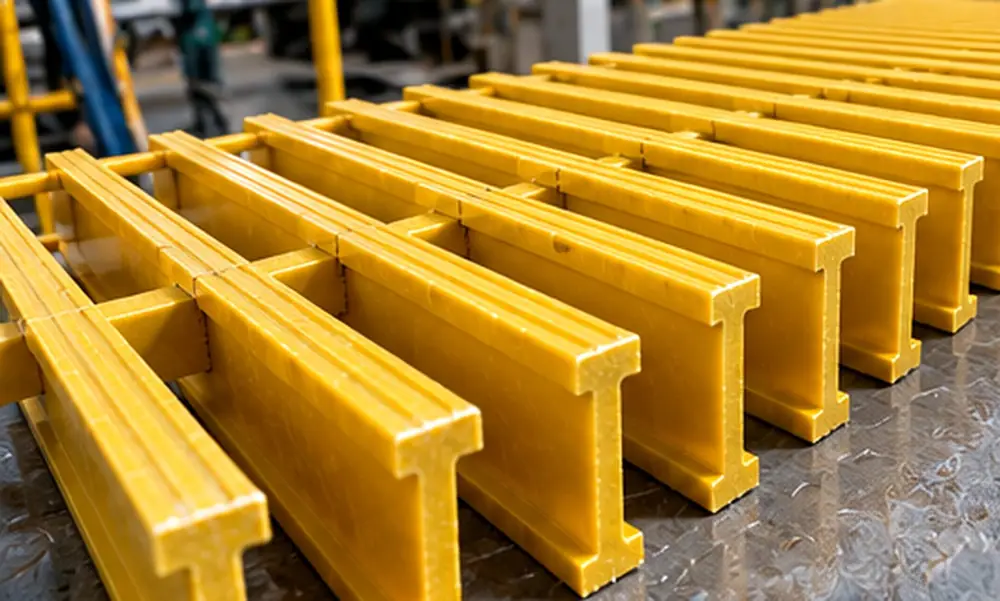
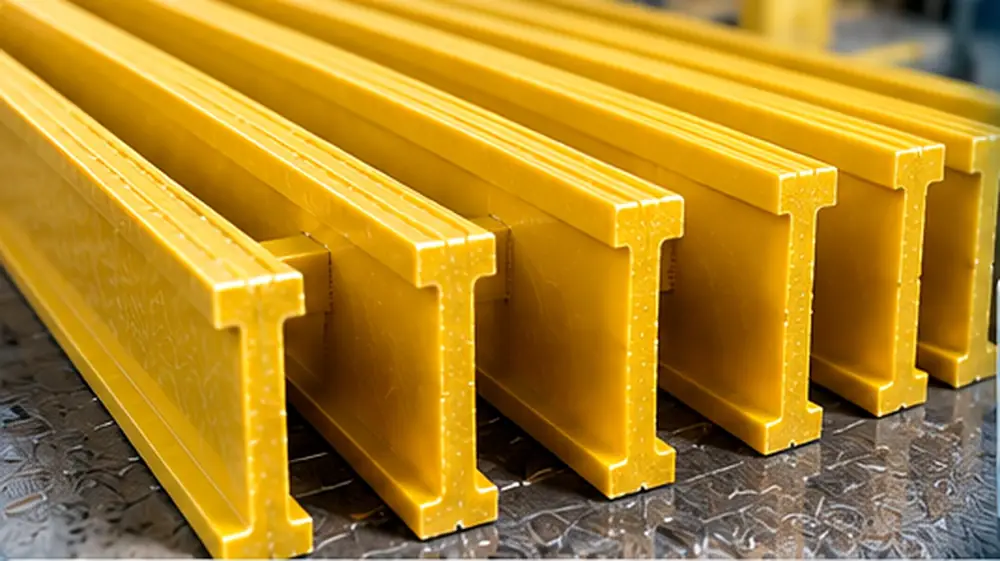
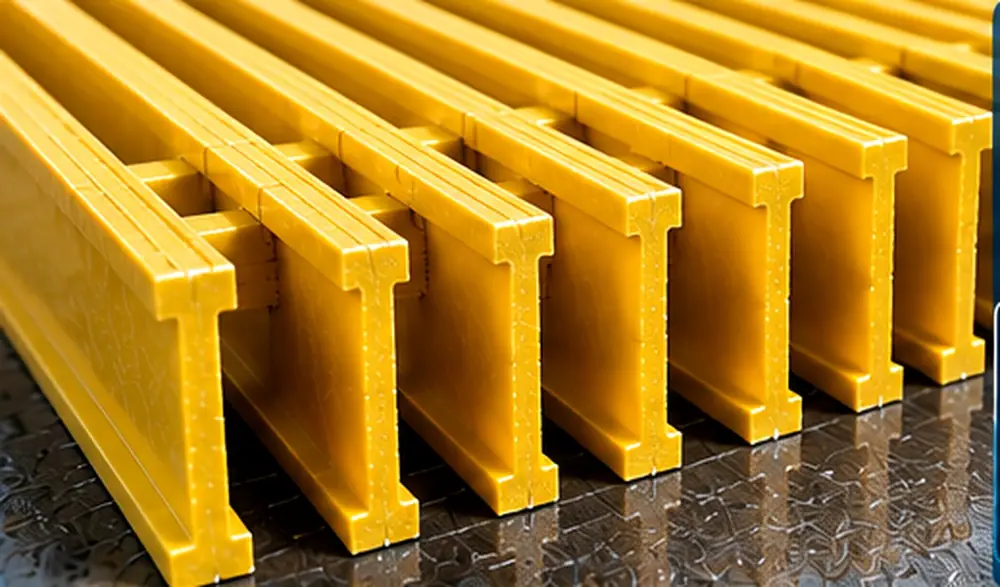
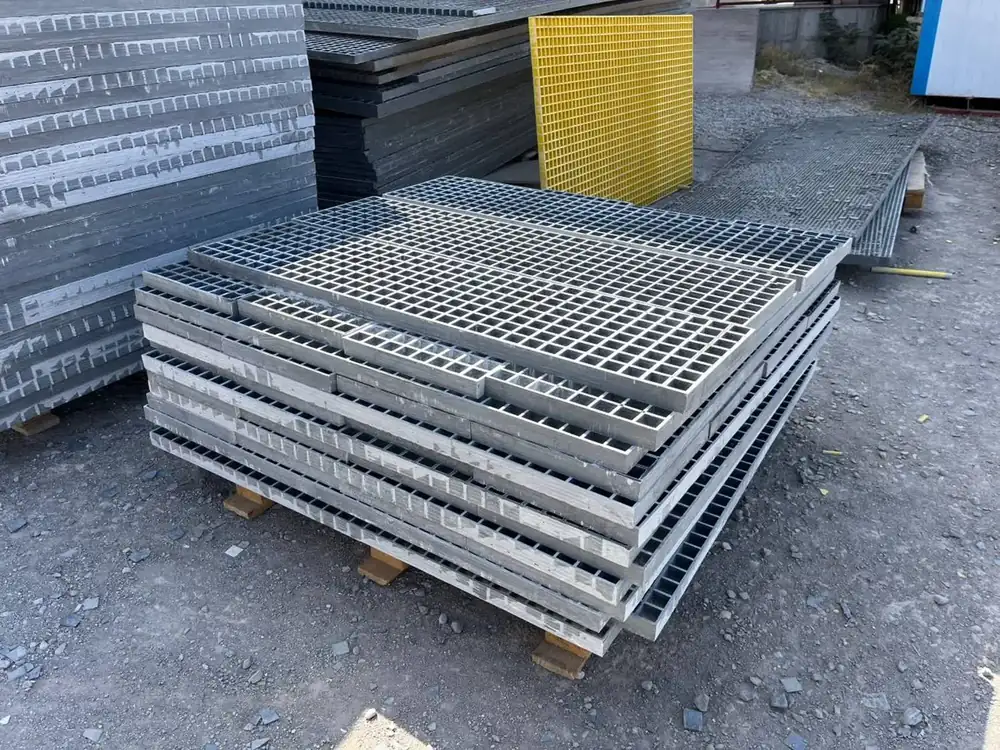
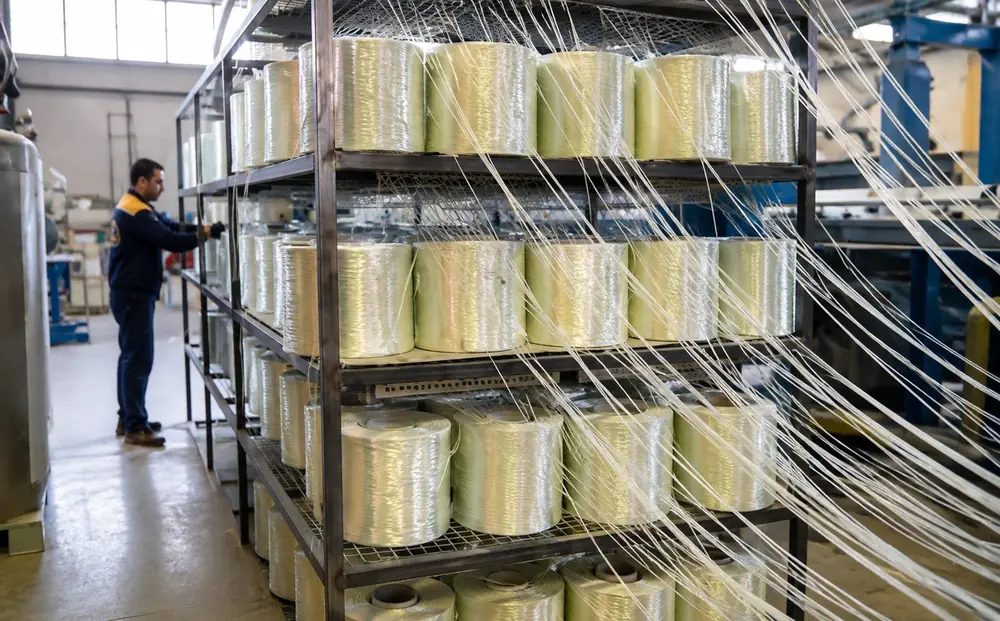
Pultruded composite grating is a type of composite mesh panel in which composite I-sections are laid side by side in parallel and tied and assembled at regular intervals by transverse rods or profiles. Each I-section is made by pultrusion: resin-wetted glass roving and mat are pulled continuously through a heated die, so the longitudinal fibers run along the length of the bar. The result is a load-bearing bar that is far stiffer and stronger lengthwise than molded grating. On the market the product is also called pultruded FRP grating, pultruded GRP grating, pultruded GFRP grating and pultruded fiberglass grating; pultruded GRP and GFRP grating are the same glass fiber (fiberglass) reinforced pultruded composite grating.
The code "38×23" or "I38-23" refers to two key numbers: a 38 mm height for the load-bearing bar and a 23 mm opening between the flanges of two adjacent bars. Within the 38 mm pultruded grating family this model has the lightest and most open layout, and it is designed for platforms, industrial walkways and channel covers where a fairly long span, fast drainage and low weight matter more than a fine opening. For an overall comparison of grating types, see the FRP grating selection guide.
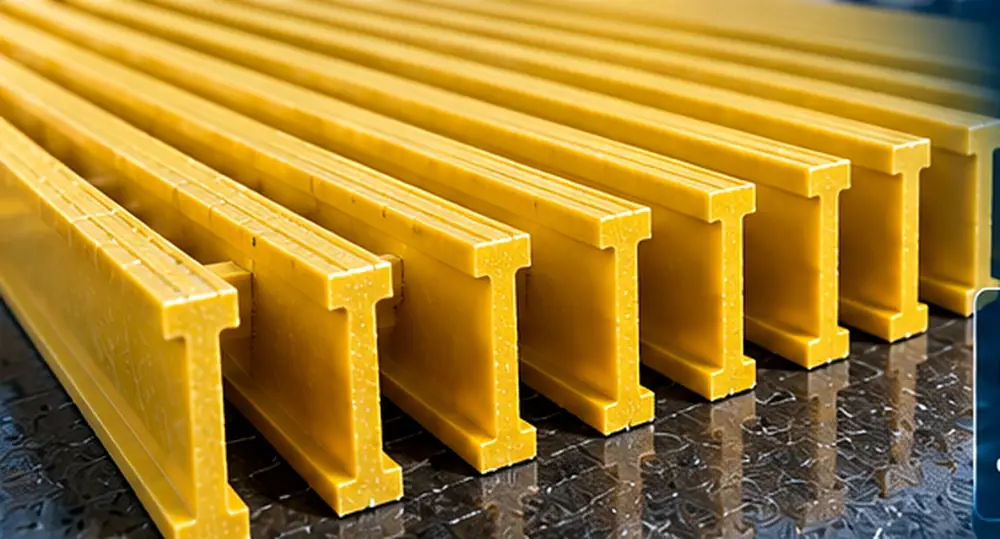
Specifications and dimensions of 38×23 pultruded grating
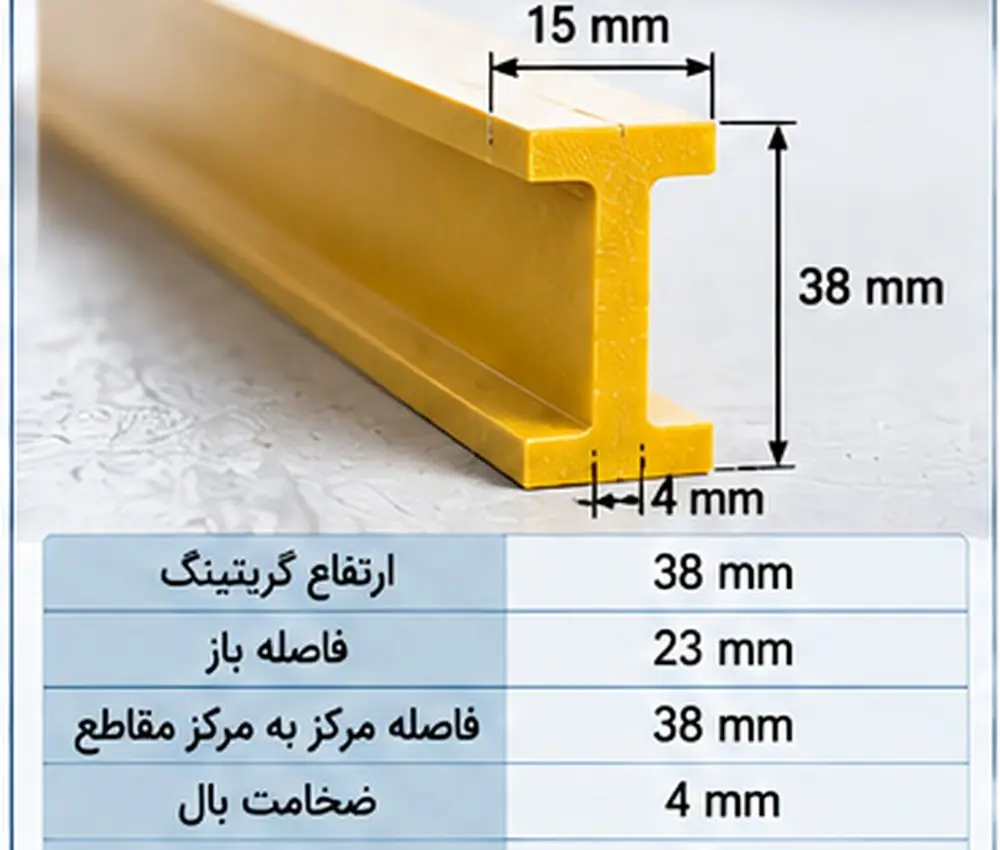
Main specifications and dimensions of 38×23 pultruded composite grating in brief:
The load-bearing bar of this model is a fiberglass I-section measuring 38×15×4 mm (depth × flange width × thickness), assembled with transverse composite profiles. The composite I-sections are at 38 mm centers — the bar pitch equals the bar height — giving about 26.3 load-bearing bars per meter of width.
Of the 38 mm pitch, 15 mm is the flange and the remaining 23 mm forms the opening; the open share across the width is 60% (23 divided by 38), and after deducting the area taken by the cross rods, the open area of the pultruded grating comes to about 57 percent.
| Property | Value | Engineering note |
|---|---|---|
| Load-bearing bar section | I-section 38×15×4 mm | Pultruded fiberglass profile with longitudinal fibers |
| Grating height | 38 mm | Full depth of the I-section |
| Grating opening | 23 mm | Open mesh for fast drainage |
| I-bar center-to-center | 38 mm | About 26 bars per meter |
| Open area of the pultruded grating | 57% | The most open 38 mm model |
| Approximate weight per m² | 16.5 kg | About 30% lighter than the 38×10 model |
| Standard resin | Isophthalic polyester | Vinyl ester and fire-resistant grade made to order |
Weight of 38×23 pultruded composite grating
The approximate weight of 38×23 pultruded grating is 16.5 kg per m². The cross-sectional area of the load-bearing bars per meter of width is 6.64×10³ mm²; with a density of about 1.9 g/cm³, the bearing bars weigh about 12.6 kg/m² and the rest (about 4 kg) is the cross rods, transverse profiles and bonding adhesive. A standard 1×3 m panel weighs about 50 kg and two people can carry and install it without lifting equipment — an advantage that noticeably reduces installation cost on elevated platforms and remote sites.
Section properties of 38×23 pultruded grating
The geometric properties of the composite section per meter of grating width — cross-sectional area, section modulus and moment of inertia — are given in the table below. These figures are direct inputs to stress and deflection calculations:
| Section property (per meter of width) | Value | Check from section geometry |
|---|---|---|
| Composite cross-sectional area | 6.64×10³ mm² | ≈ 26.3 bars × 250 mm² |
| Section modulus S | 6.66×10⁴ mm³ | I ÷ 19 = 6.68×10⁴ ✓ |
| Moment of inertia I | 1.27×10⁶ mm⁴ | ≈ 26.3 × 48×10³ mm⁴ ✓ |
Because the I-section is symmetric, the section modulus is obtained by dividing the moment of inertia by half the depth (19 mm), and the datasheet figures are consistent. More importantly, the section properties of the 38×23 model are lower than those of the 38×10 model exactly in proportion to the number of bars (26.3 versus 40): each load-bearing bar does the same share, and only the density of the layout has changed.
Features of pultruded composite grating
38×23 pultruded composite grating has the same inherent advantages of FRP composite, and its large open area adds several new ones:
How pultruded grating sits on its supports
In pultruded grating the main load is transferred to the FRP I-bars, and the cross rods only restrain the bars and spread the load. The panel must therefore sit on the support seat with the panel length (the direction of the load-bearing bars) perpendicular to the support beams. Installing it the wrong way round reduces capacity to a small fraction of the table values.
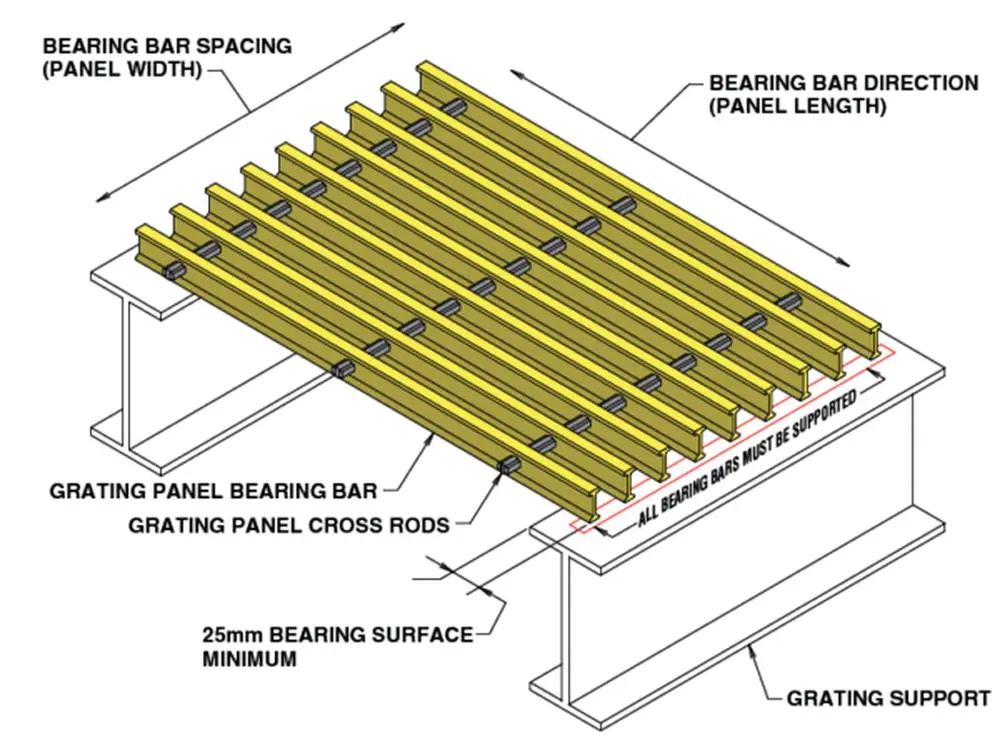
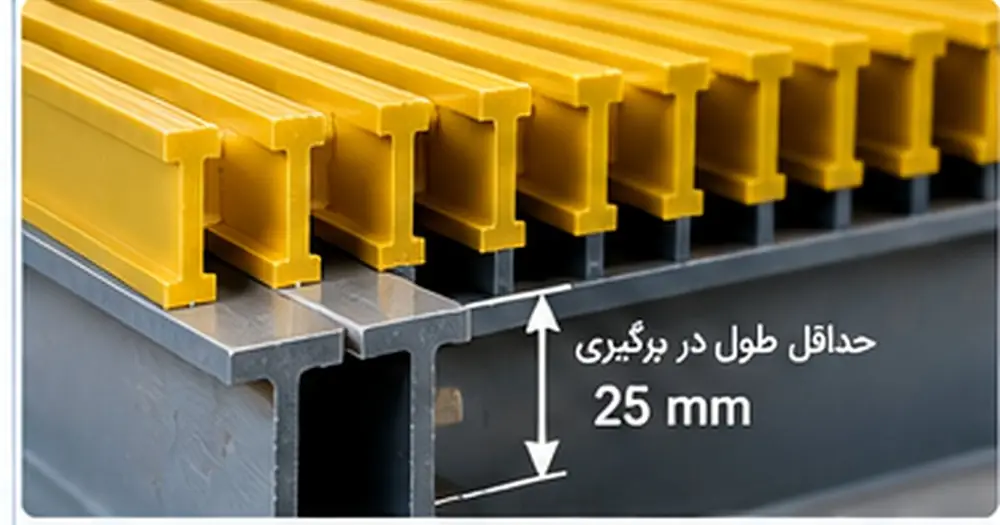
Installing fiberglass grating is straightforward. Panels are fixed to the substructure with stainless steel grating clips (M-clips, saddle clips or hold-down clips); fixing details and clip types are covered in the grating installation article. Because this model is light, on open platforms and in windy areas at least four clips per panel are essential so the panel does not move. After cutting on site, seal the edges with resin (see cutting and machining composites).
Load capacity of pultruded composite grating
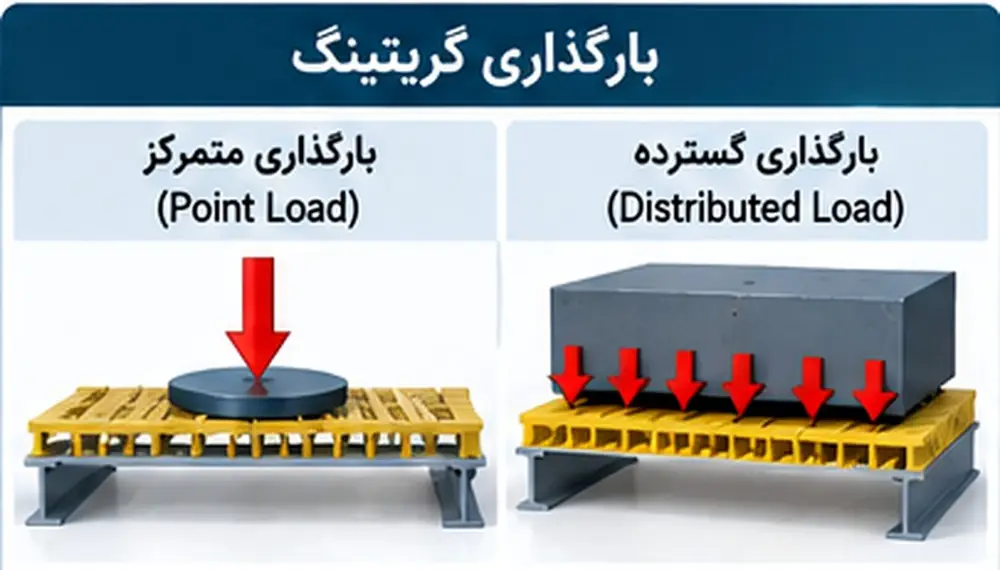
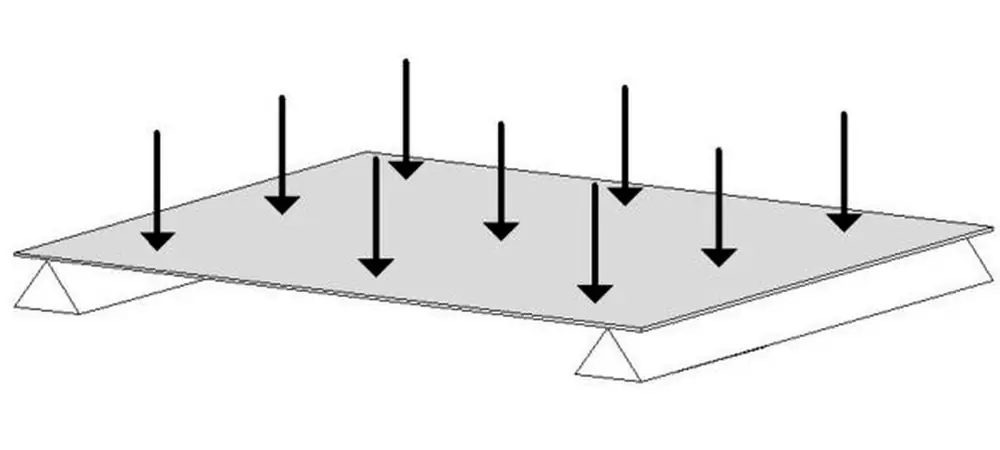
The loading of 38×23 pultruded composite grating is assessed in two cases: concentrated load, where the force is applied at a point or small area (an equipment leg, a wheel), and uniform load, where the force is spread over the whole surface (pedestrian traffic, light storage). Two figures are reported for each:
- Allowable load based on deflection: the load that brings the mid-panel deflection to L/200 of the support spacing (0.5% of the span).
- Ultimate (failure) load: the maximum load at which the grating panel will certainly fail.
Load table for 38×23 pultruded grating
The table below gives the allowable load at L/200 deflection and the ultimate load of 38×23 pultruded composite grating, for concentrated and uniform loading, at six common support spacings:
| Support spacing (mm) | Concentrated load (kg) | Uniform load (kg/m²) | ||
|---|---|---|---|---|
| Allowable load at L/200 deflection | Ultimate load | Allowable load at L/200 deflection | Ultimate load | |
| 400 | 980 | 6,100 | 15,400 | 49,000 |
| 600 | 450 | 4,600 | 4,600 | 26,000 |
| 800 | 260 | 3,500 | 1,900 | 12,000 |
| 1,000 | 160 | 2,800 | 990 | 9,500 |
| 1,200 | 110 | 2,300 | 570 | 6,000 |
| 1,400 | 80 | 1,500 | 360 | 4,600 |
- The allowable uniform load falls roughly with the cube of the span: from 400 to 800 mm the span doubles and the allowable load drops about 8 times (15,400 to 1900) — fully consistent with the simple-beam deflection formula.
- The allowable concentrated load falls roughly with the square of the span (980 at 400 and 160 at 1000 mm).
- At every span the deflection-based allowable load is below 40% of the ultimate load (for example at a 1000 mm span: 990 versus 3800), so deflection, not strength, governs the design.
- At a 1200 mm span, L/200 deflection is exactly 6 mm, so 570 kg/m² at this span satisfies both the L/200 criterion and the pedestrian comfort limit. At 1400 mm, take the allowable load as about 300 kg/m² for a 6 mm limit.
Load comparison with other composite gratings
In design, comparing the allowable loads of different models shows which grating meets the project's needs at the lowest weight.
The position of this model among common composite gratings can be judged by the allowable uniform load at L/200 deflection (kg/m²):
| Grating type | Weight (kg/m²) | 800 span | 1000 span | 1200 span |
|---|---|---|---|---|
| Molded grating 38×38×38 | — | 750 | 400 | 250 |
| Molded grating 50×50×50 | — | 1250 | 650 | 400 |
| Pultruded 25×25 | — | 1250 | 680 | 400 |
| Pultruded 25×15 | 14.5 | 1600 | 850 | 550 |
| Pultruded 38×23 | 16.5 | 1900 | 990 | 570 |
| Pultruded 38×10 | 24 | 2800 | 1450 | 870 |
At a 1 m span, 38×23 pultruded grating has about 2.5 times the capacity of 38 mm molded grating and 1.5 times that of 50 mm molded grating, while its open area is about the same as molded grating. Compared with 25×15 pultruded grating, for only 2 kg more per m² it provides more allowable load and much more open area (57% versus 48%). See the full tables in FRP grating load capacity tables, and the sister models in 38×10 pultruded grating, 25×15 pultruded grating and 25×25 pultruded grating.
Load design examples for pultruded composite grating
- Allowable load at L/200 = 990 ≥ 500 ✓; approximate deflection = 5 × 500/990 ≈ 2.5 mm.
- Safety: 0.4 × 9500 = 3800 ≫ 500 ✓; in this case the 38×10 model would only add weight and cost.
- Allowable concentrated load at L/200 = 260 ≥ 150 ✓; approximate deflection = 4 × 150/260 ≈ 2.3 mm.
- Safety: 0.4 × 3500 = 1400 ≫ 150 ✓
38×23 or 38×10 pultruded grating?
This is the most frequent question from buyers of 38 mm pultruded grating. Both models are made from the same I-section; only the center-to-center bar spacing differs. The table below sets out the differences side by side:
| Property | 38×23 | 38×10 | Ratio 23 to 10 |
|---|---|---|---|
| Center-to-center spacing | 38 mm | 25 mm | — |
| Load-bearing bars per meter | 26.3 | 40 | 0.66 |
| Open area | 57% | 38% | 1.5 |
| Weight (kg/m²) | 16.5 | 24 | 0.69 |
| Moment of inertia (mm⁴) | 1.27×10⁶ | 1.9×10⁶ | 0.67 |
| Allowable uniform load at 1000 span | 990 | 1450 | 0.68 |
| Allowable concentrated load at 1000 span | 160 | 240 | 0.67 |
| Capacity per weight (kg/m² per kg) | 60 | 60 | 1.0 |
- Choose 38×23 when the design load is met by this model's table, drainage of water, snow or mud or airflow matters, weight on the structure or the cost of transport and installation is important, and there is no public traffic with heeled shoes or small wheels.
- Choose 38×10 when you have heavy concentrated loads or longer spans, the route carries trolleys and carts, or safety for heels and wheelchairs and preventing screws and tools from falling through is the priority.
The 23 mm opening lets small tool parts through; on platforms above sensitive equipment or on pedestrian routes, a composite cover plate over the grating or a toe plate can be used so that the open-area advantage is kept over the rest of the surface.
Assembly sections for pultruded composite grating
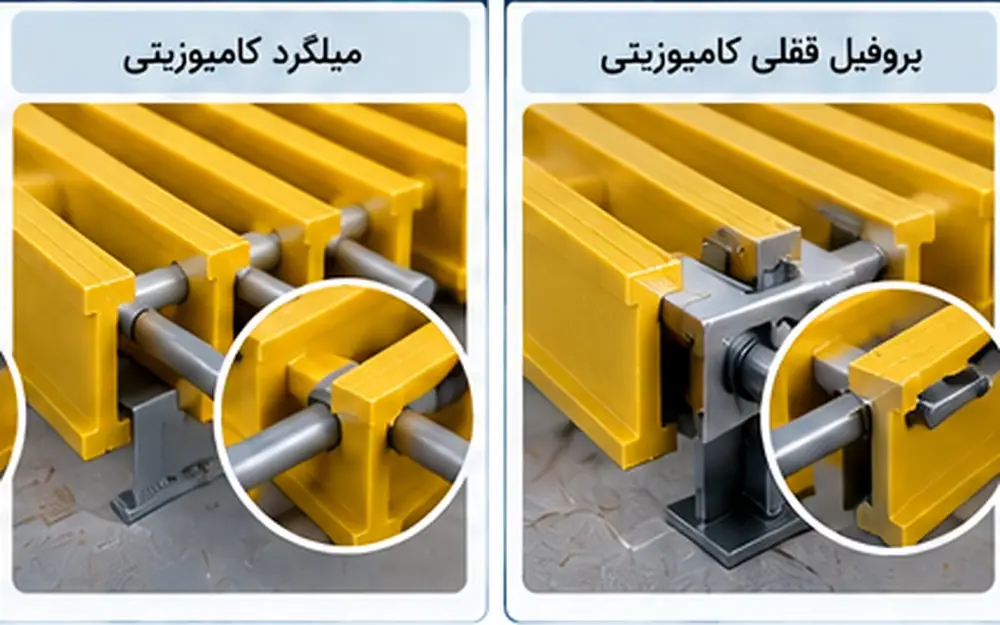
The I-sections of pultruded composite grating are assembled with two types of cross member:
1) Assembly with a composite locking profile: a slotted pultruded profile is locked over the flanges of the I-sections and fixed with screws or pins. The top surface is more even, and bars can be removed and moved during repairs.
2) Assembly with composite rods: FRP composite rods are passed through holes in the webs of the I-sections and fixed with epoxy adhesive — a one-piece joint that spreads concentrated loads over several neighboring bars.
On the 38×23 model, because each load-bearing bar takes a larger share of a concentrated load, cross members at 100 to 150 mm spacing are recommended for point loads.
Surface types of pultruded composite grating
Pultruded composite grating is produced with three surface types. The surface is chosen according to slip risk, the presence of oil and water, the slope of the route and the type of traffic; on slopes and in areas exposed to oil spills, high slip resistance is essential:
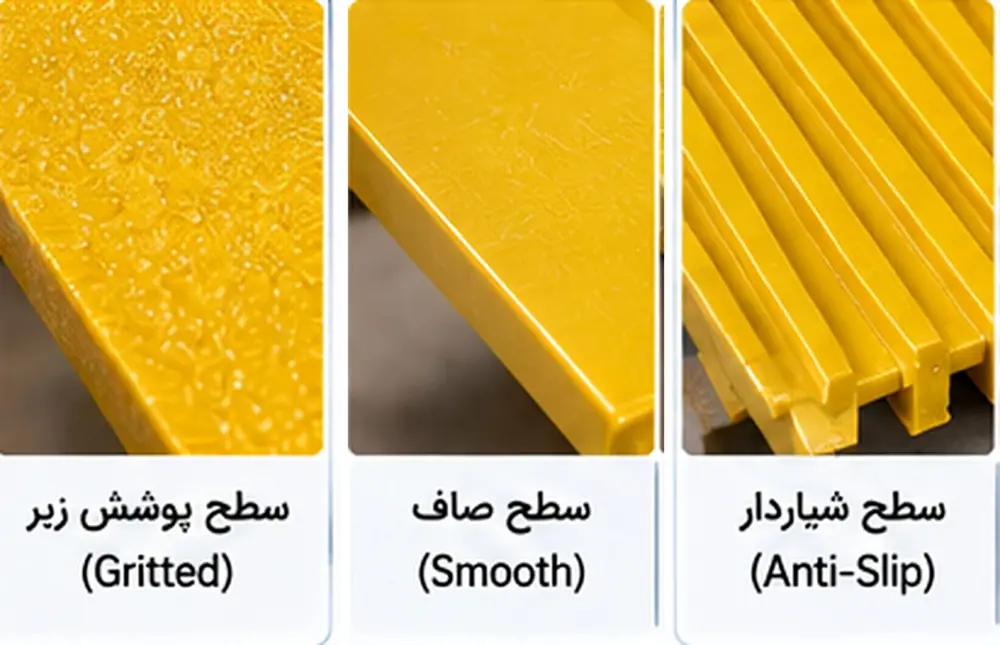
- Grooved surface: longitudinal grooves formed on the top flange during production of the I-section prevent slipping; the standard option for this model on platforms and walkways. Groove depth is allowed for in the effective height used in calculations.
- Smooth surface: a smooth, polished surface for special uses such as sports halls, hygienic areas and exhibition stands. By turning the grating over, both surfaces can be used on the same project.
- Gritted surface: a coating of quartz grit and sand of a defined grading for slopes, oily areas and wet routes. The grit particles are bonded into a resin layer, increasing surface roughness and minimizing slip risk even when oil is present. For more roughness, the surface can also be sandblasted after production; sandblasting also gives a uniform roughness on a smooth surface. On slopes, combining a grooved surface with grit coating gives the highest safety.
Applications of 38×23 pultruded grating
The combination of a 38 mm height, low weight and large open area makes these composite mesh panels suitable where molded fiberglass grating lacks capacity over long spans and metal grating corrodes:
- Cooling tower platforms and walkways, where airflow and drainage are vital.
- Access walkways and channel covers in water and wastewater treatment plants with spans up to about 1200 mm.
- Open platforms in petrochemical plants, refineries and power plants exposed to rain, snow and salt mist.
- Access platforms in electrical substations and cable routes, because it is insulating.
- Industrial footbridges, light jetties and coastal structures.
- Floors in livestock and poultry houses and food plants with constant washdown.
Pultruded composite grating compared with metal grating
In wet and corrosive environments, 38×23 pultruded composite grating, with its long life and negligible maintenance, is an economical alternative to galvanized steel grating:
| Feature | 38×23 pultruded composite grating (FRP composite) | Galvanized steel grating |
|---|---|---|
| Weight | approx. 16.5 kg/m² | Far heavier for similar capacity |
| Corrosion | None; resistant to UV and salt mist | Rusts once the zinc layer is damaged |
| Electrical conductivity | Fully insulating | Conductive |
| Impact behavior | Absorbs impact without permanent deformation | Permanent denting |
| Installation | Cut with simple tools; clips and bolted fixings | Welding and re-galvanizing of edges |
| Maintenance cost | Very low | Periodic painting and repair |
Ordering guide for pultruded grating
For an accurate price and production of 38×23 pultruded grating, prepare the following information; the type and size of the load are the most important inputs for choosing the model:
- Panel size: length in the direction of the load-bearing bars, and panel width
- Span and loading: support spacing and uniform or concentrated load
- Assembly type: locking profile or composite rod
- Surface type: grooved, smooth or gritted
- Resin and color: polyester, vinyl ester or fire-resistant grade
- Clips: type and number of grating clips and the substructure
Pultruded grating production and delivery at Nabak Composite
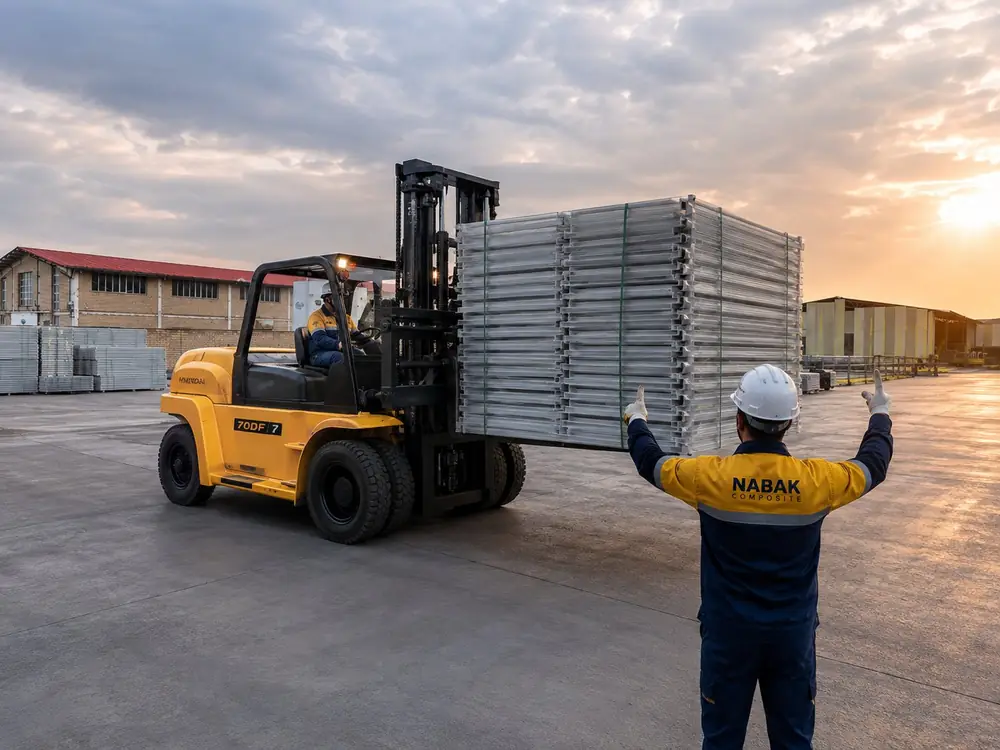
Nabak Composite produces, cuts and assembles the composite I-sections and cross rods of pultruded grating on its own pultrusion lines, and packs and ships panels in custom sizes and various colors with grooved, smooth or gritted surfaces.
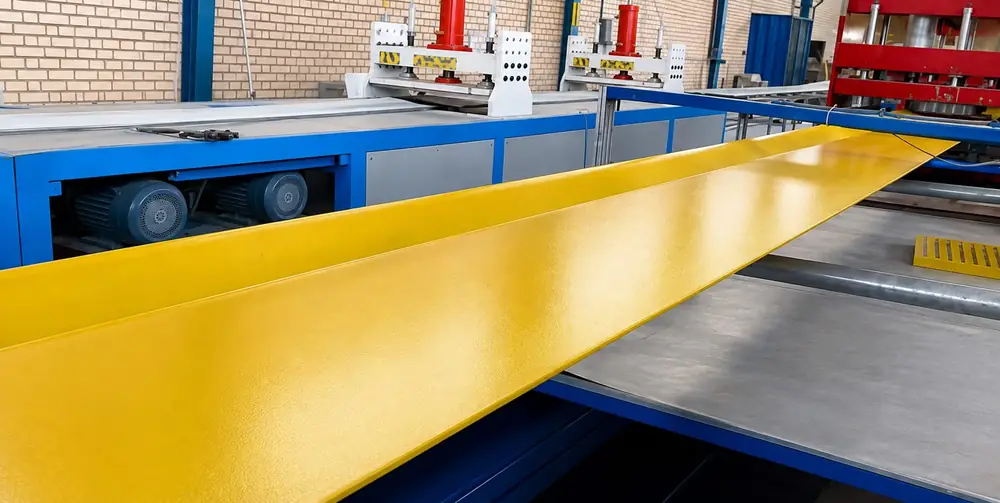
The light weight of 38×23 pultruded grating also has a direct effect on transport: when loading this model the limit is usually volume, not weight, and a truck carries more panel area than with metal grating or the denser models.




Frequently asked questions about 38×23 pultruded grating
How much does 38×23 pultruded grating weigh?
The approximate weight of pultruded composite grating with a 38 mm height and a 23 mm opening is about 16.5 kg per m²; a 1×3 m panel weighs about 50 kg and two people can easily carry it.
Is 38×23 or 38×10 pultruded grating better?
Capacity per kilogram of weight is almost the same in both models. The 38×23 model is about 30% lighter and cheaper and has 57% open area; the 38×10 model has about 45% more capacity and a safer opening for heels and small wheels. If the load and span are met by 38×23 and there is no public traffic, 38×23 is the more economical choice.
What is the allowable load of 38×23 pultruded grating at a 1 m span?
The allowable uniform load at L/200 deflection for a 1000 mm span is 990 kg/m² and the allowable concentrated load is 160 kg; the ultimate uniform load at the same span is 9,500 kg/m².
What is the benefit of 57 percent open area?
A 57% open area allows fast drainage of water, snow and mud, lets air and light through and reduces wind load; that is why this model suits cooling towers, treatment plants, open platforms and channel covers.
What is the minimum seat length for 38×23 pultruded grating?
The minimum bearing length of pultruded grating on the supporting member is 25 mm, and the load-bearing I-sections must be perpendicular to the support beams.
Summary
38×23 pultruded composite grating — with 38×15×4 mm I-sections at 38 mm centers, about 26 load-bearing bars per meter, 57% open area and a weight of 16.5 kg/m² — is the lightest and most open 38 mm pultruded grating. A moment of inertia of 1.27×10⁶ mm⁴ allows an allowable uniform load of 990 kg/m² at a 1 m span, enough for most industrial walkways and platforms. Its structural efficiency equals that of the 38×10 model, at a lower weight and price and with better drainage. Installed correctly (load-bearing bars perpendicular to the supports and a seat of at least 25 mm), with the right surface and the 40%-of-ultimate cap respected, this pultruded FRP grating is a light, insulating and durable alternative to steel grating.

This article was prepared by the technical team of Nabak Composite, a manufacturer of pultruded grating and composite products.