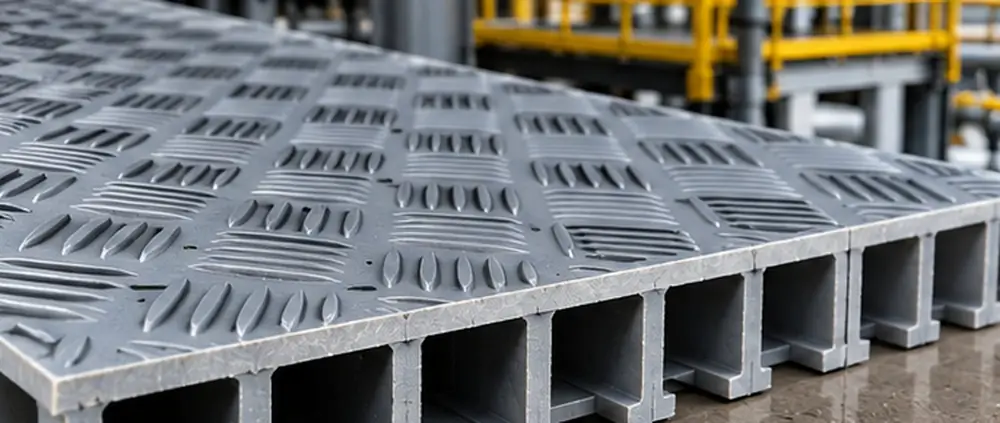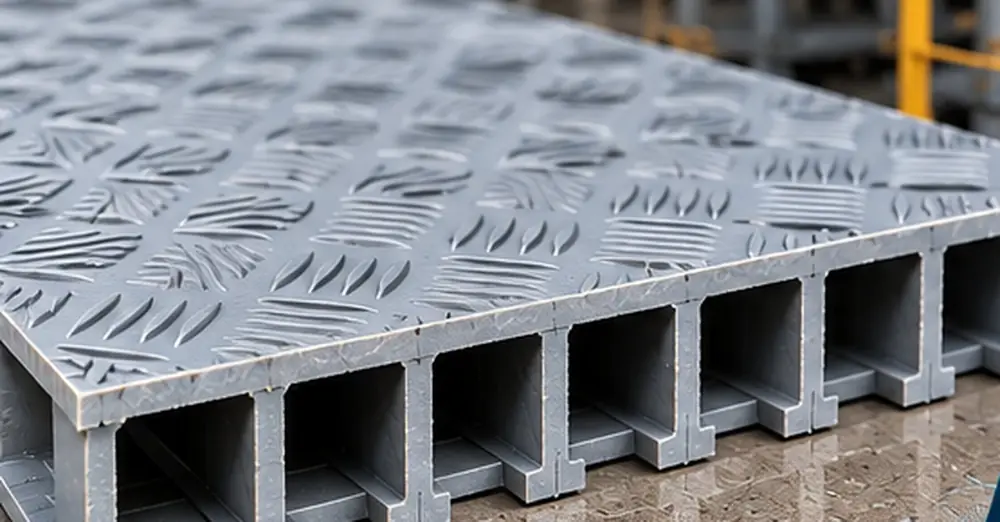
What is 25 mm fiberglass grating?
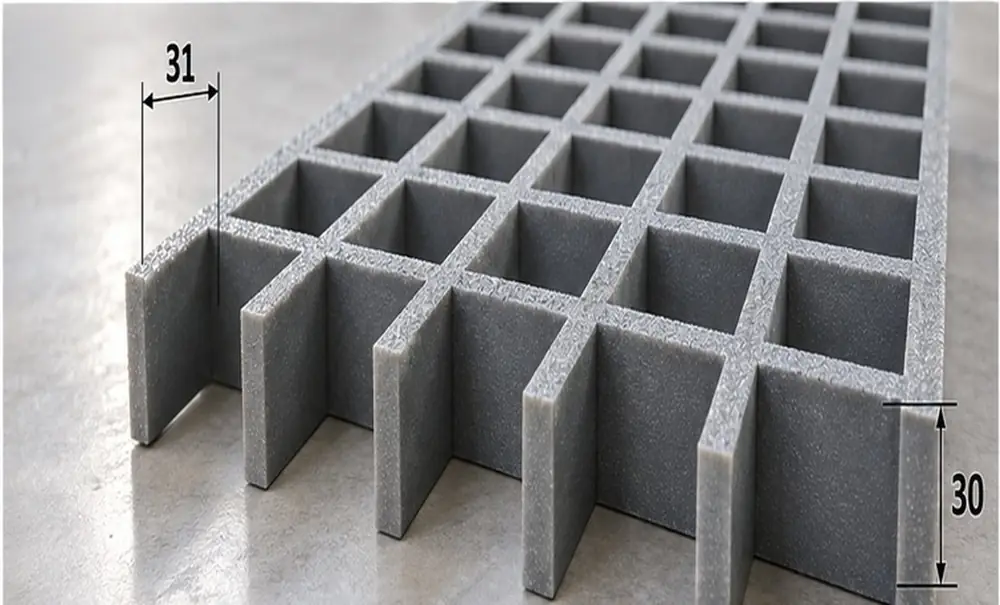
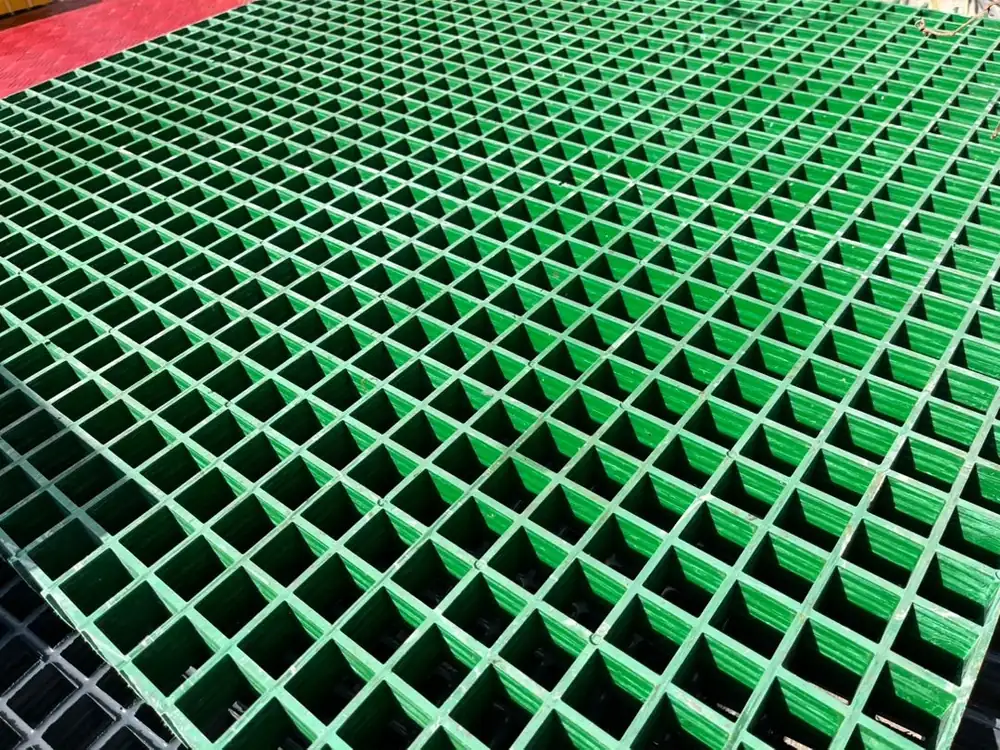
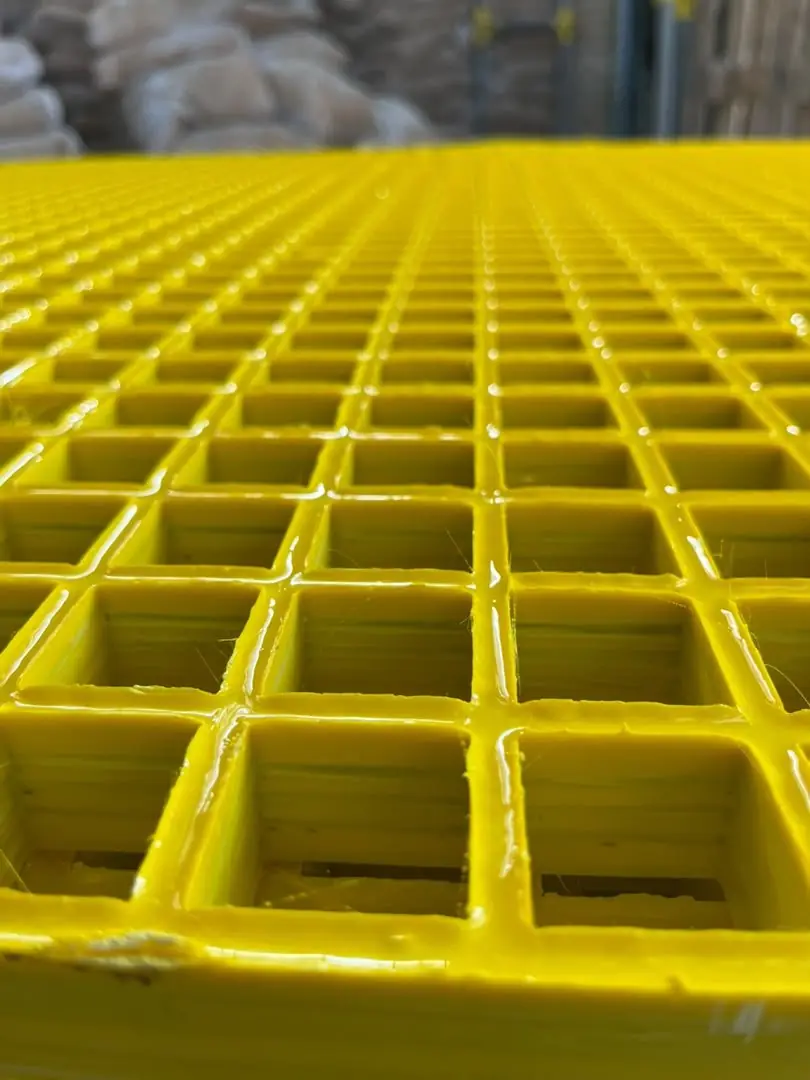
Composite grating is an open-mesh panel in which hollow cells repeat at equal spacing across the whole surface. On the market these panels are known as fiberglass grating, FRP grating, GRP grating, GFRP grating, composite mesh panel, polymer grating and even plastic grating. The last name is technically inaccurate: the product is a glass fiber reinforced polymer composite, and it is several times stronger than ordinary plastics.
The 25 mm model is produced by molding (molded grating): continuous glass roving is laid layer by layer, crossing in the grooves of the mold, and wetted out with resin; after curing the result is a one-piece panel with no mechanical joints. The outcome is a bidirectional fiberglass grating with almost the same capacity in the longitudinal and transverse directions. To compare it with other types, see the FRP grating selection guide, and for the production process see how composite grating is made.
Specifications and dimensions of 25 mm fiberglass grating
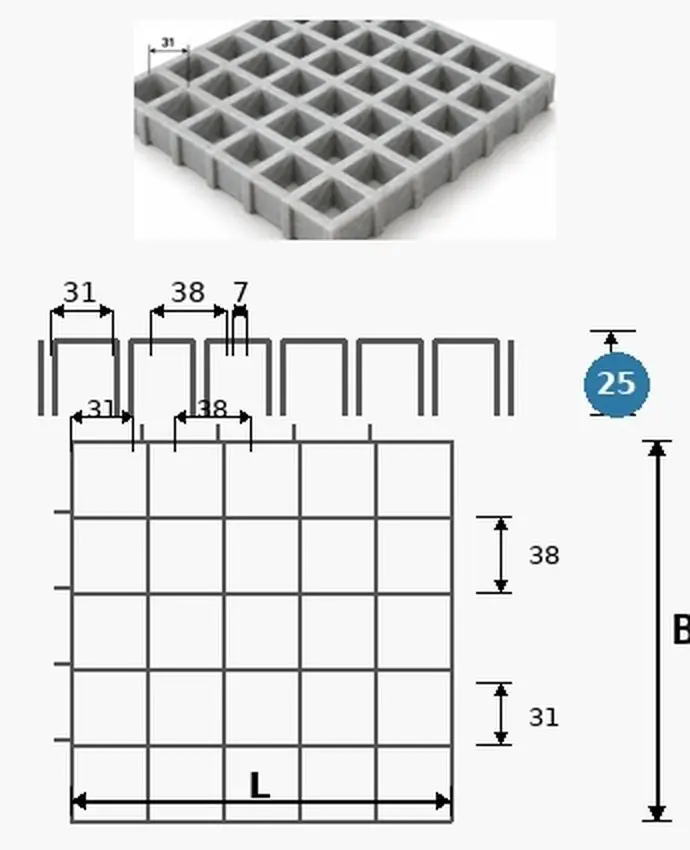
Key specifications and dimensions of 25 mm high composite grating:
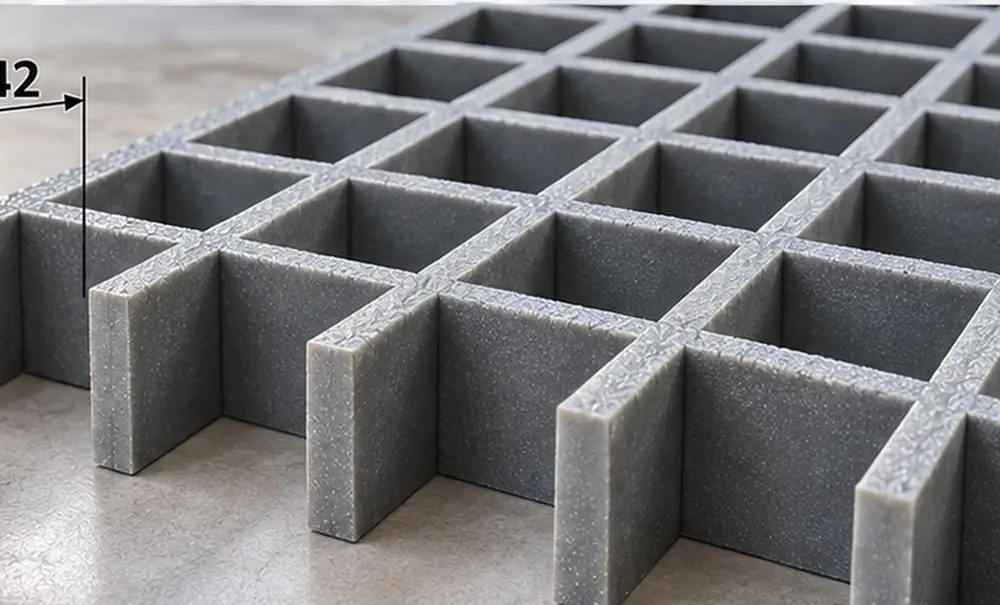
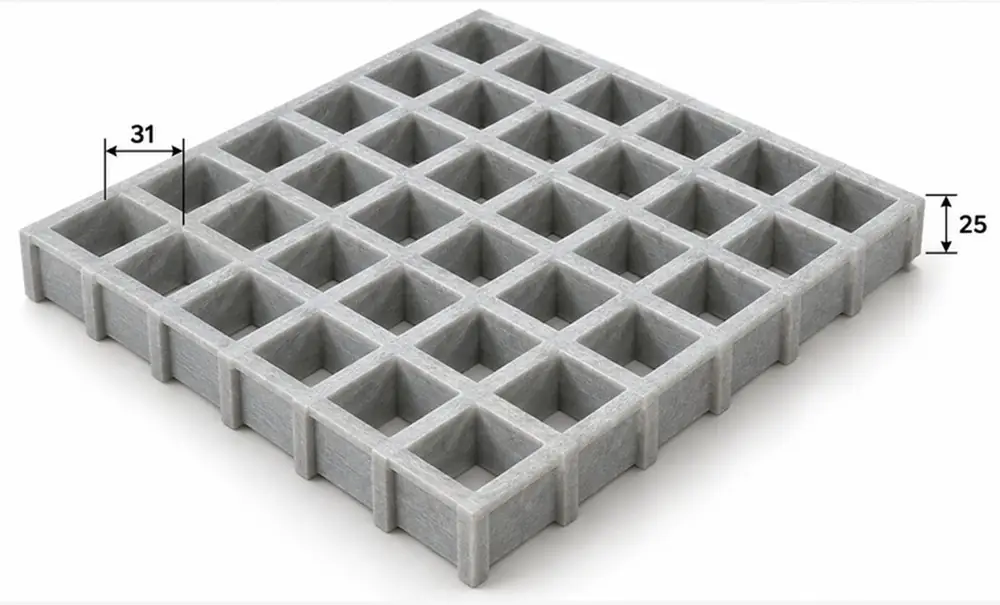
Cell geometry: grating height 25 mm and center-to-center cell spacing 38 mm (exactly 38.1 mm, or 1.5 in). The clear opening of each cell at the top is about 31 mm and the bar thickness at the crown is about 7 mm; the bars taper slightly towards the bottom so the panel can release from the mold.
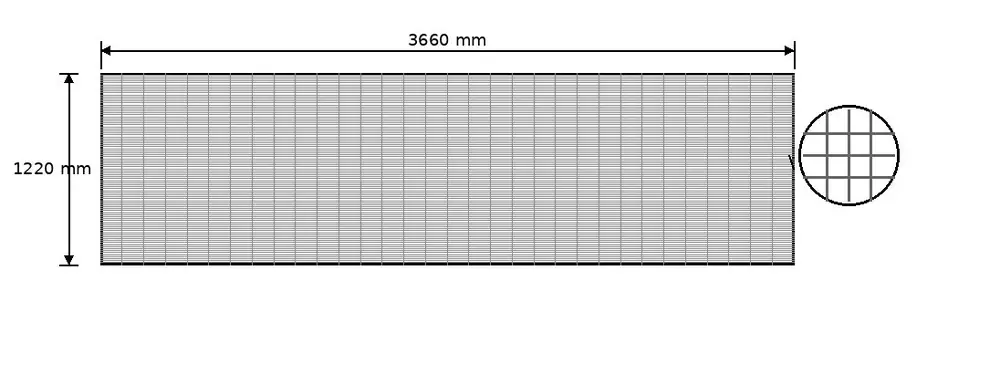
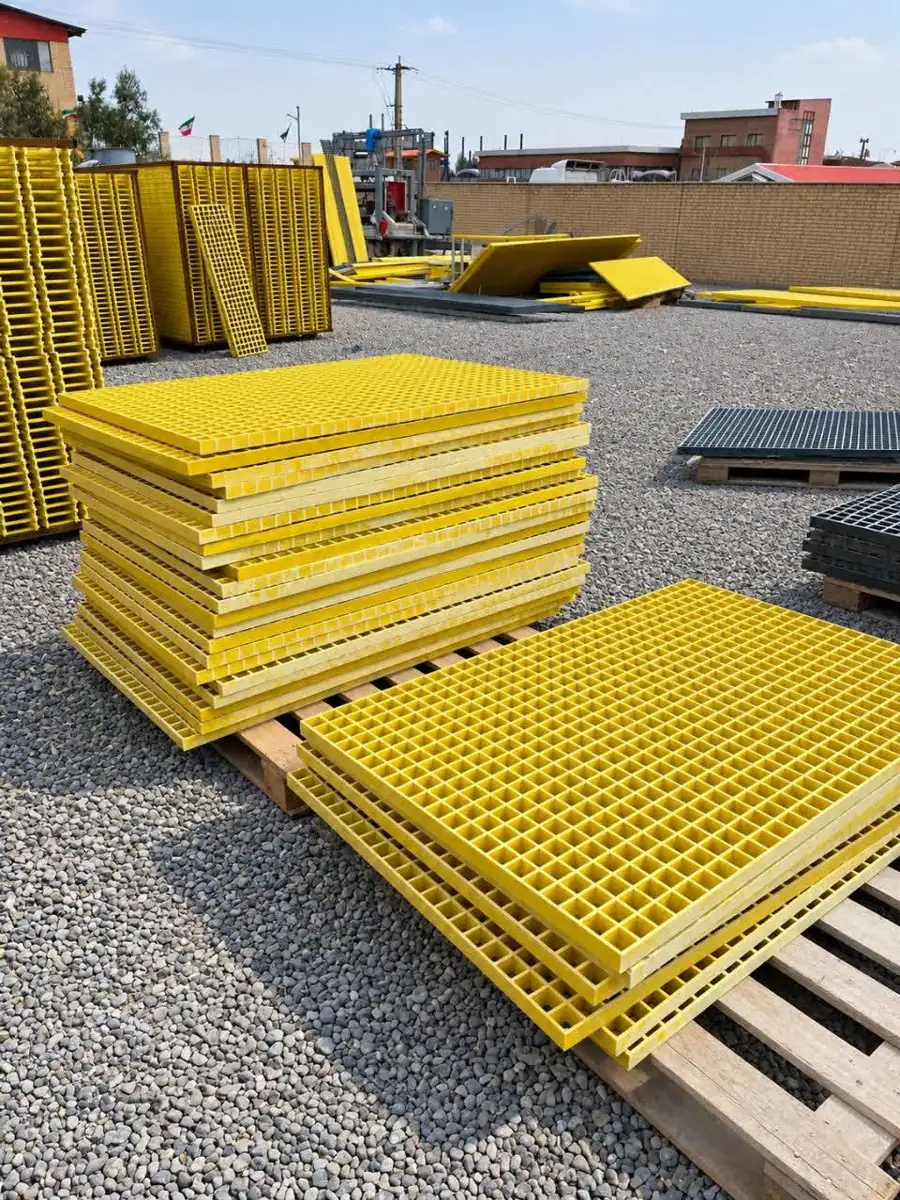
Full sheet (panel) size: 1220×3660 mm (3660 mm long by 1220 mm wide, i.e. 4×12 ft, about 4.47 m²).
Number of cells: 96 full cells along the length and 32 full cells across the width — 3,072 cells per panel in total.
| Property | Value | Engineering note |
|---|---|---|
| Grating height | 25 mm | The lowest-profile standard molded grating |
| Cell center-to-center | 38 mm (38.1) | Square, bidirectional cell |
| Full sheet size | 1220×3660 mm | 32 × 96 full cells |
| Open area of the fiberglass grating | 68% | Lets water, air and light through; reduces wind load |
| Weight of one full sheet | approx. 51 kg | approx. 11.4 kg/m² |
| Tensile modulus | 15 GPa | Molded glass/resin composite (GFRP) |
| Maximum service temperature | About 100 °C | Standard resin; special grades made to order |
| Fire behavior | Self-extinguishing | Higher fire-rated grade made to order |
Drawing of the 1220×3660 fiberglass grating panel
An accurate panel drawing is the basis for planning cuts and laying out panels on a platform. The full-panel drawing of the 1220×3660 mm grating shows the 32 × 96 cell layout and is available from the Nabak Composite technical team in DWG (2D AutoCAD drawing) and STEP (3D model) formats. The cell layout of this model is identical to the 38 mm molded grating and to the 28, 33 and 41 mm checker plates, so a single cutting plan works for all of these products.
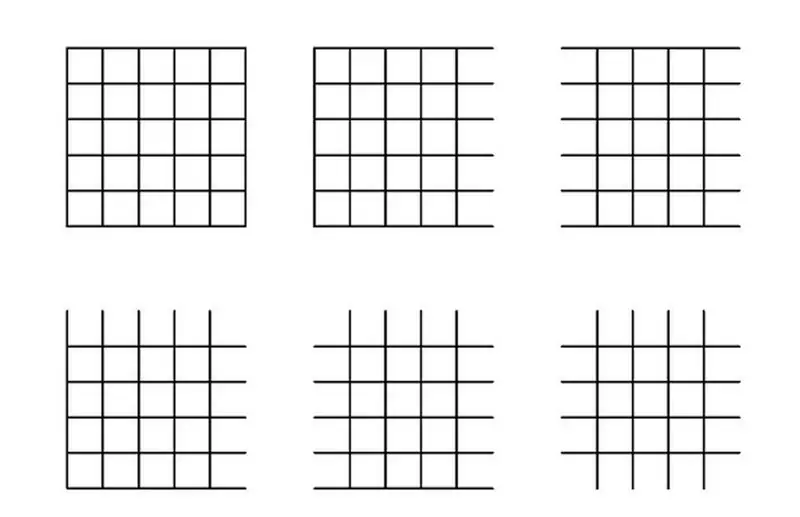
Cut sizes that leave full cells on composite grating
If a fiberglass grating sheet is cut through the middle of a cell, the panel edge is left with open prongs and no bar. That looks poor, can catch a shoe, and gives a weak edge for bearing on the support and for fixing clips. To keep full cells after cutting, choose the cut length from the table below; the values apply to both the length and the width of FRP and GRP grating.
| Cells | Length (mm) | Cells | Length (mm) | Cells | Length (mm) | Cells | Length (mm) | Cells | Length (mm) | Cells | Length (mm) |
|---|---|---|---|---|---|---|---|---|---|---|---|
| 1 | 42 | 17 | 652 | 33 | 1261 | 49 | 1871 | 65 | 2481 | 81 | 3090 |
| 2 | 81 | 18 | 690 | 34 | 1299 | 50 | 1909 | 66 | 2518 | 82 | 3128 |
| 3 | 118 | 19 | 728 | 35 | 1338 | 51 | 1947 | 67 | 2557 | 83 | 3166 |
| 4 | 156 | 20 | 766 | 36 | 1376 | 52 | 1985 | 68 | 2595 | 84 | 3204 |
| 5 | 195 | 21 | 804 | 37 | 1414 | 53 | 2023 | 69 | 2633 | 85 | 3243 |
| 6 | 233 | 22 | 842 | 38 | 1452 | 54 | 2061 | 70 | 2671 | 86 | 3281 |
| 7 | 271 | 23 | 880 | 39 | 1490 | 55 | 2100 | 71 | 2709 | 87 | 3319 |
| 8 | 309 | 24 | 918 | 40 | 1528 | 56 | 2138 | 72 | 2747 | 88 | 3357 |
| 9 | 347 | 25 | 957 | 41 | 1566 | 57 | 2176 | 73 | 2785 | 89 | 3395 |
| 10 | 385 | 26 | 995 | 42 | 1604 | 58 | 2214 | 74 | 2823 | 90 | 3433 |
| 11 | 423 | 27 | 1033 | 43 | 1642 | 59 | 2252 | 75 | 2862 | 91 | 3471 |
| 12 | 461 | 28 | 1071 | 44 | 1680 | 60 | 2290 | 76 | 2900 | 92 | 3509 |
| 13 | 499 | 29 | 1109 | 45 | 1719 | 61 | 2328 | 77 | 2938 | 93 | 3547 |
| 14 | 537 | 30 | 1147 | 46 | 1757 | 62 | 2366 | 78 | 2976 | 94 | 3585 |
| 15 | 576 | 31 | 1185 | 47 | 1795 | 63 | 2404 | 79 | 3014 | 95 | 3623 |
| 16 | 614 | 32 | 1220 | 48 | 1833 | 64 | 2442 | 80 | 3052 | 96 | 3660 |
Weight of 25 mm fiberglass grating
A full 1220×3660 mm sheet of 25 mm fiberglass grating weighs about 51 kg; with an area of 4.47 m² that gives about 11.4 kg per m². This is the lightest composite grating in the Nabak range: a 1×1 m panel weighs only about 11 kg and one person can easily carry and install it. By comparison, 25 mm galvanized steel grating weighs about 25 to 30 kg/m², so the fiberglass grating weighs less than half as much and cuts the cost of transport, cranage and structural strengthening.
Common names for composite grating and how they differ
The same product is sold under several names, which sometimes causes confusion when requesting quotations. The table below explains what each name means and whether it refers to the same product as the 25 mm molded composite grating:
| Common name | Technical meaning | Relation to this product |
|---|---|---|
| Fiberglass grating / fibreglass grating | Grating reinforced with glass fibers | Same product |
| FRP grating | Fiber Reinforced Polymer — a fiber-reinforced polymer composite | Same product |
| GRP grating | Glass Reinforced Plastic — the common European term | Same product |
| GFRP grating | Glass Fiber Reinforced Polymer — the most precise technical name | Same product |
| Composite mesh panel / grating mesh | Describes the open-mesh appearance of the panel | Same product |
| Polymer grating | Emphasizes the polymer resin matrix | Same product |
| Plastic grating | Colloquial name | Technically incorrect; plastic grating without fibers is far weaker |
| Pultruded grating | Grating assembled from pultruded I-bars | A different type of composite grating |
So when a buyer talks about composite grating, FRP grating, GRP grating or polymer grating, they usually mean this molded composite grating. In an enquiry, however, always state the height (25 or 38 mm), the cell size and the surface type: 25 mm and 38 mm composite gratings look similar but their capacities differ several-fold. Also do not confuse cheap plastic grating without glass fibers with composite grating.
Features of 25 mm composite grating
Grating clips and installation of fiberglass grating
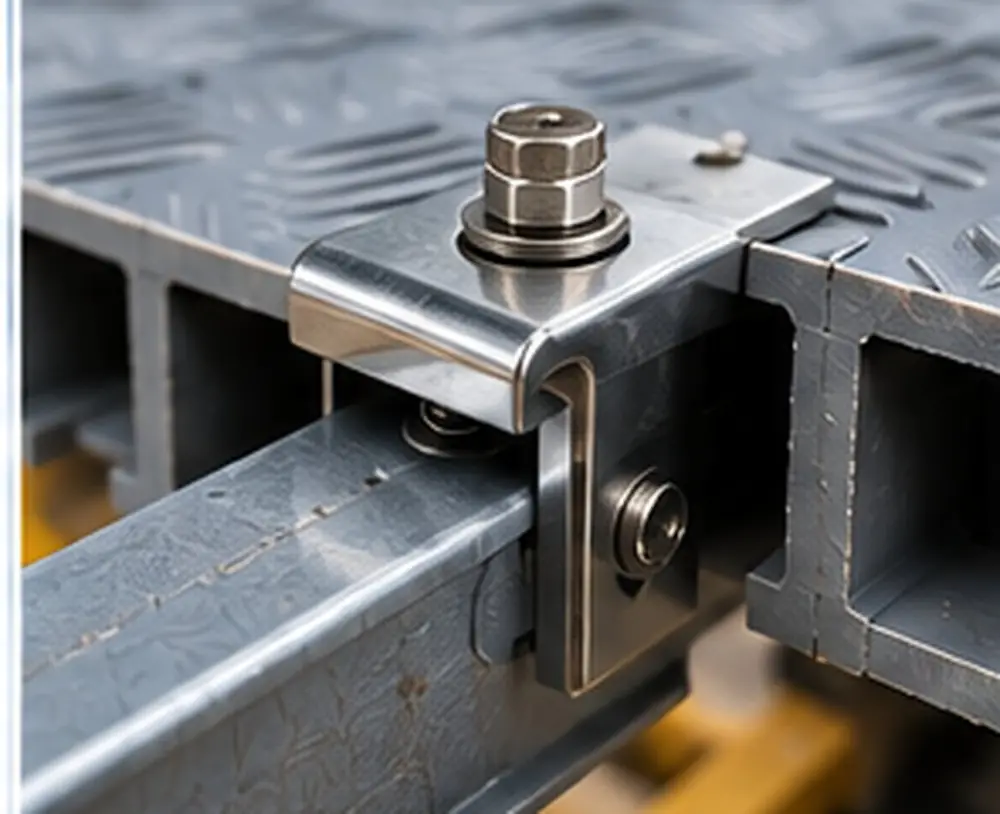
Installing fiberglass grating is straightforward, and the standard composite grating fixings apply to this model. Panels are locked onto the flange of the supporting beam with stainless steel clips, with no welding or drilling of the beam. For correct clip fixing of this composite grating:
- At least four clips per panel, plus one extra clip for every 600 mm of length.
- A bearing (seat) of at least 25 mm on the support at each edge of the panel.
- Clips must sit on a full bar at the panel edge — which is why full-cell cutting matters.
- Seal cut edges with resin (see cutting and machining composites).
- In highly corrosive environments, specify 316 stainless steel fixings.
Load capacity of 25 mm fiberglass grating
The structural behavior of polymer grating is assessed with a standard load table. Loading on composite grating is defined in two cases, and in both the bars of the mesh panel share the load in both directions:
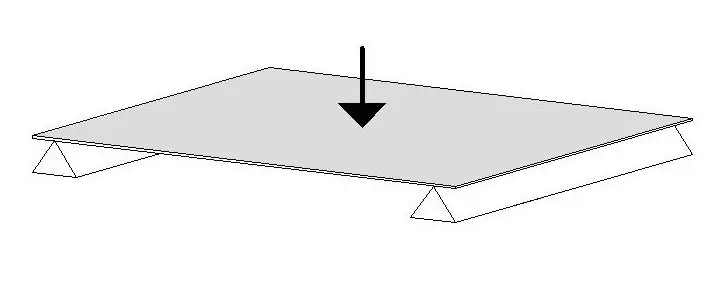
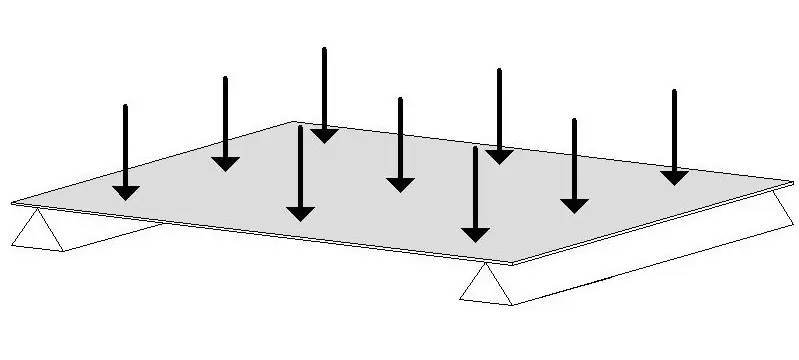
- Allowable load based on deflection: the load that brings the mid-span deflection of the panel to L/200 of the support spacing (0.5% of the span).
- Ultimate (failure) load: the maximum load at which the polymer grating panel will certainly fail.
Load table for 25 mm high fiberglass grating
The load table for the 25 mm fiberglass grating panel gives the allowable load at L/200 deflection and the ultimate load, for concentrated and uniform loading, at six common support spacings:
| Support spacing (mm) | Concentrated load (kg) | Uniform load (kg/m²) | ||
|---|---|---|---|---|
| Allowable load at L/200 deflection | Ultimate load | Allowable load at L/200 deflection * | Ultimate load | |
| 400 | 281 | 3,000 | 1,607 | 21,000 |
| 600 | 125 | 2,000 | 476 | 9,000 |
| 800 | 70 | 1,500 | 201 | 5,000 |
| 1,000 | 45 | 1,200 | 103 | 3,200 |
| 1,200 | 31 | 1,000 | 60 | 2,200 |
| 1,400 | 23 | 700 | 37 | 1,600 |
- The allowable uniform load falls roughly with the cube of the span: from 400 to 800 mm it drops about 8 times (1607 to 201); the allowable concentrated load falls roughly with the square (281 to 70).
- The gap between the deflection-based allowable load and 40% of the ultimate load is very large (at a 600 mm span: 476 versus 3600). The 25 mm molded grating is entirely deflection-governed: it has a large strength reserve before failure, but walking comfort limits the span.
- The economic range of this model is 400 to 600 mm spans for pedestrian use. For longer spans, the 25×15 pultruded grating of the same height carries about 8 times more allowable load at a 1 m span.
Comparison with other composite gratings of the same height
Compare the allowable uniform load at L/200 deflection (kg/m²) of 25 mm fiberglass grating with options of the same height:
| Grating type | Weight (kg/m²) | 600 span | 800 span | 1000 span |
|---|---|---|---|---|
| Molded grating 25×38×38 (this model) | 11.4 | 476 | 201 | 103 |
| Checker plate 28 (this grating + 3 mm plate) | 17 | 650 | 300 | 150 |
| Pultruded grating 25×15 | 14.5 | 3750 | 1600 | 850 |
Thanks to its bidirectional fibers, molded grating carries load in both directions and has higher chemical resistance (a higher resin-to-fiber ratio); pultruded grating, with its continuous longitudinal fibers, is much stiffer in one direction. See the full tables in FRP grating load capacity tables and the closed-surface version in 28 mm checker plate grating.
Load design examples for composite grating
The examples below show, step by step, how to check a composite grating panel against the load table.
- At a 600 mm span: allowable uniform load 476 < 500 ✗ (slightly short); approximate allowable load at a 550 mm span ≈ 476 × (600/550)³ ≈ 620 ≥ 500 ✓
- Concentrated at 600: 125 ≥ 100 ✓; safety: 0.4 × 2000 = 800 ≫ 100 ✓ → maximum beam spacing about 550 mm.
- 281 ≥ 200 ✓; deflection ≈ 2 × 200/281 ≈ 1.4 mm; safety: 0.4 × 3000 = 1200 ✓
- Approximate allowable load at 700 ≈ 476 × (600/700)³ ≈ 300 ≥ 250 ✓; deflection ≈ 3.5 × 250/300 ≈ 2.9 mm.
Surface types of molded composite grating
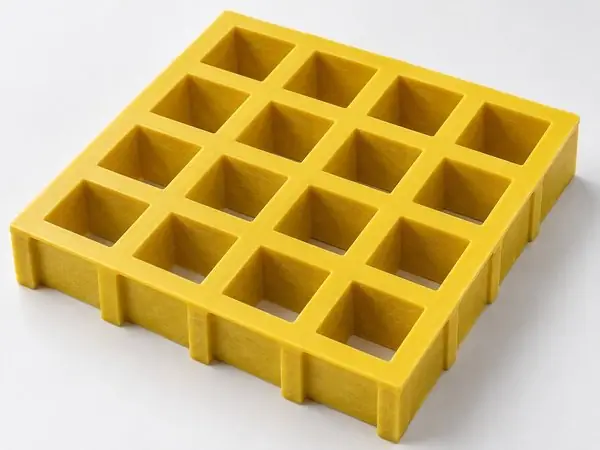
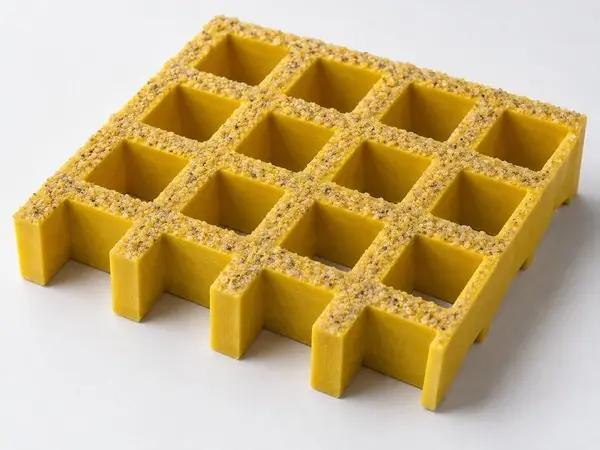
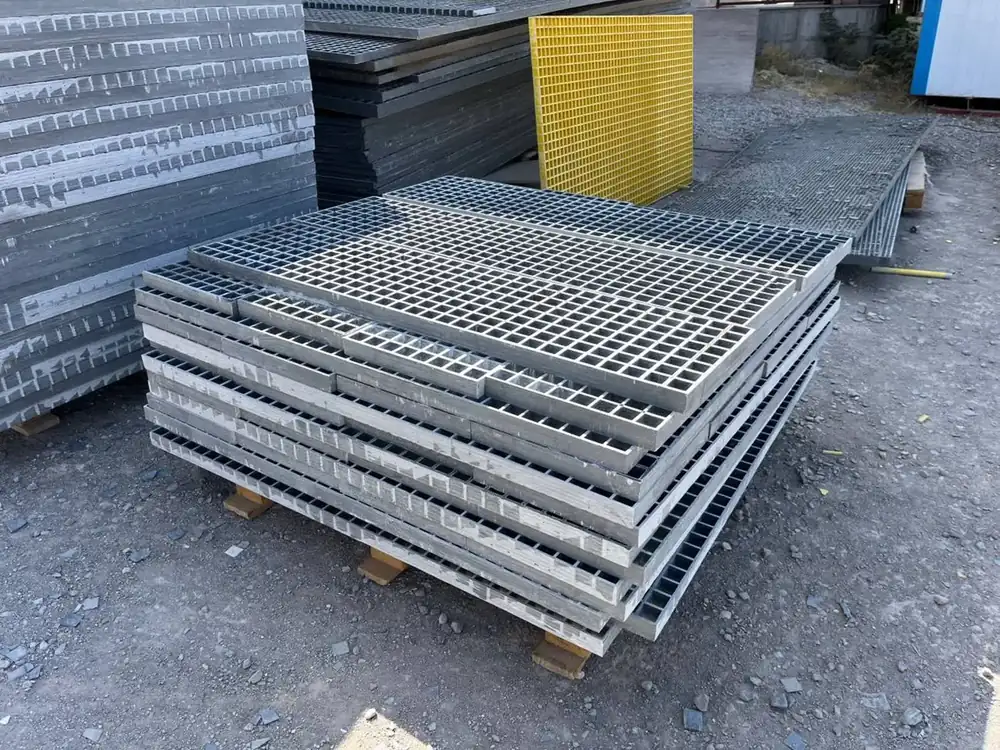
Molded composite grating has two faces, each with a different surface. Surface quality determines the safety and durability of composite grating, and choosing the right surface for the slip risk, the presence of oil and the slope of the route ensures safe access:
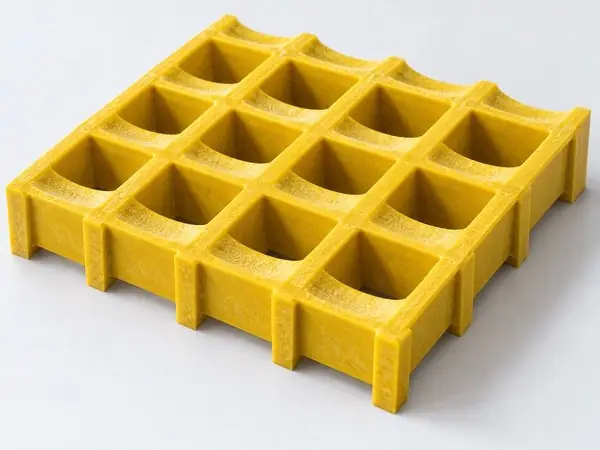
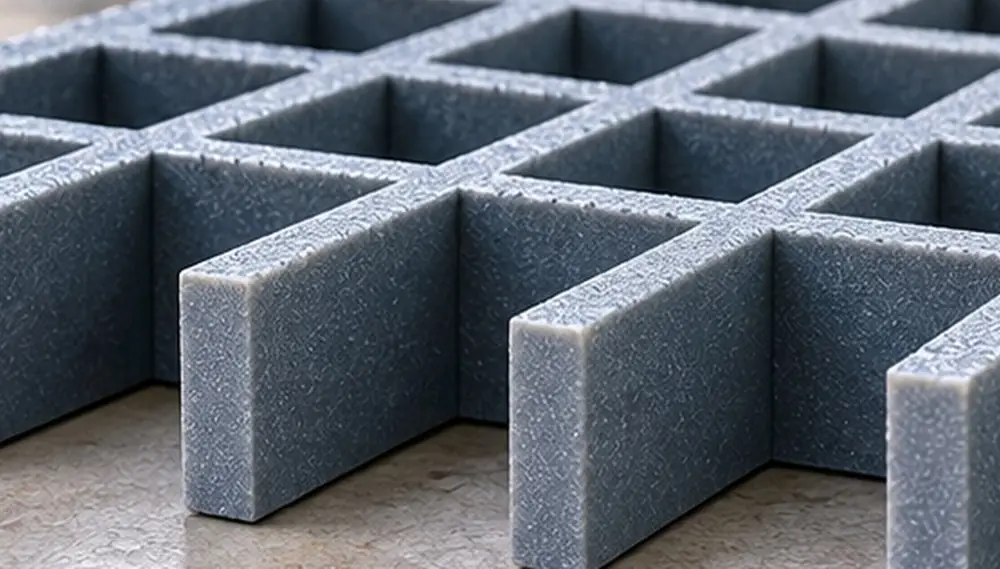
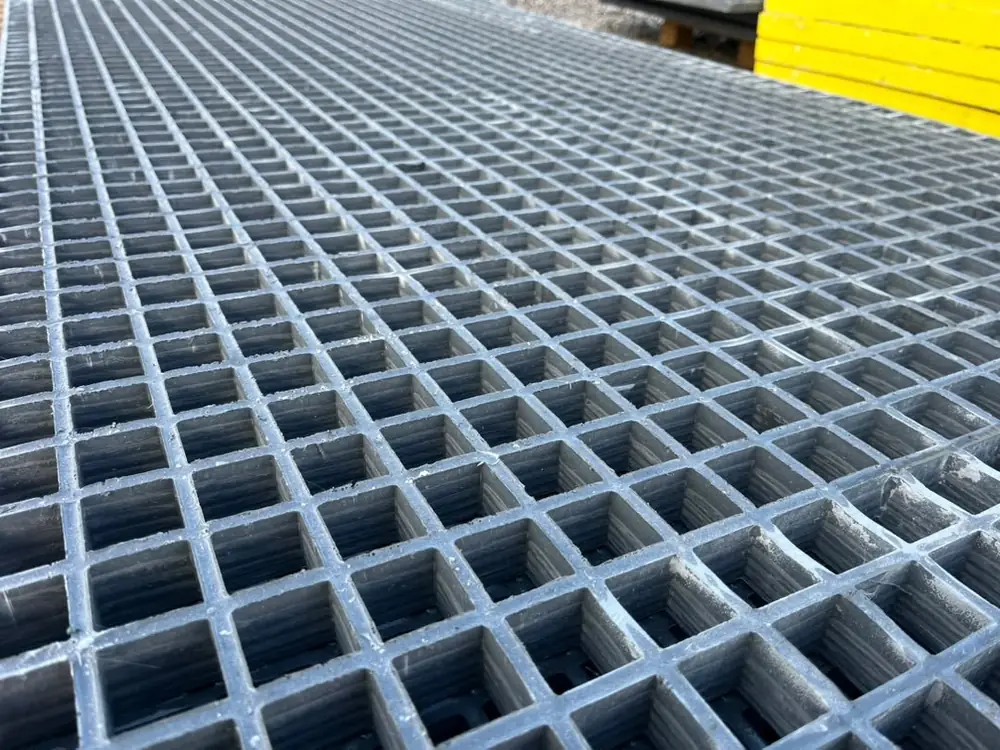
- Concave (meniscus) surface: the face formed in the mold gives the bar crowns a concave, crescent shape. The sharp edges of these crescents grip the shoe and provide natural slip resistance with no extra coating; this is why the concave surface is the most widely used and stops people slipping on the composite mesh panel.
- Smooth surface: after production the other face of the panel is ground down a few millimetres to give a completely smooth, polished surface. A polished surface is easy to clean and suits floors used by trolleys or wheelchairs where the slip risk is low. Polishing slightly reduces the height, which must be allowed for in the floor level design.
- Gritted surface: for sloping surfaces, areas exposed to oil spills and permanently wet routes, quartz grit and sand of a specific grading are bonded into resin on the surface, giving the highest slip resistance on the grating mesh. To increase roughness further, the grating panels can also be sandblasted after production; sandblasting a smooth surface also gives a uniform texture.
Applications of 25 mm fiberglass grating
The allowable load range of this model determines its applications.
The right surface for each use depends on the environment and the level of corrosion. Low weight, high open area and chemical resistance make 25 mm fiberglass grating suitable for these applications:
- Short-span floors and access walkways in water and wastewater treatment plants.
- Covers for surface-water and sewage channels and gutters.
- Floors over basins, and platforms in chemical and plating units.
- Cooling tower platforms and wet environments.
- Floors in livestock and poultry houses and food plants with constant washdown.
- Cable trench covers in electrical substations and insulating platforms.
Fiberglass grating compared with steel grating
| Feature | 25 mm fiberglass grating (FRP) | 25 mm galvanized steel grating |
|---|---|---|
| Weight | approx. 11.4 kg/m² | About 25 to 30 kg/m² |
| Corrosion | None | Rusts once the zinc layer is damaged |
| Load-bearing behavior | Bidirectional (crossed fibers) | Mainly one-directional |
| Electrical conductivity | Insulating | Conductive |
| Service temperature | Up to about 100 °C | High |
| Cutting and installation | Simple tools; clip fixing without welding | Thermal cutting, welding and re-galvanizing of edges |
| Maintenance cost | Very low | Periodic painting and repair |
Ordering guide for fiberglass grating
To request a price for 25 mm fiberglass grating (FRP or GRP grating), prepare the following information; the loading conditions and span are the most important inputs for choosing the model:
- Dimensions: full 1220×3660 sheet, or full-cell cut sizes from the table
- Span and loading: support spacing, uniform and concentrated load
- Surface type: concave, smooth or gritted
- Color and resin: grey, yellow, green, red or custom; isophthalic, vinyl ester or fire-retardant resin
- Clips: type and number of grating clips
- Drawing: request the DWG or STEP drawing to mark cuts on the panel and plan the panel layout
Fiberglass grating production and delivery at Nabak Composite
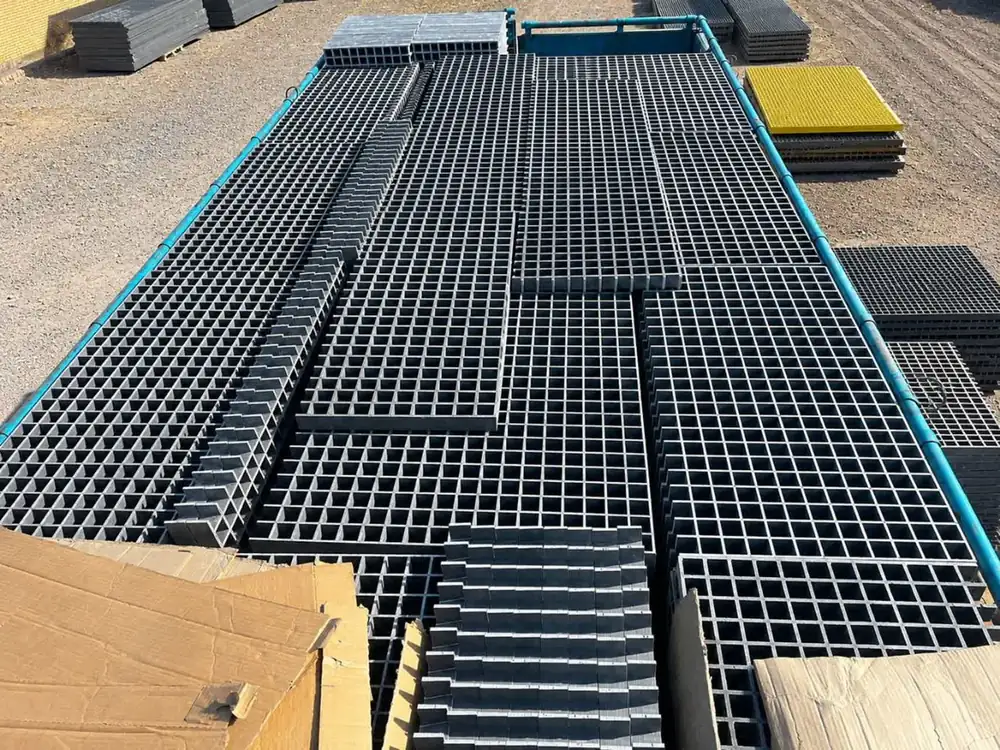
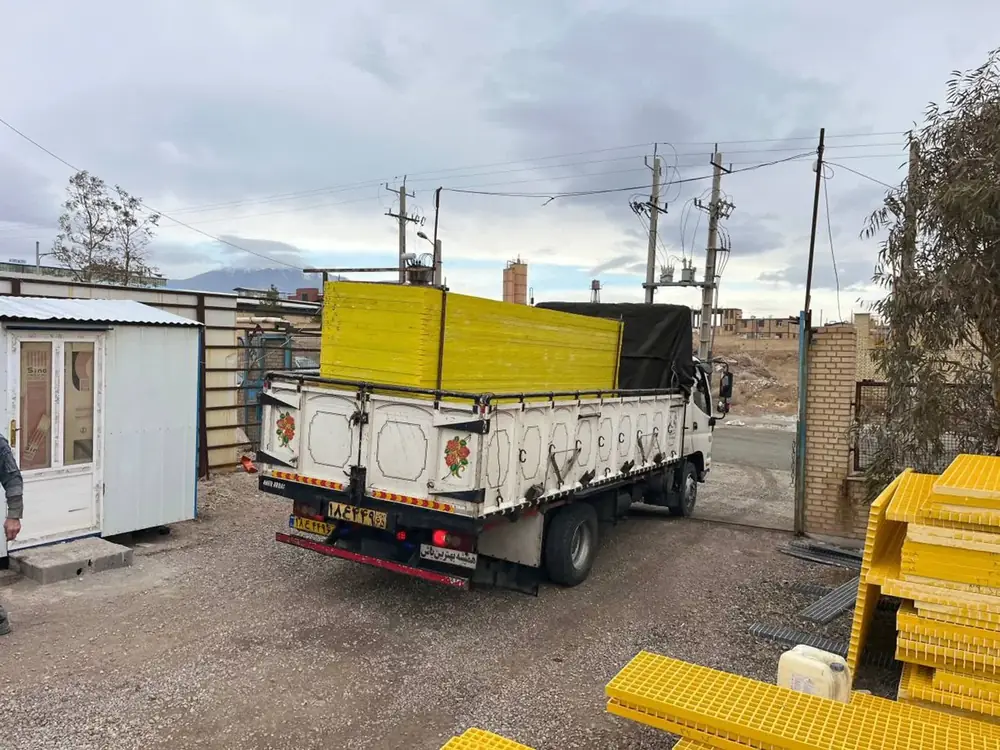
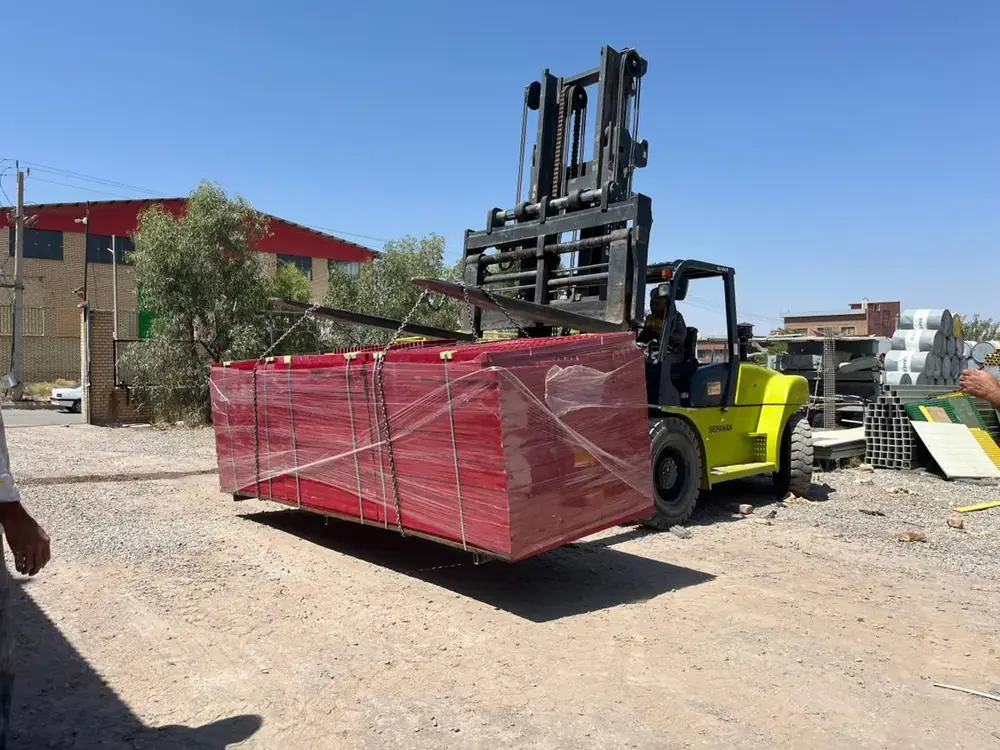
Nabak Composite produces, cuts and packs 25 mm and 38 mm molded composite grating, covered grating (checker plate) and pultruded grating in grey, yellow, green and red, and supplies them together with other composite products — fiberglass sheet, composite box sections, fiberglass angles, composite channels, composite beams, fiberglass tubes, composite flat bars, polymer rods, composite rods, and cable trays and cable ladders.

Frequently asked questions about 25 mm fiberglass grating
How much does 25 mm fiberglass grating weigh?
A full 1220×3660 mm sheet of 25 mm fiberglass grating weighs about 51 kg, i.e. about 11.4 kg per m².
What span is 25 mm fiberglass grating suitable for?
For a pedestrian walkway with a uniform load of 500 kg/m² and a concentrated load of 100 kg, a maximum support spacing of about 550 to 600 mm is recommended; for light service walkways with a 250 kg/m² load, up to about 750 mm.
What is the allowable load of 25 mm molded grating at a 600 mm span?
The allowable uniform load at L/200 deflection is about 476 kg/m² and the allowable concentrated load is 125 kg; the ultimate uniform load is 9,000 kg/m².
Which fiberglass grating surface is the most slip resistant?
The concave (meniscus) surface is the most common anti-slip surface; for slopes and oily areas, the quartz-gritted surface gives the highest slip resistance.
What is the difference between 25 mm fiberglass grating and the 28 mm checker plate?
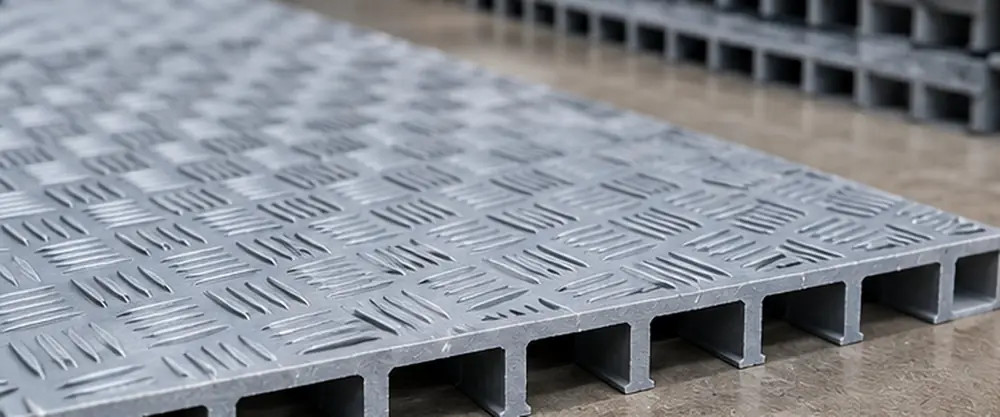
The 28 mm checker plate is this same 25 mm molded grating with a 3 mm patterned plate laminated on top. Its surface is closed and its capacity is about 40 to 50% higher, but it weighs about 17 kg/m² and does not let water or air through.
Summary
25 mm fiberglass grating (molded grating 25×38×38) is a one-piece glass fiber and resin mesh panel with 38 mm cells, 68% open area and a weight of about 11.4 kg/m². Each 1220×3660 mm sheet with 32 × 96 full cells weighs about 51 kg; its tensile modulus is 15 GPa and it can be used up to about 100 °C. An allowable uniform load of 476 kg/m² at a 600 mm span makes it an economical choice for walkways and short-span channel covers. Cut to full cells using the table, with a concave, smooth or gritted surface chosen to suit the slip conditions, correct clip fixing and the 40%-of-ultimate cap respected, this FRP grating is a light, insulating and durable alternative to steel grating.

This article was prepared by the technical team of Nabak Composite, a manufacturer of molded fiberglass grating, checker plate, pultruded grating and other composite products.