Why does knowing how grating is made matter?
The production method of composite grating depends on the product type, and each of the three types of composite grating (molded, covered and pultruded) follows a different route. In this article we describe how grating is made, from choosing raw materials to removing the part from the mold and shipping it to the project — information useful to buyers, designers and engineers of industrial projects.
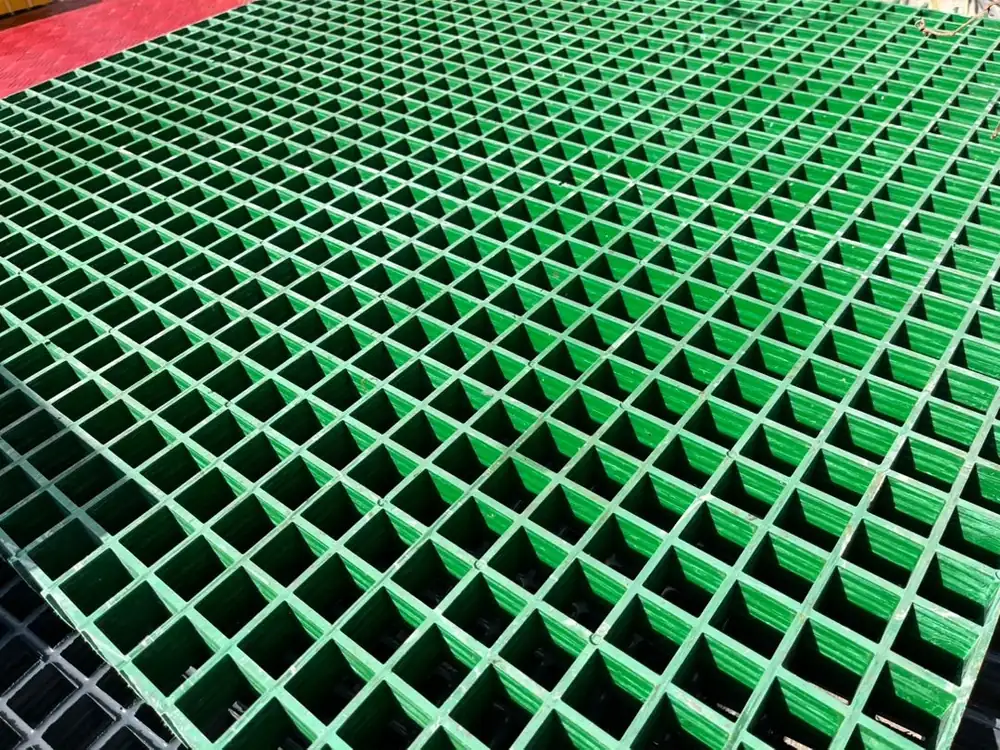
FRP grating (composite grating, fiberglass grating or GRP grating) is an open-mesh panel of glass fiber and resin that has become a light, corrosion-proof replacement for metal grating. The quality of a composite grating does not depend on its design alone; fiber placement, resin type and formulation, cure temperature and the care taken in finishing directly affect the product's strength, chemical resistance, appearance and life. A buyer who knows how grating is produced can tell the difference between two seemingly identical products and write the right technical specifications in their order.
Three types of composite grating and how their production differs
Composite gratings are produced in three main types: 1) molded composite grating, 2) covered composite grating or composite checker plate, and 3) pultruded composite grating. The production method differs for each, and each is described separately below:
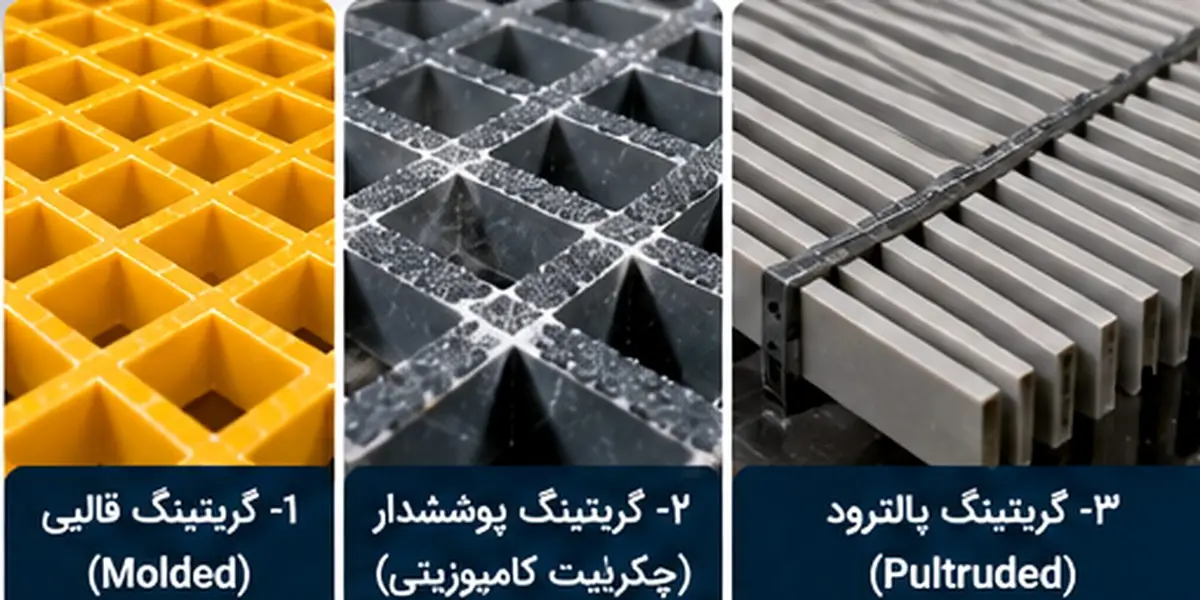
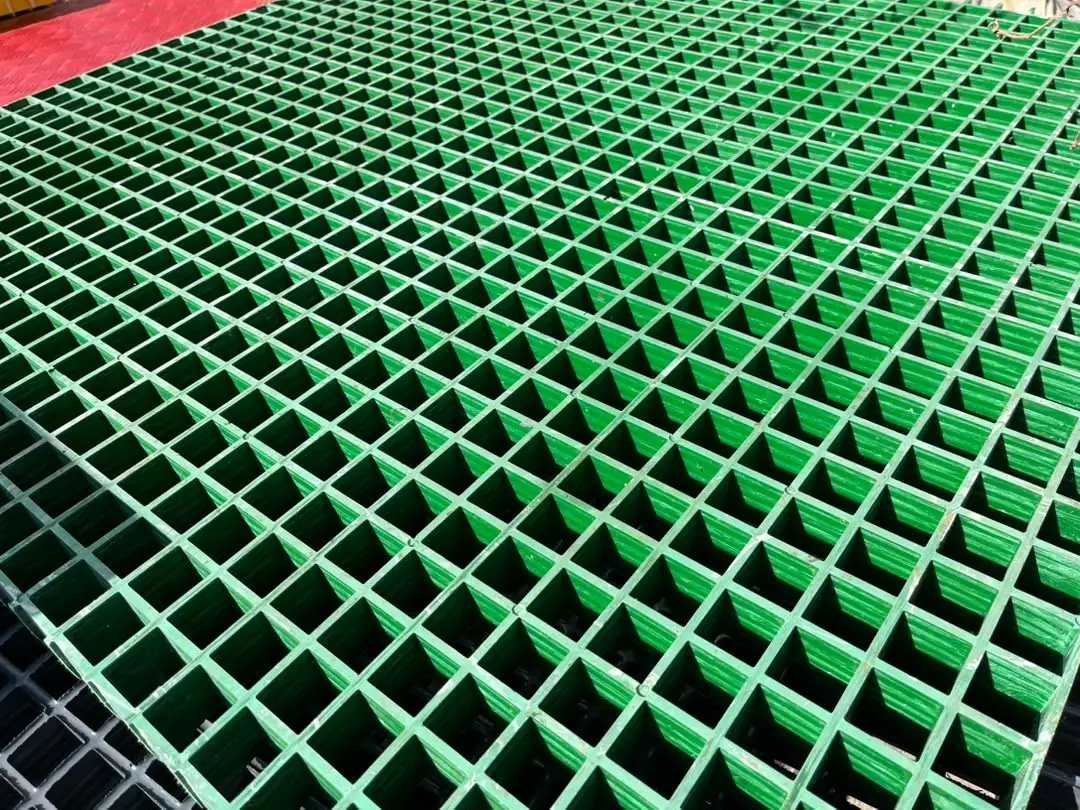
1. Molded grating
Produced in one piece in a metal mold with cores. Its production method falls under contact molding and manual processes (similar tohand lay-up), except that pressing and heat curing are used.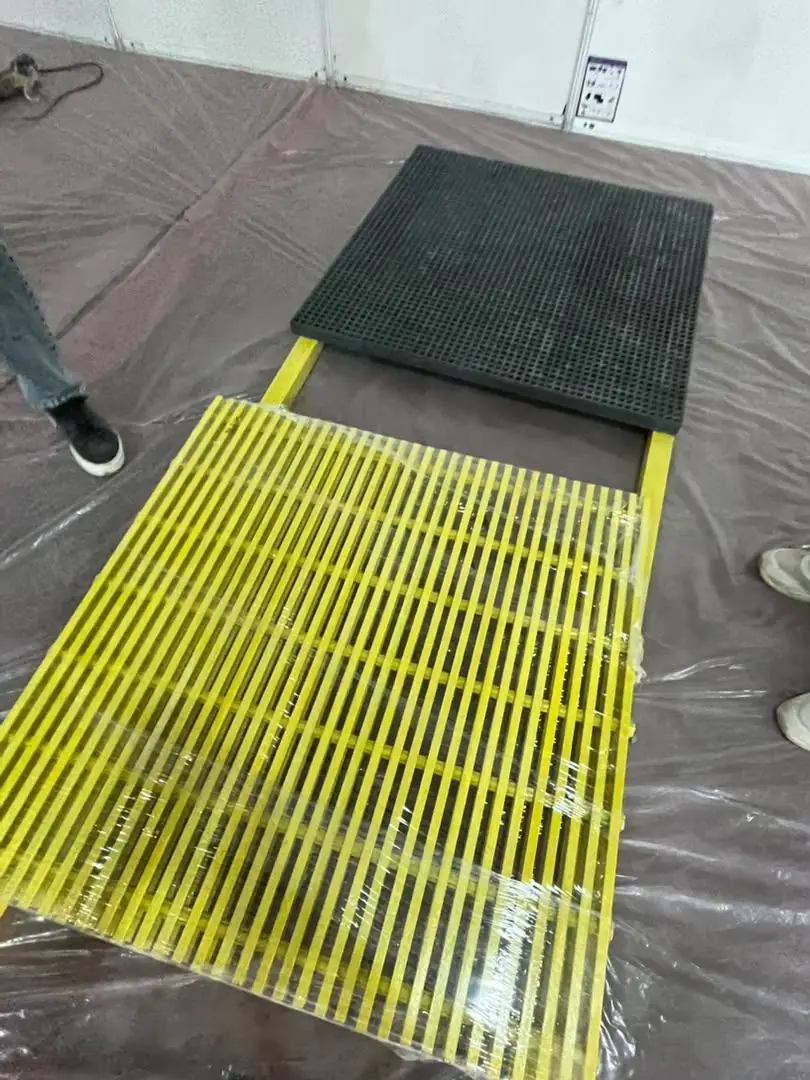
2. Covered grating (checker plate)
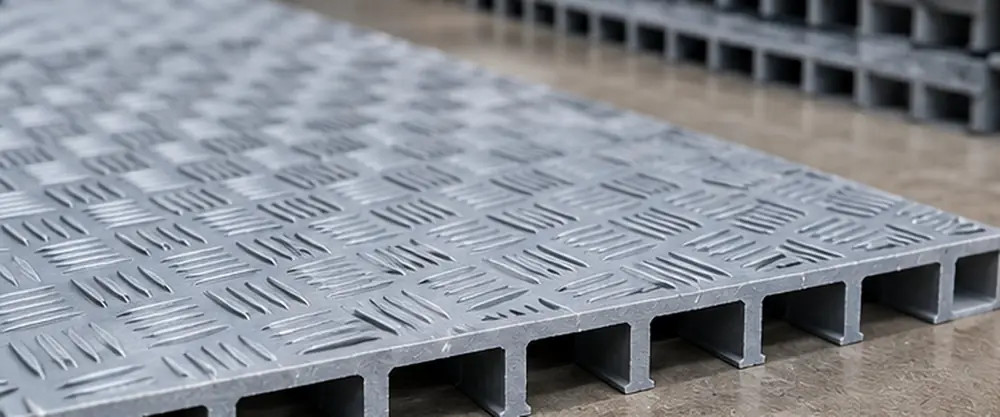
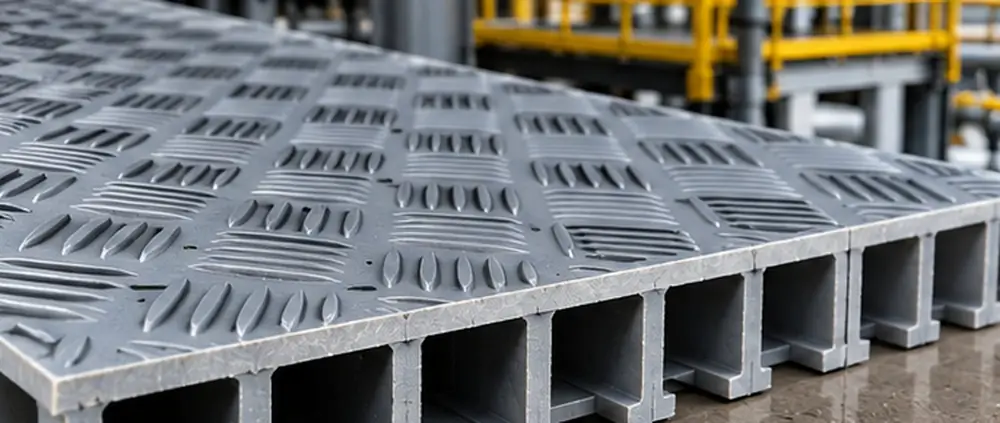
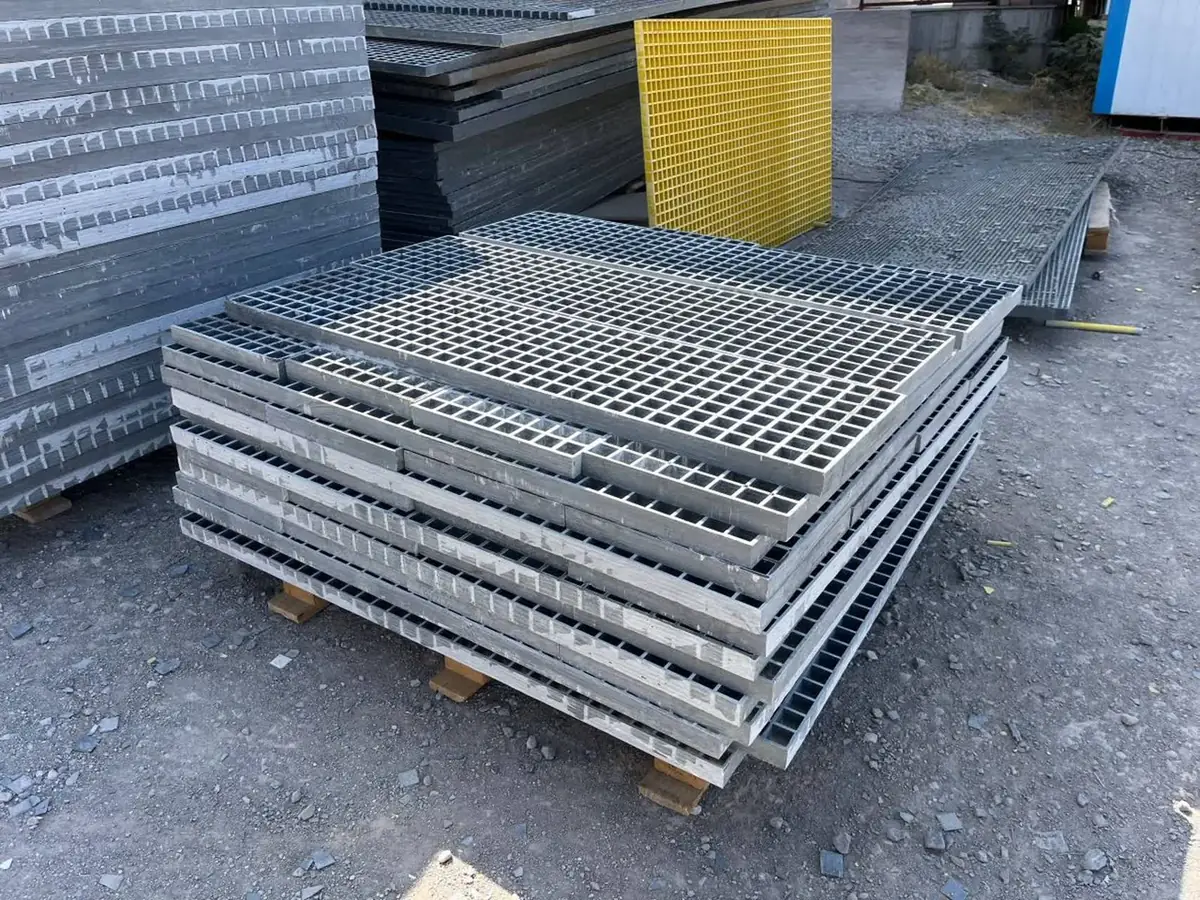
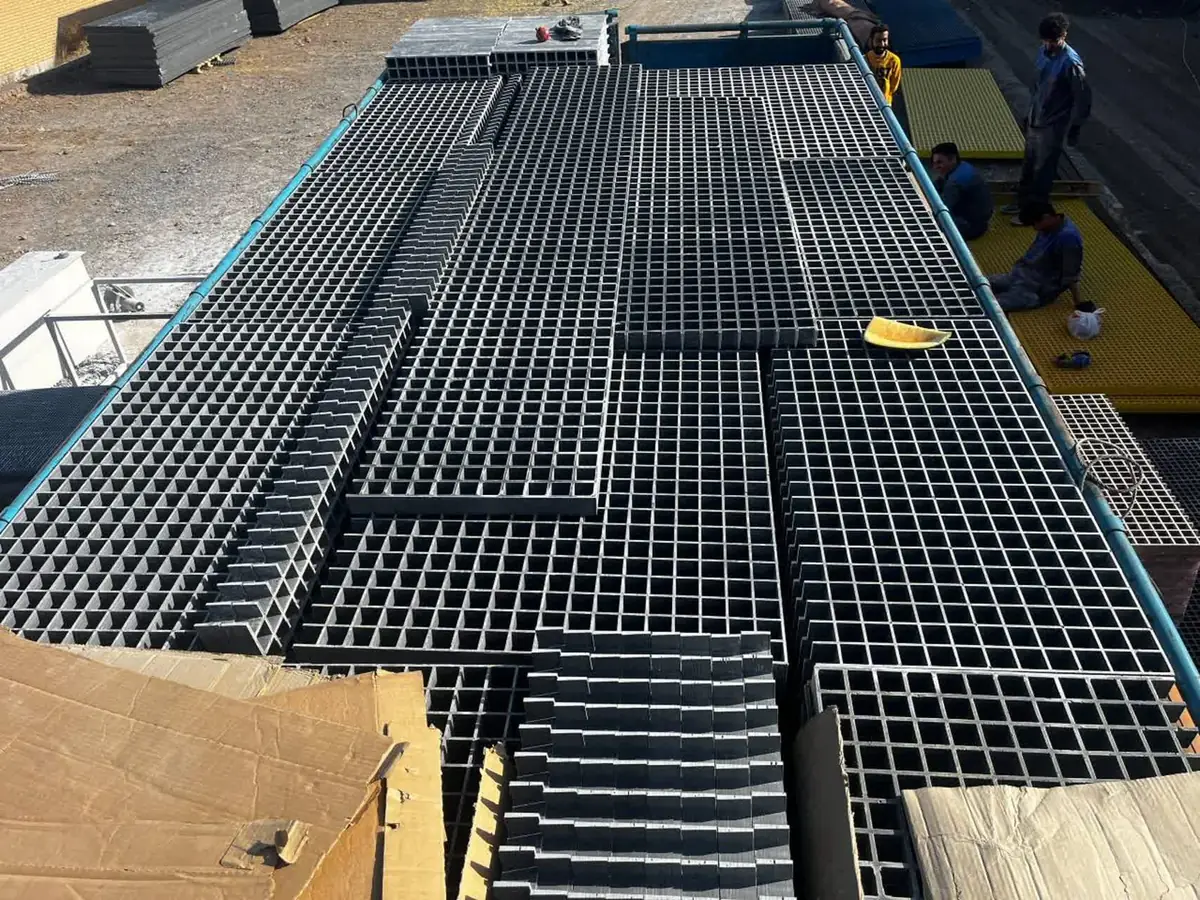
A molded grating on whose surface, after demolding, an anti-slip composite sheet about 3 mm thick is built up by hand. Image: black checker plate next to yellow pultruded grating.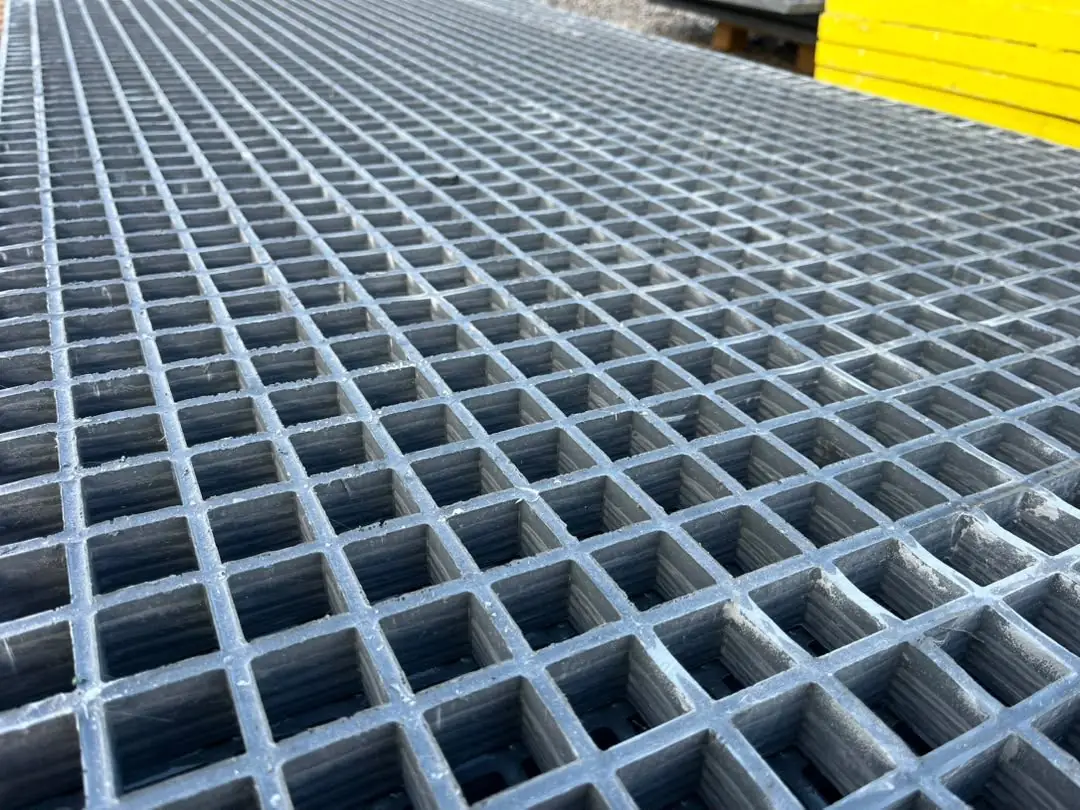
3. Pultruded grating
Made by assembling pultruded I-profiles and cross bars. Both components are produced bypultrusionand then assembled into panels in an assembly jig.The mold for producing composite grating
Producing these parts requires a special grid mold of defined size and shape. In molded grating production, the voids in the mold are filled with raw materials — resin, glass fiber and other additives — and after the resin cures, the solid part is removed from the mold. The heart of the molded grating process is its mold. A grating mold is a metal plate on whose surface a large number of metal cores are arranged at regular intervals. The spaces between the cores form a network of interconnected grooves in which fiber and resin accumulate and, after cure, form the grating bars. In other words, the cores are the grating's open meshes and the grooves are its load-bearing and cross bars.
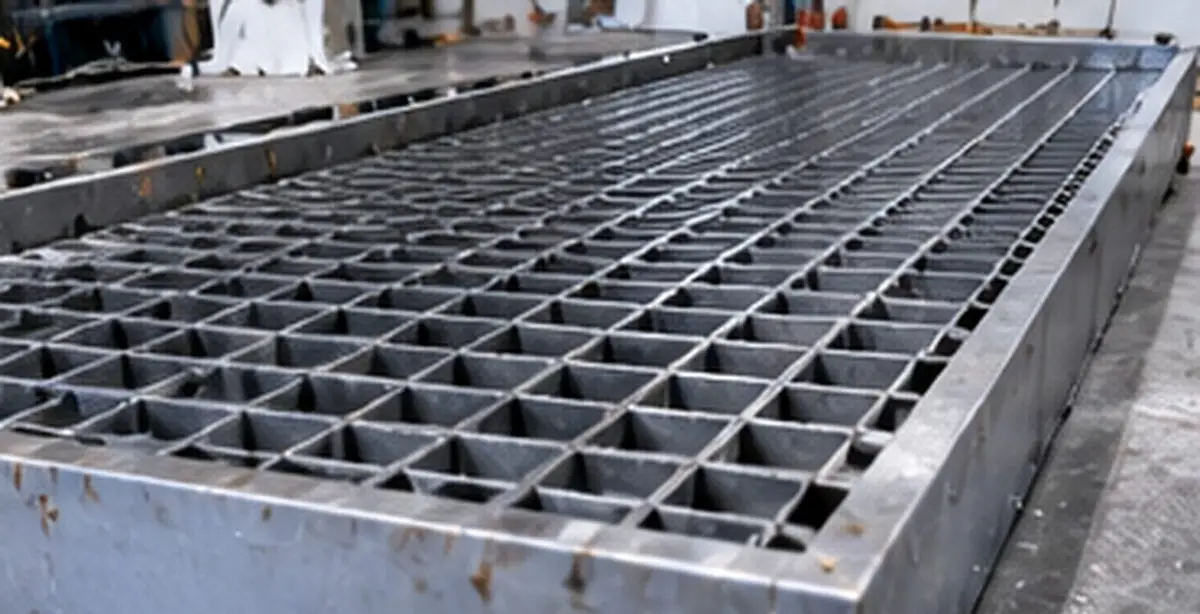
| Grating mold feature | Typical value | Effect on the product |
|---|---|---|
| Mold (and panel) size | 1220 × 3660 mm (122 × 366 cm) | Standard panel size before cutting |
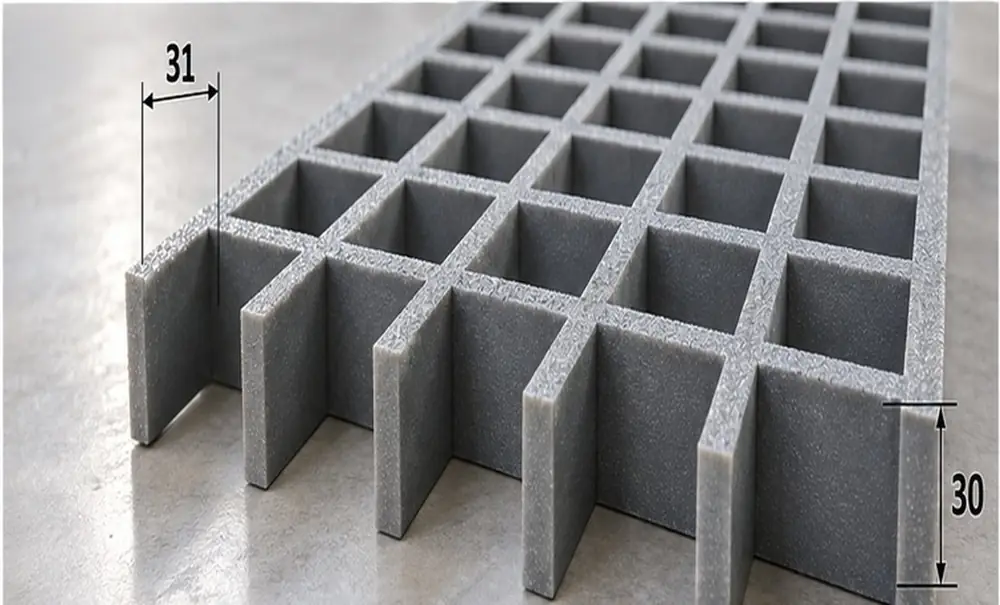
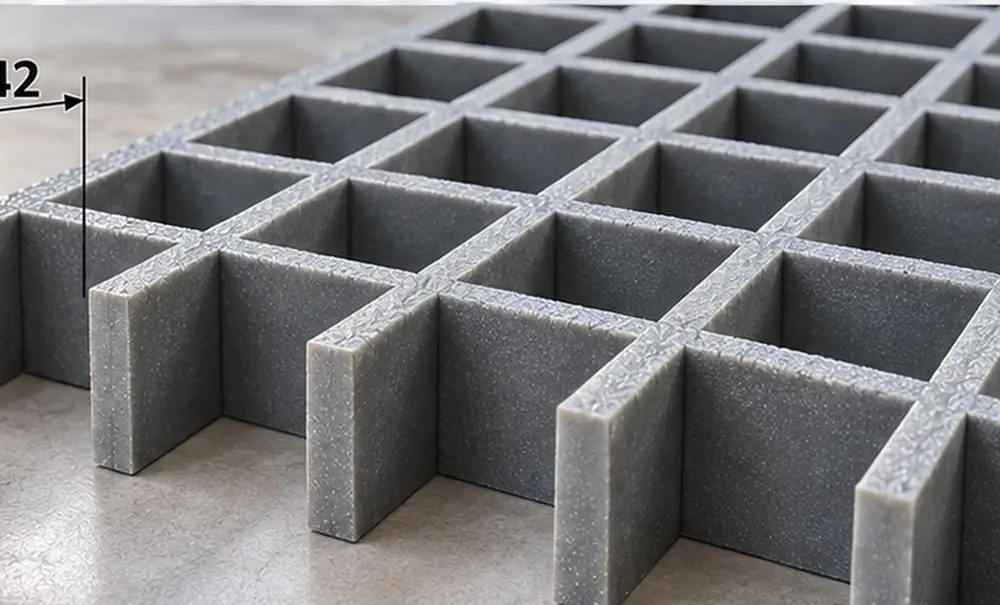
| Core height | 25, 30, 38 and 50 mm | Grating height (thickness) and load capacity |
| Core pitch (mesh) | 38×38 and 50×50 mm | Number of bars per meter and percentage open area |
| Core wall taper | A few degrees of draft | Easy panel release; bar cross-section slightly tapered (wider at the top) |
| Heating system | Hot water or hot oil circulation channels | Uniform cure over the whole panel area |
Molded grating production steps: making grating step by step
Molded grating is produced in ten main steps. Steps 3 and 4 (laying fiber and resin impregnation) are repeated several times until the mold voids are completely filled:
- Preparation: roving and formulated resin
- Mold cleaning: removing residue from the previous run and applying release agent
- Laying fiber: continuous roving through the mold grooves
- Resin impregnation: resin distribution and pressing
- Curing: about 100 °C, about 2 hours
- Polishing: smoothing one surface
- Repair and touch-up: quality control and correction with resin
- Cleaning up: sanding and removing flash
- Cutting: to the customer's drawing
- Packing and shipping: palletizing and transport
1. Preparing raw materials
The first step in producing FRP grating is preparing the roving and resin. Roving bobbins are placed on the creel, and the resin is prepared in a mixing tank according to the order's application (isophthalic polyester, vinyl ester or fire-retardant grade) together with fillers, pigment, UV additive and cure initiator. Accurate weighing of the components is essential for repeatable color and properties in each batch.
2. Mold cleaning
Before each production run, the mold must be cleaned thoroughly with special cleaning agents. Any flash or residue left from the previous run causes stains and unevenness on the surface of the new part. After cleaning, a release layer is applied to the cores so the cured panel releases easily from the mold.
3. Laying roving through the mold
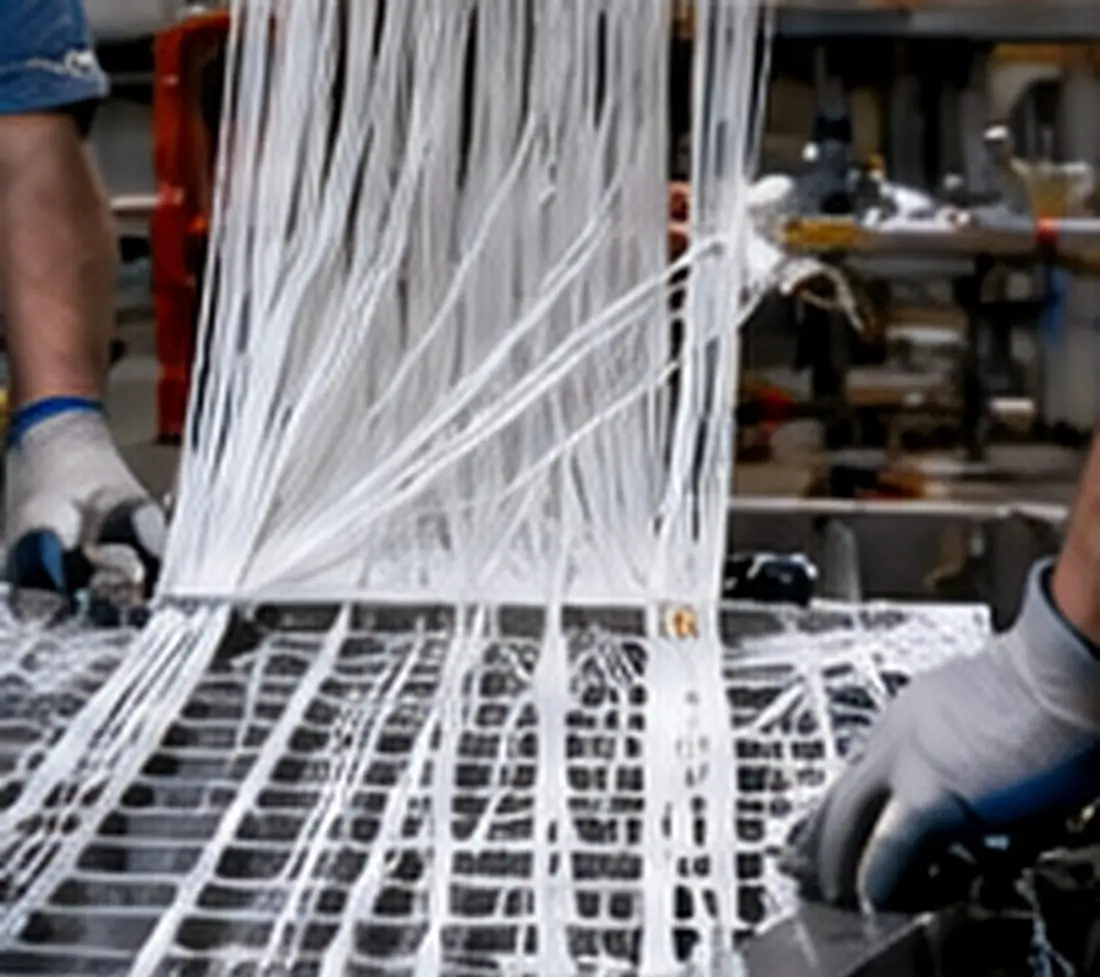
At this step, the operator lays continuous roving strands through the mold grooves in a defined order: one layer lengthwise and the next crosswise. This alternating layup interweaves the fibers where the bars intersect and produces an integral panel with almost equal strength in both directions — the advantage that sets molded grating apart from pultruded grating. Continuity of the strands from one edge of the panel to the other is the main source of grating strength. Wherever a strand is broken, that point becomes a weak spot in the part, so operator skill at this step is decisive.
4. Resin impregnation and pressing
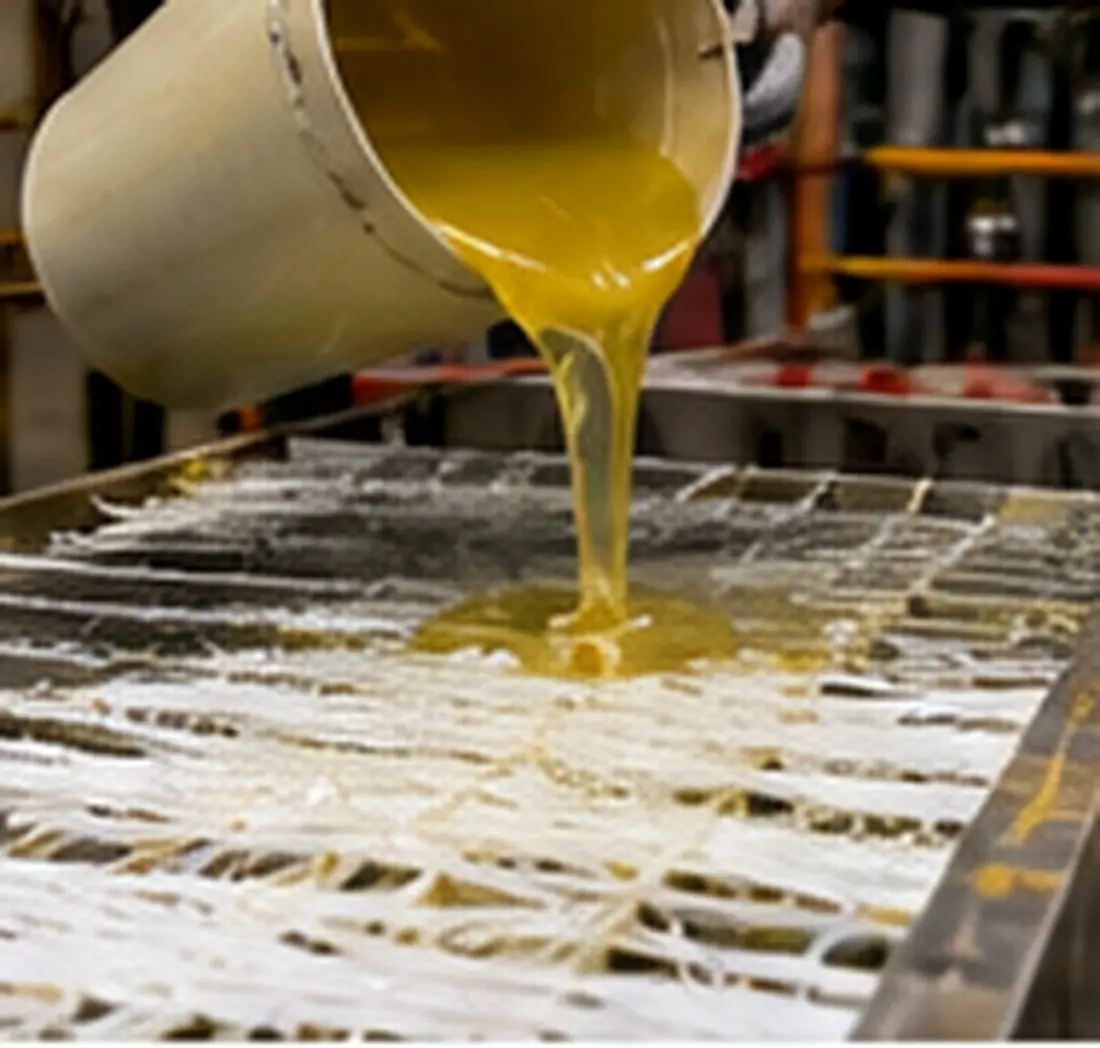
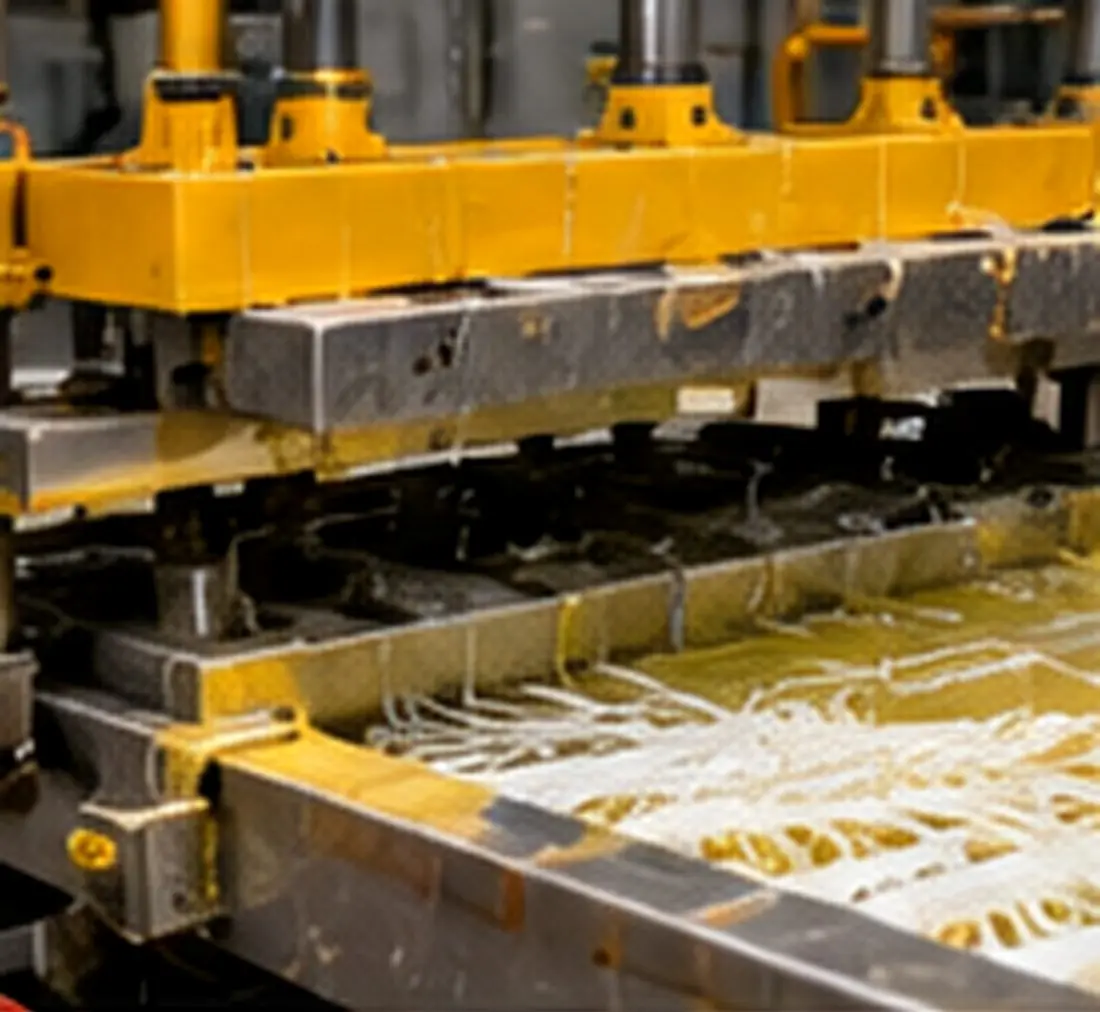
The prepared resin is distributed over the laid fibers. Then, for complete wet-out, the whole mold is placed under special presses so the resin penetrates deep into the fiber bundles and trapped air escapes. Fiber laying and resin distribution are repeated several times until the mold grooves are filled to the full height of the cores. Press pressure both completes the wet-out and keeps fiber content in the design range (about 35 percent by weight).
5. Curing the grating
At this step, once the mold is completely filled, hot water or hot oil circulating through the mold channels raises its temperature to about 100 °C. After about 2 hours, the grating is fully cured and removed from the mold. Compared with curing at ambient temperature, heat curing gives a higher degree of cure, greater Barcol hardness and better chemical resistance. Gradual cooling before demolding prevents the panel from warping.
| Process parameter | Typical value | Consequence of error |
|---|---|---|
| Mold temperature during cure | About 100 °C | Too low: incomplete cure; too high: cracks and bubbles |
| Cure time | About 2 hours | Too short: low hardness and styrene odor |
| Fiber weight fraction | approx. 35% | Too low: low strength; too high: incomplete wet-out |
| Heating medium | Hot water or hot oil | Uneven distribution: panel warping |
Note 2 — grit coating: at the customer's request, the surface of GRP grating is coated with sand (grit) to increase roughness and prevent slipping. This is sometimes done before cure and sometimes after cure (with an adhesive resin layer). The material, grading and embedment depth of the sand or grit (usually silica or aluminum oxide) determine the roughness and durability of the anti-slip surface; sand that merely sits on the surface comes off quickly under traffic.
6. Polishing
At this step, after the part is demolded, one surface of the grating is ground down a few millimeters with a polisher and grinder until it is completely smooth. The other surface naturally has a concave unevenness (meniscus) created by resin shrinkage at the top of the grooves. This concave surface is a natural anti-slip surface that prevents slipping when walking. So, depending on the application, the buyer can install the grating with either the smooth or the concave surface facing up. Excessive grinding must be avoided, because it reduces the effective height and load capacity of the grating; the concave surface is also the safer option on wet and oily routes.
7. Repair and touch-up
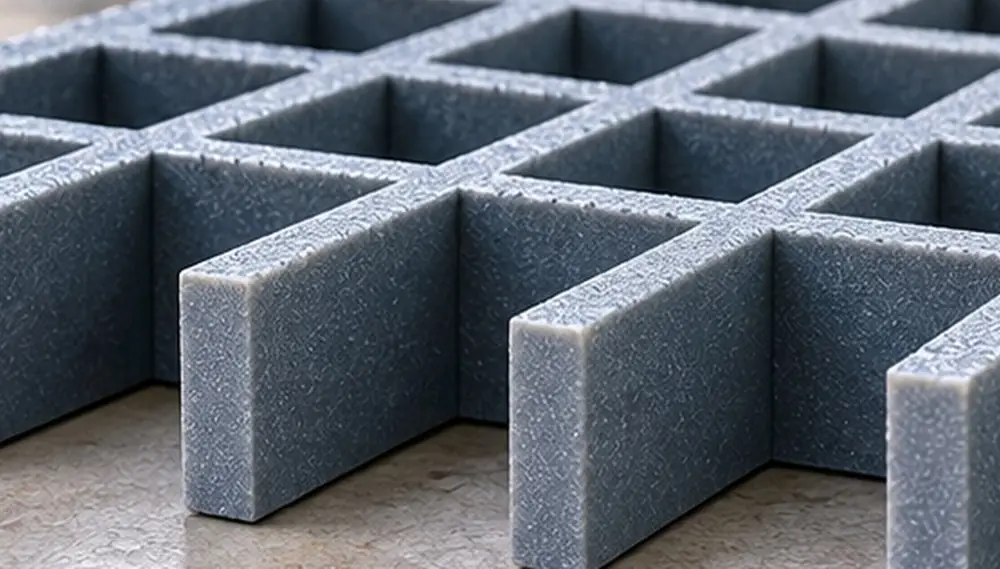
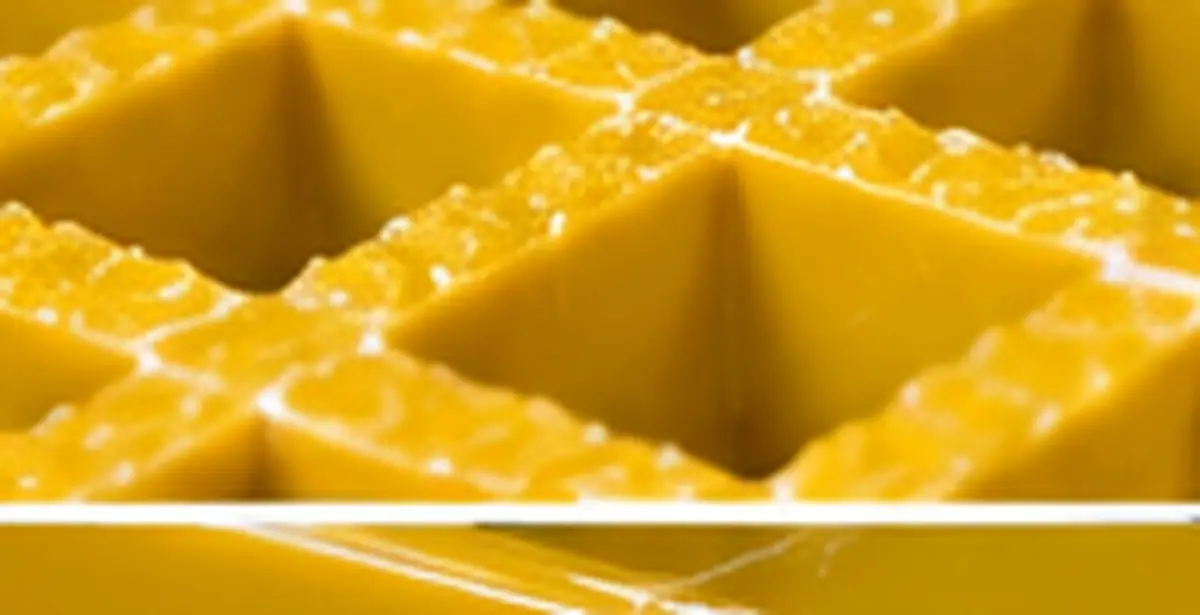
The finished fiberglass grating may have stains, small pores or surface defects in places. All surfaces are inspected by the quality control officer before delivery, and defects are carefully corrected with matching-color resin. The glossy, resin-rich surface in the adjacent image is a sign of complete fiber wet-out and proper cure.
8. Cleaning up
At this step, any flash left from the various production stages, such as resin burrs on edges and protruding fibers, is removed with sandpaper and special tools so the part is safe to handle and install.
9. Cutting
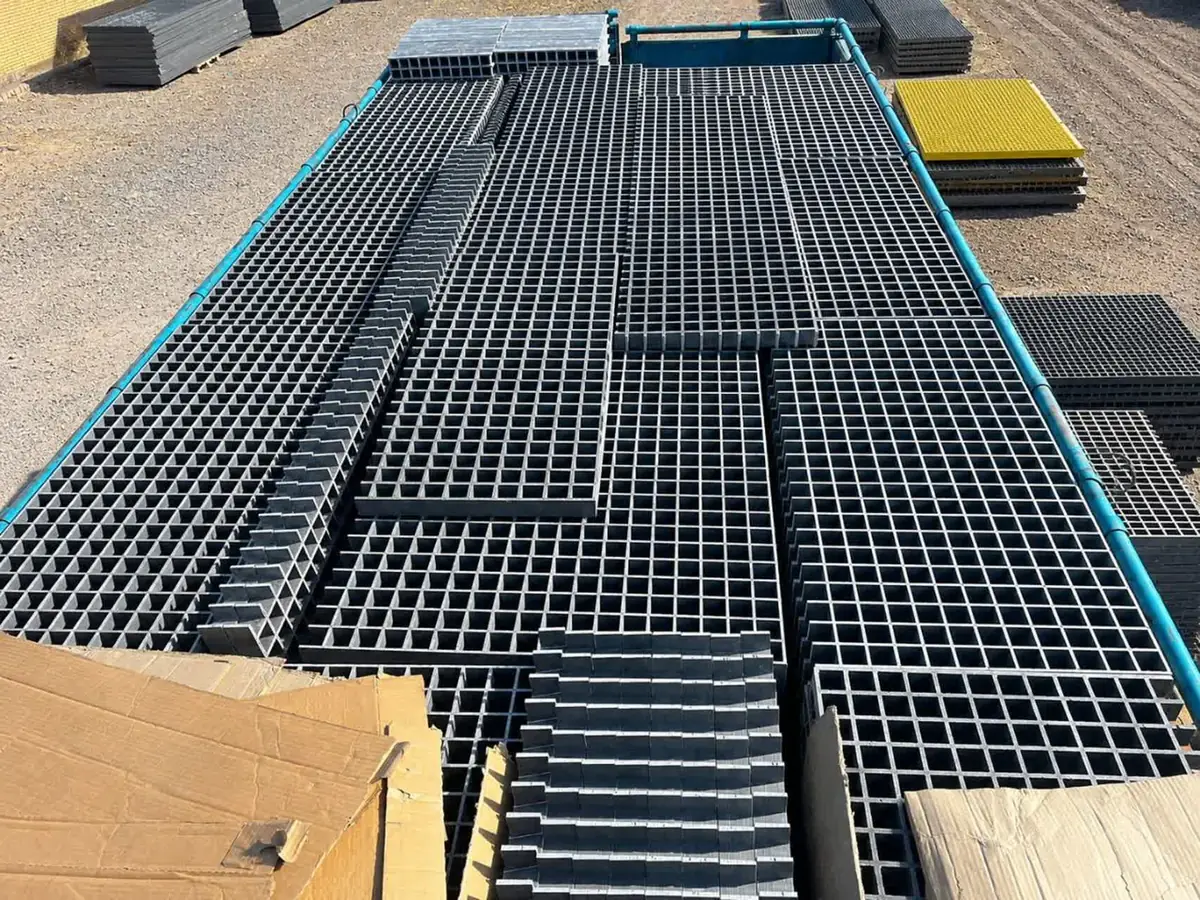
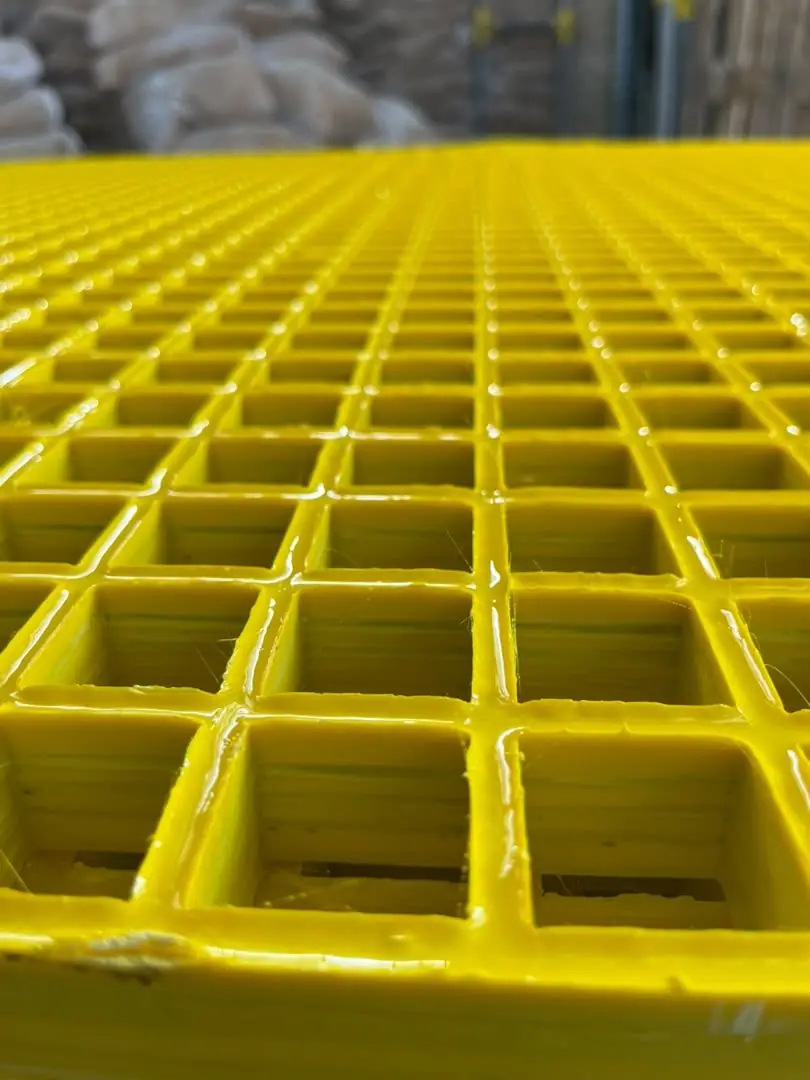
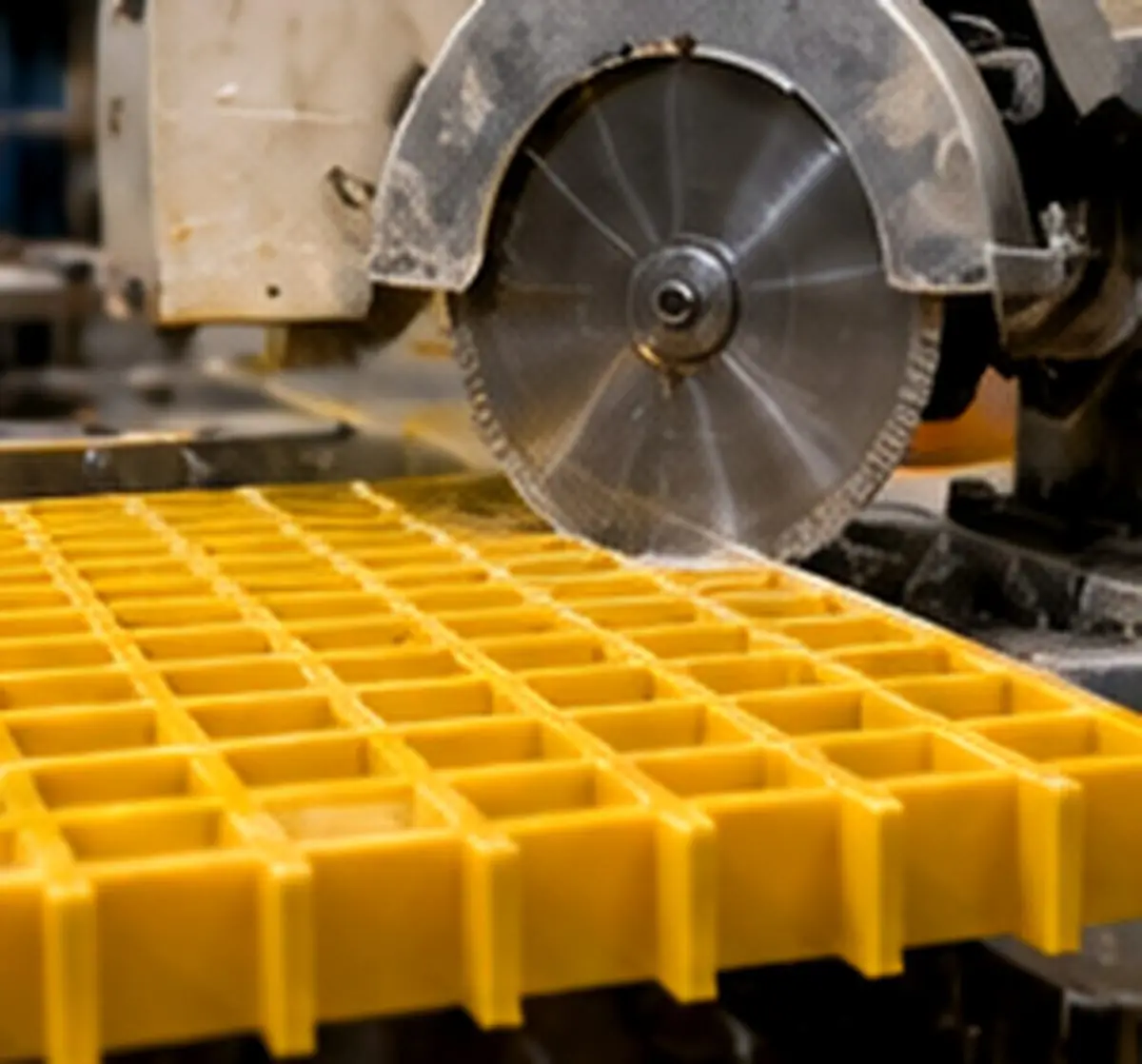
At this step the composite grating panels are cut. The standard composite grating panel is produced at 122 × 366 cm and at this stage is cut to the dimensions and drawings the customer requires. For small amounts of cutting a manual hacksaw can be used, but for industrial cutting a cutting machine with a diamond or carbide disc is recommended; an ordinary grinding disc wears quickly against glass fiber, whereas a diamond or carbide disc gives a clean edge without fraying the fibers. Cut edges, especially in corrosive environments, must be sealed with resin. The full method is in the article cutting composites.
Cutting optimization (nesting): since all pieces are cut from a 1220 × 3660 mm panel, the choice of piece dimensions and beam spacing directly affects waste and therefore final cost. The example below compares two designs:
10. Packing and shipping
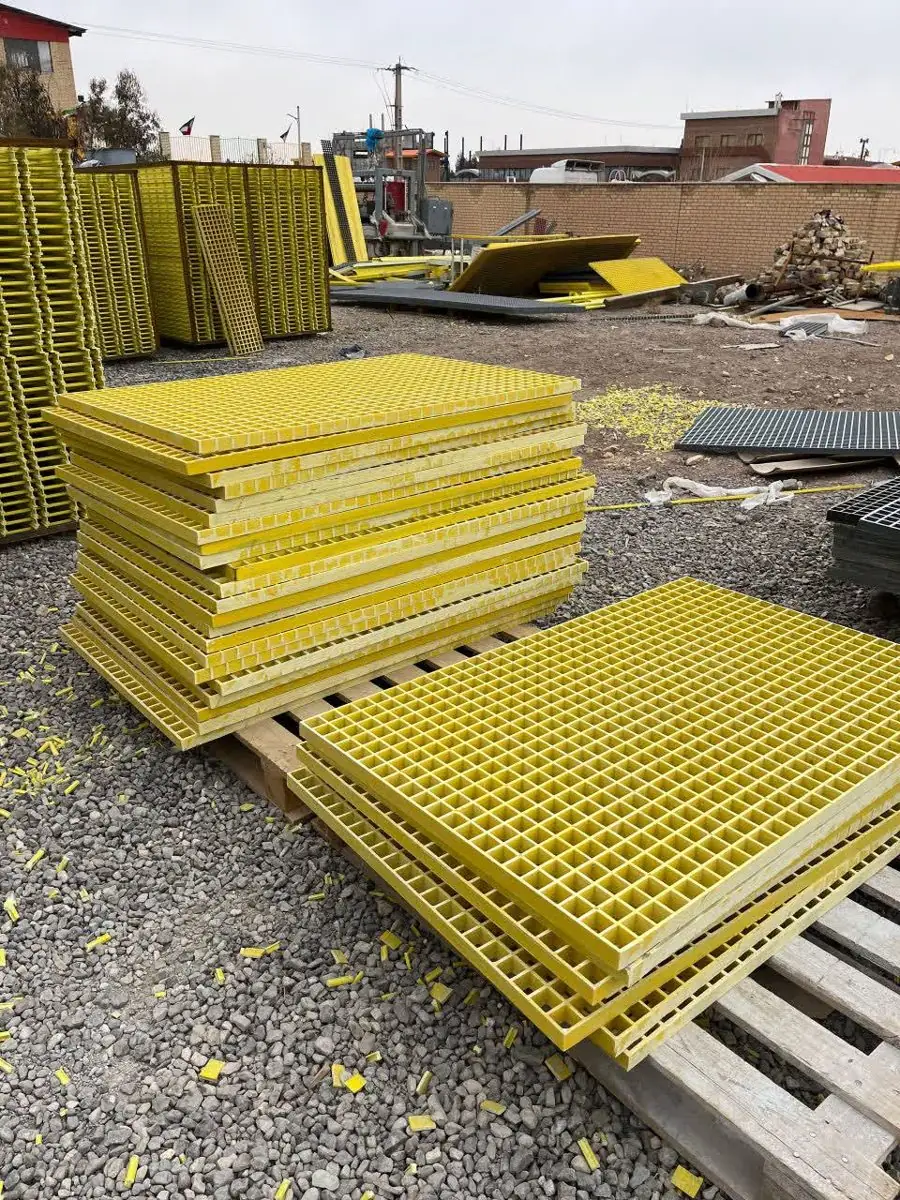
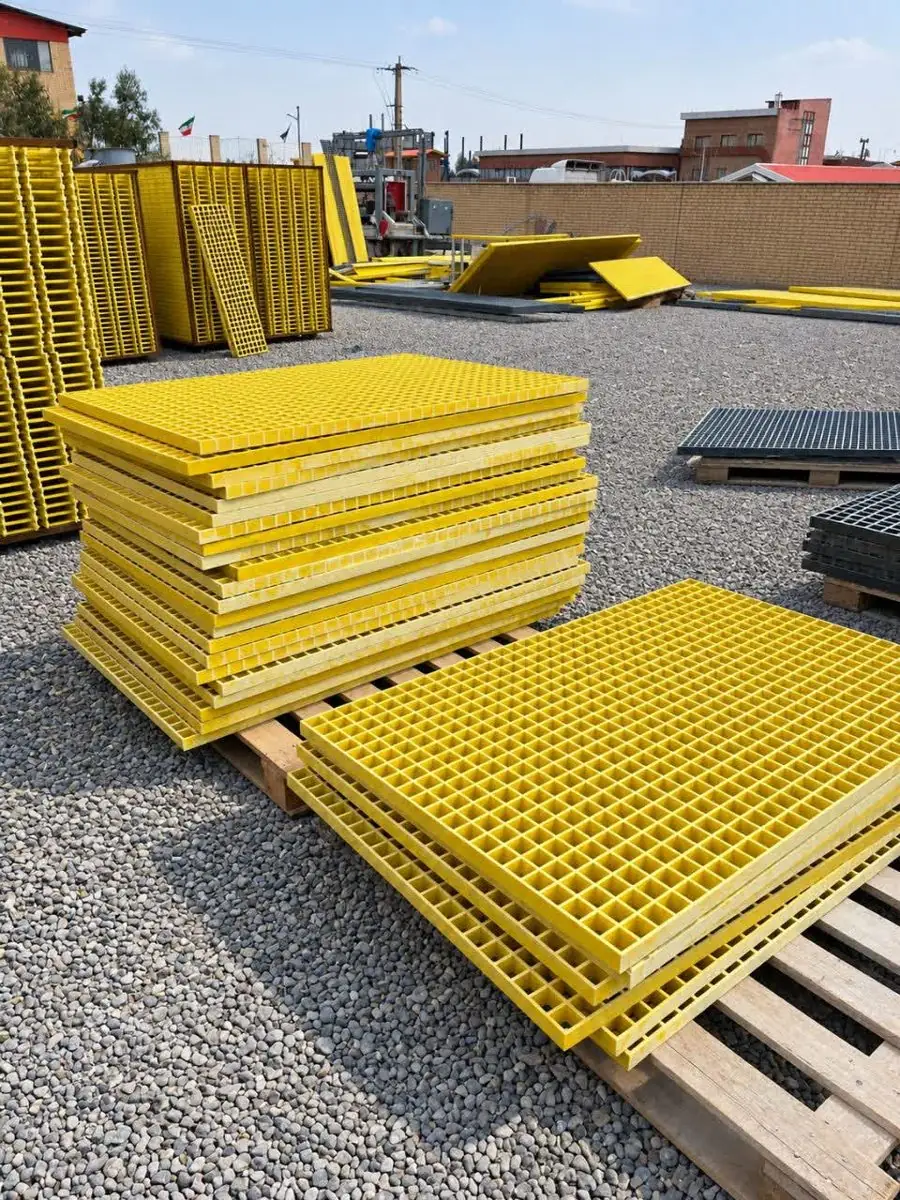
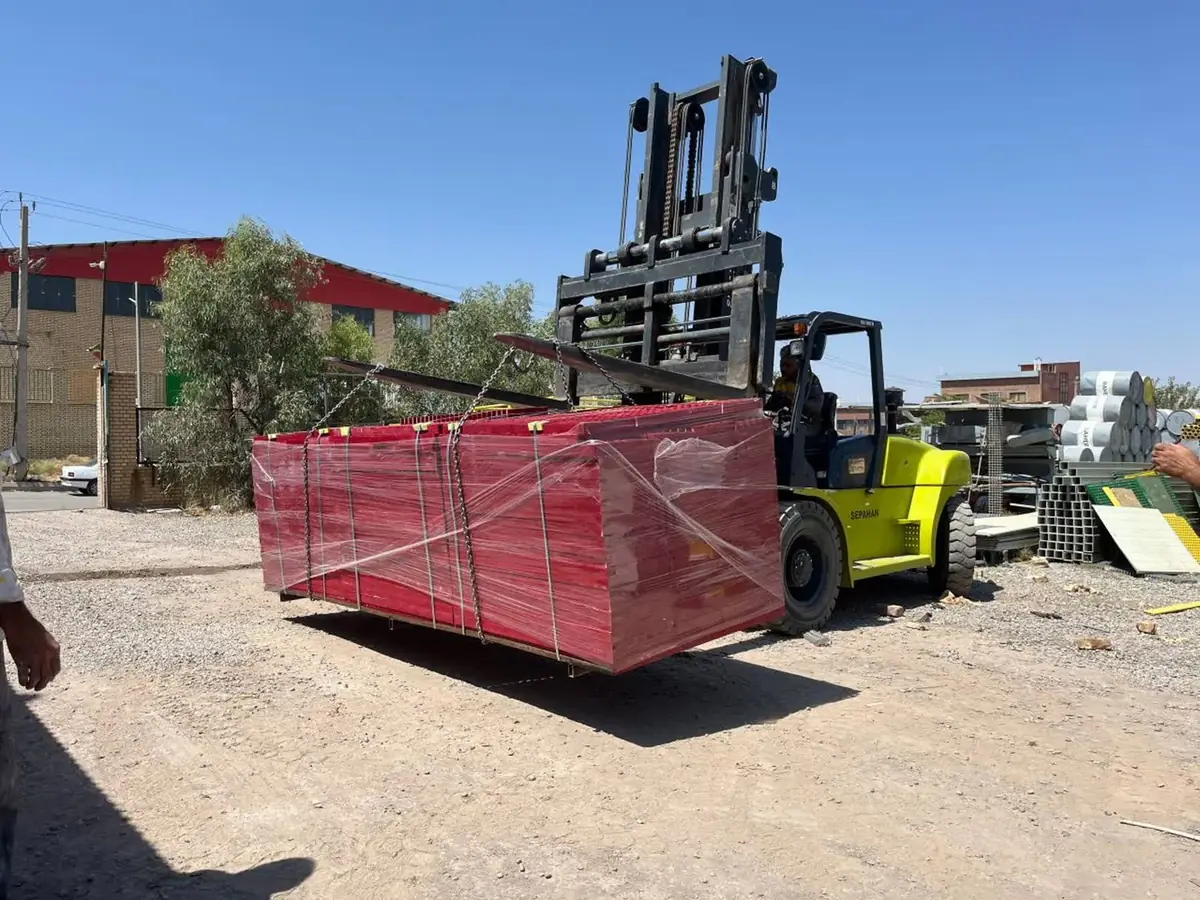
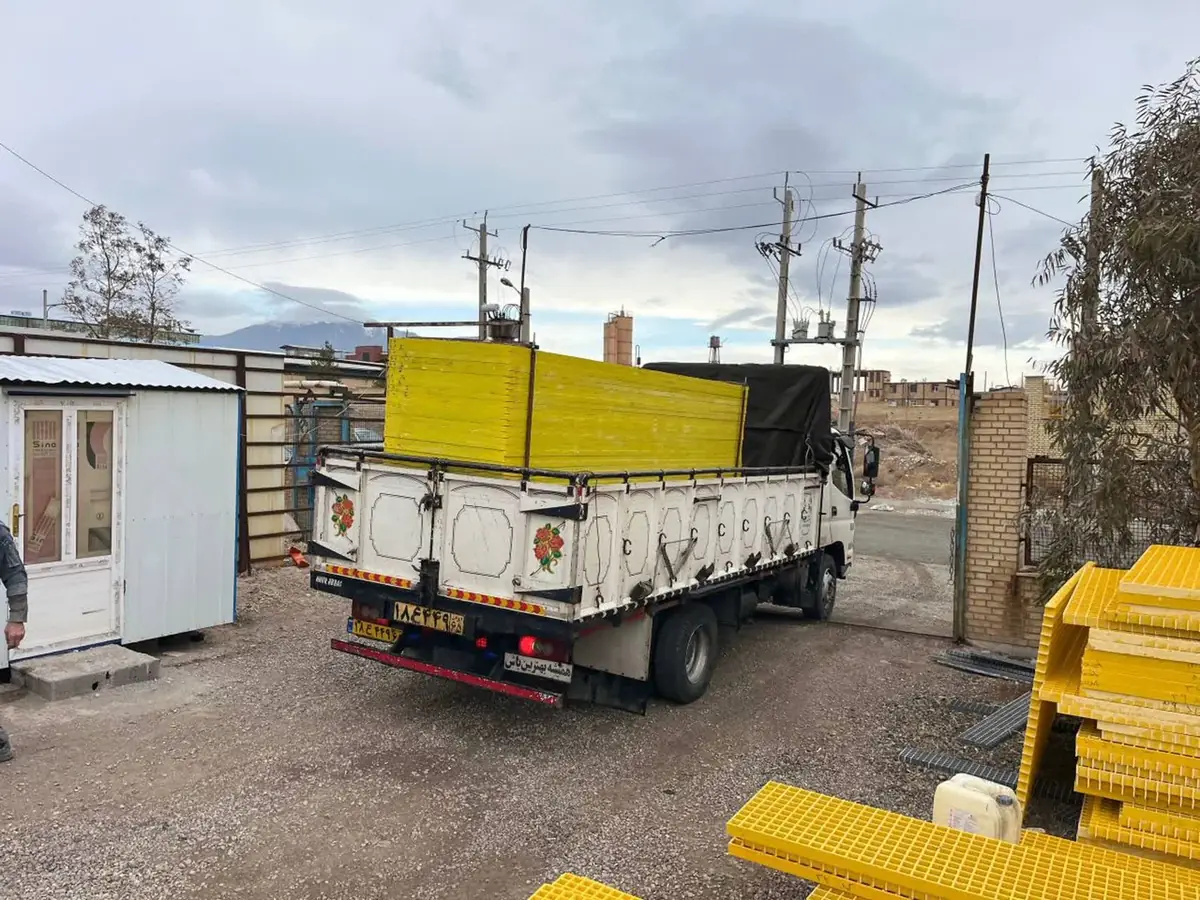
The last step in producing FRP grating is packing. Depending on the grating size and height, the product is stacked on wooden pallets, strapped and stretch-wrapped, and then shipped to the project site by carrier, pickup or dedicated truck. Panels must be stacked on a flat surface with enough supports so they do not warp in transit, and covered with UV-protective sheeting for long-term outdoor storage.
How pultruded grating is produced
The production method for pultruded grating is completely different from molded grating. Pultruded grating consists of a series of parallel I-shaped (or T-shaped) profiles held at a fixed spacing by parallel cross bars. Both the I-profiles and the cross bars are produced by pultrusion: roving and mat pass through a resin bath and are shaped in a heated die. Once the composite profiles are ready, their webs are drilled at set intervals, the cross bars are passed through the holes and fixed with epoxy adhesive or a mechanical lock, and the assembly becomes a pultruded composite grating.
| Criterion | Molded grating production | Pultruded grating production |
|---|---|---|
| Process | One-piece molding with pressing and heat curing | Profile pultrusion + assembly |
| Fiber weight fraction | approx. 35% | About 60 to 70% in the profiles |
| Direction of strength | Bidirectional | Mainly in the direction of the load-bearing bars |
| Chemical resistance | Excellent (more resin) | Good to excellent |
| Panel size | Fixed (mold size) | Length can be chosen |
| Typical use | Platforms, walkways, trenches, corrosive environments | Long spans and heavy loads |
Materials used in grating production
a) Reinforcing fibers
In molded composite grating production, the fiber used is exclusively continuous roving, making up about 35 percent of the grating's weight. The fiber is normally glass fiber (E-glass); production with carbon and Kevlar (aramid) fibers is also possible but not usual because of the high price. Carbon fiber grating is much stiffer but conducts electricity; Kevlar grating has excellent impact resistance but is sensitive to ultraviolet light. That is why glass fiber gives the best balance of price and properties in composite grating. To learn more about fiber types, see the article types of fiber in composites.
b) Resin
The resin type is very important in grating production, because the grating's main property — resistance to corrosion and chemicals — depends on the resin. The resins used are polyester resins (isophthalic or orthophthalic) or vinyl ester resin:
| Resin type | Corrosion resistance | Recommendation for grating production |
|---|---|---|
| Ortho polyester | Low | Not recommended for composite grating production because of low chemical resistance |
| Iso polyester | Good | The most common resin; suitable for most chemical environments, mineral acids of moderate concentration and salts |
| Vinyl ester | Excellent | Severely corrosive environments such as concentrated acids, alkalis and salts |
To choose a resin for specific chemical environments, read the article FRP grating buying and selection guide.
c) Fillers and additives
Besides resin and fiber, several groups of additives are used in composite grating formulations. The amounts of calcium carbonate, talc powder and aluminum hydroxide must be balanced; too much filler raises resin viscosity, makes fiber wet-out difficult and reduces resistance to corrosion and chemicals. A UV-absorbing additive is also essential for gratings installed outdoors.
| Group | Examples | Role in grating |
|---|---|---|
| Mineral fillers | Calcium carbonate, talc powder | Lower shrinkage, better surface and lower cost |
| Flame retardant | Aluminum hydroxide (ATH) | Fire retardancy and smoke reduction; releases water when heated |
| Cure initiator | Organic peroxides such as MEKP or tert-butyl peroxybenzoate | Starting the resin cure reaction at mold temperature |
| Other additives | Pigment, ultraviolet (UV) absorber | Through-color and outdoor durability |
| Surface coating | Spray-applied topcoat | Additional protection on some orders |
Quality control in grating production
Every polymer grating piece must be inspected before shipment. Besides visual inspection, a quality composite grating should pass the following tests:
| Test | Purpose | Common acceptance criterion |
|---|---|---|
| Dimensional inspection | Height, mesh, flatness and squareness | Within order tolerance |
| Barcol hardness | Checking complete cure | Close to the resin datasheet value |
| Burn-off test (fiber content) | Checking fiber-to-resin ratio | About 35% by weight for molded grating |
| Sample load test | Verifying load capacity and deflection | Per the load table |
| Surface and roughness inspection | Stains, pores, dry fibers, cracks and roughness of grit-coated surface | Defect-free or repaired with resin |
Comparing composite grating and metal (galvanized) grating
Because of its resin matrix, fiberglass or polymer grating has properties completely different from steel. Composite grating production yields a product that behaves differently from metal grating. Under impacts and falling objects, composite grating behaves differently: the polymer matrix damps the impact energy and the panel returns to its original shape, whereas metal and galvanized grating suffers permanent deformation and denting, and its galvanized layer is damaged.
| Feature | FRP composite grating | Galvanized metal grating |
|---|---|---|
| Weight | About one third to one quarter | Heavy |
| Corrosion | Inherently resistant; no painting needed | Corrosion once the zinc layer is damaged |
| Impact behavior | Impact damping and return to original shape | Permanent deformation |
| Electrical and magnetic conductivity | Insulating and non-magnetic | Conductive and magnetic |
| Cutting and installation | With simple tools, no welding | Requires welding and re-galvanizing of edges |
| Maintenance cost | Very low | Periodic painting and repair |
Grating production at Nabak Composite
Nabak Composite produces molded grating in 25, 30, 38 and 50 mm heights, covered grating (composite checker plate) and pultruded grating with isophthalic polyester and vinyl ester resins, in a variety of colors and with optional anti-slip grit coating. Cutting to drawings, standard packing and shipping nationwide are among Nabak's services. Each grating piece is shipped with a specification label. For fiberglass grating price quotes and to buy composite grating, contact our team.
Other Nabak composite products include fiberglass sheet, composite box sections, fiberglass angles, composite channels, composite beams, fiberglass tubes, composite flat bars, polymer rods, composite wire and cable trays and ladders. Together with composite grating, these products form a complete corrosion-proof structure — for example a grating platform on composite beams with a handrail of fiberglass tube, and composite cable trays and ladders on electrical routes. Fiberglass roofing sheet, polymer rods and composite wire are also used in construction and agricultural projects.
Frequently asked questions about grating production
How is molded FRP grating produced?
In molded grating production, continuous roving is laid layer by layer in two directions through the grooves of a metal mold with cores, resin is distributed over the fibers and forced into them by pressing, then the mold is heated with hot water or hot oil to about 100 °C, and after about 2 hours the cured panel is removed from the mold.
What is the standard size of a composite grating panel?
The standard molded grating panel is produced at 1220 × 3660 mm (122 × 366 cm) in heights of 25, 30, 38 and 50 mm, and is then cut to the customer's drawing.
What is the difference between producing molded and pultruded grating?
Molded grating is made in one step as a single piece in a mold, whereas pultruded grating is assembled from pultruded I-profiles and cross bars; the profiles are first produced by pultrusion and then assembled.
What resin is suitable for grating production?
Isophthalic polyester resin is the most common resin for grating production and is used in most chemical environments. Vinyl ester resin is used for severely corrosive environments. Orthophthalic polyester resin is not recommended for grating production because of its low chemical resistance.
What percentage of molded grating weight is fiber?
In molded grating, glass roving makes up about 35 percent of the product weight, and the rest is resin, mineral fillers and additives; this high resin content gives molded grating its excellent chemical resistance.
Summary
Molded composite grating is produced in ten steps: preparing materials, cleaning the mold, laying roving, resin impregnation with pressing, heat curing at about 100 °C, polishing, repair and touch-up, cleaning up, cutting and packing. Covered grating is made by adding a 3 mm layer by hand, and pultruded grating by assembling pultruded profiles. Final quality depends on an accurate mold, suitable resin (isophthalic polyester or vinyl ester), controlled fiber content, complete cure and careful quality control. Knowing how grating is made helps you order FRP grating and other fiberglass open-mesh panels with confidence and be sure of their quality.

This article was prepared by the technical team of Nabak Composite, a manufacturer of FRP grating and composite products.