Why does choosing FRP grating need a guide?
Experience from industrial projects and operator feedback shows that the biggest challenge for buyers of composite grating is not the product itself but choosing the right grating among many options: FRP grating type (molded, covered molded or pultruded), fiberglass grating height and mesh size, resin type (orthophthalic polyester, isophthalic polyester or vinyl ester), fire and UV additives, and finally the color of the FRP composite grating. A wrong choice of any of these parameters can lead to excessive deflection and a feeling of insecurity underfoot, loosening of clips, premature corrosion or extra cost.
In this article, with an engineering approach based on laboratory data, we set out a clear decision path for buying grating, so that after reading it you can choose the right option from the load tables with two key figures: the distance between supports and the load.
Composite grating compared with other gratings on the market
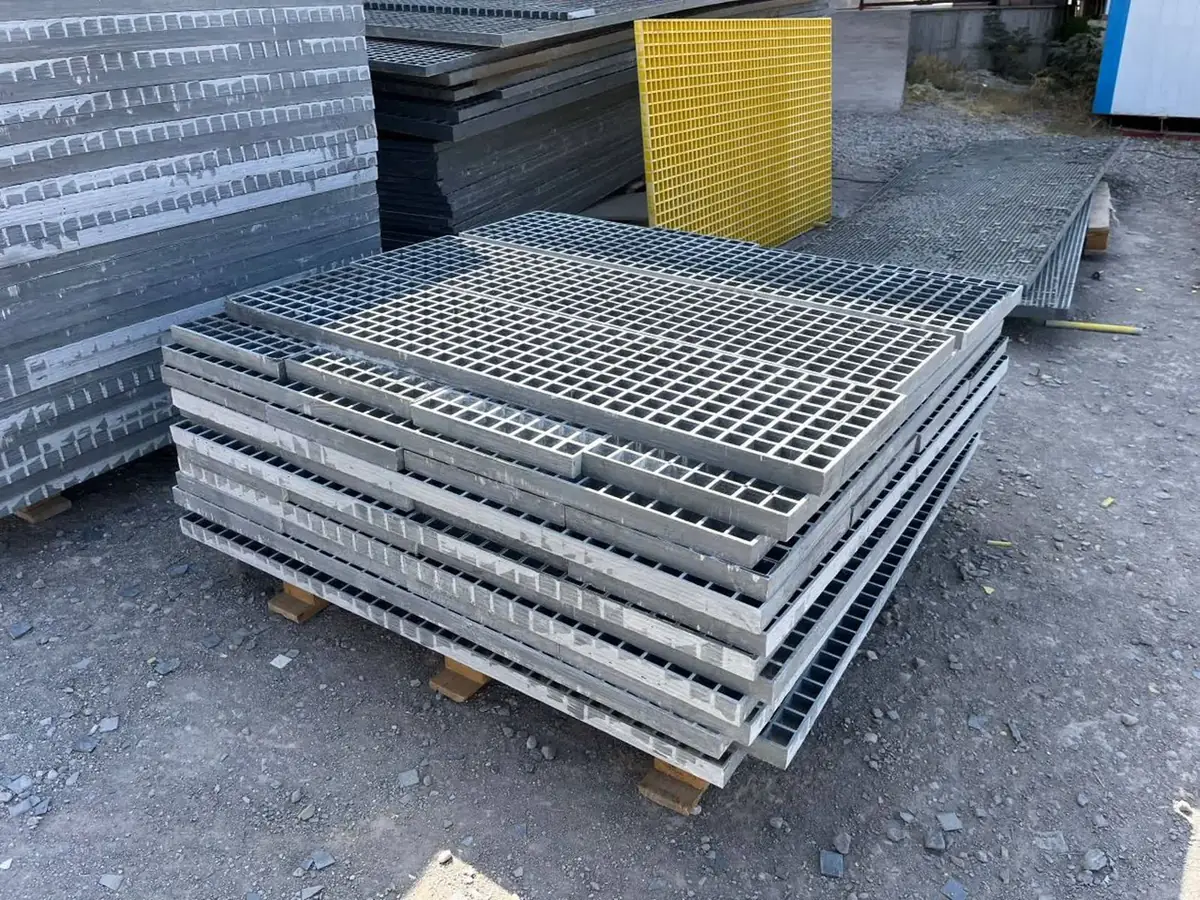
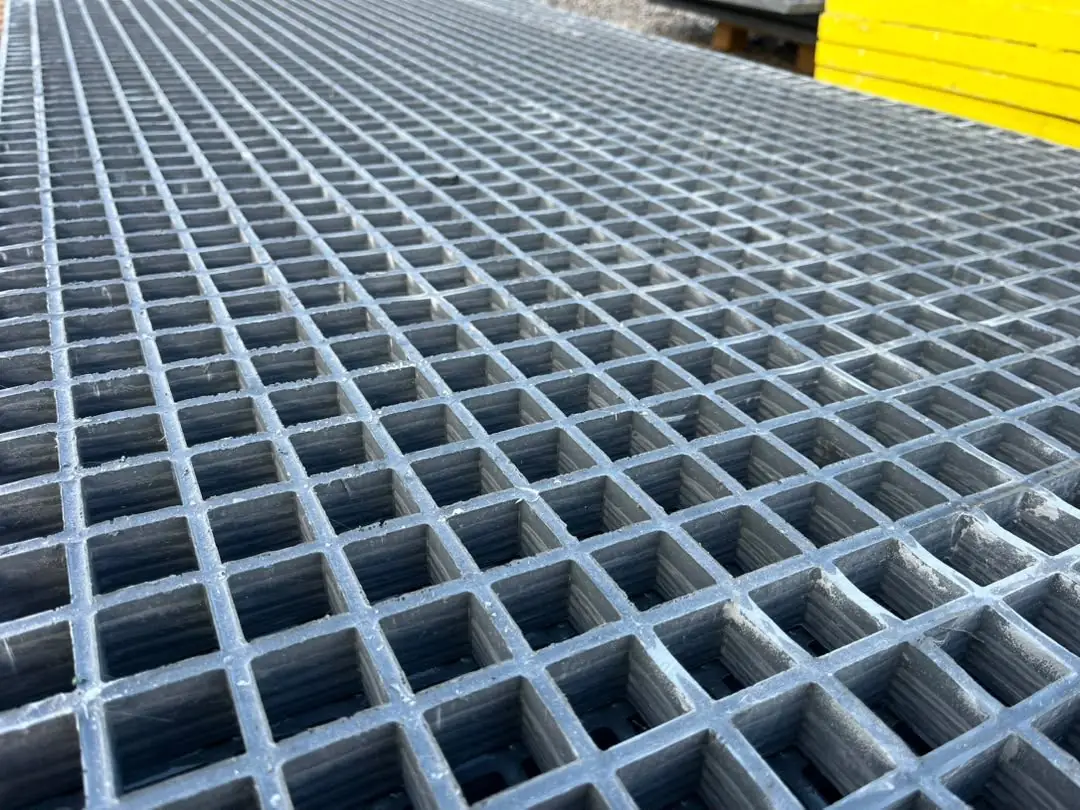
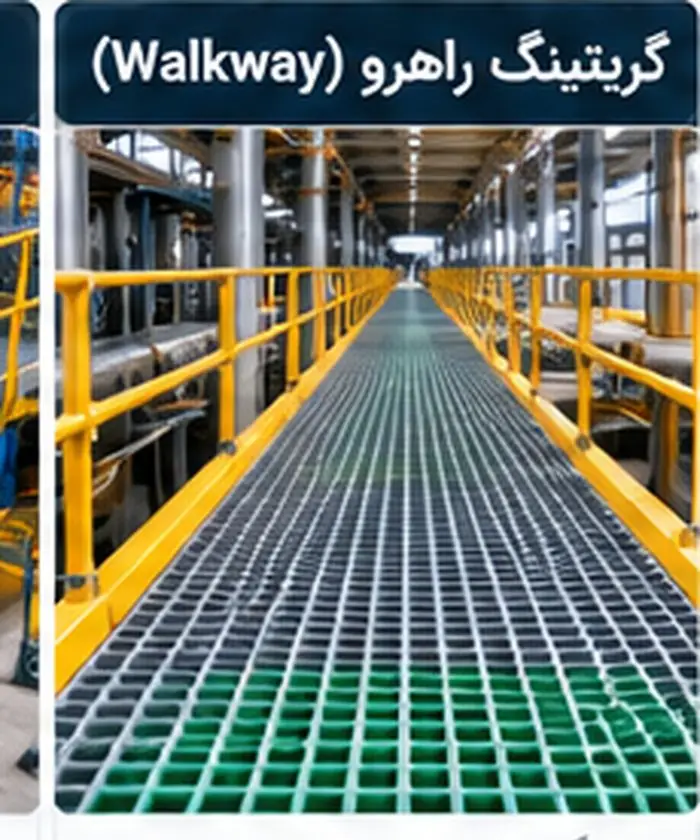
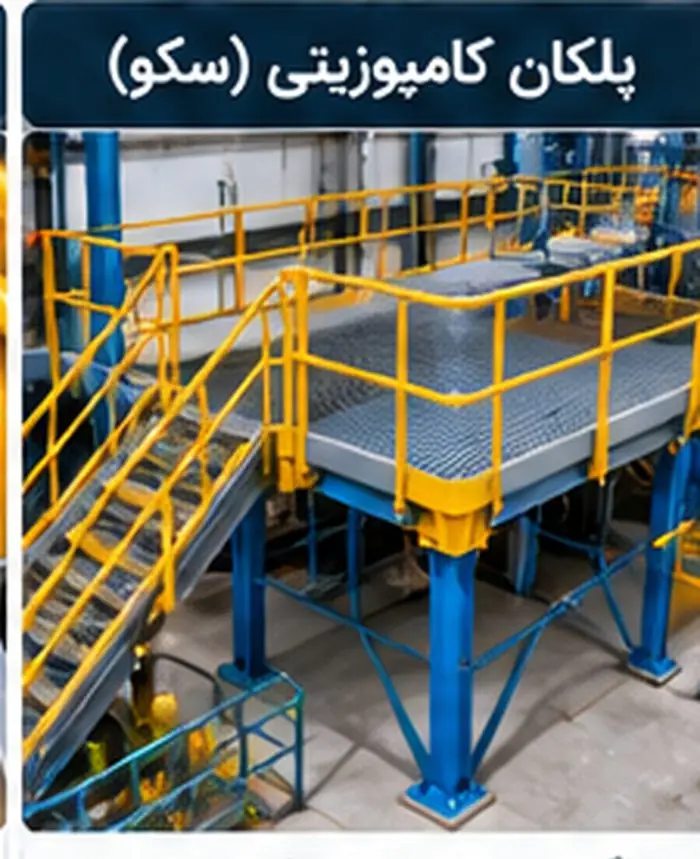
Gratings on the Iranian market are made from various materials: steel metal grating, galvanized grating, stainless steel grating, aluminum grating, cast iron grating, serrated grating (steel with a toothed edge) and composite grating. Among these, FRP grating (also known as GRP grating, GFRP grating, fiberglass grating and polymer grating) has become one of the best choices for industrial and urban applications because of its low weight, inherent corrosion resistance, insulation and favorable life-cycle cost.
| Grating material | Weight | Corrosion resistance | Electrical conductivity | Maintenance |
|---|---|---|---|---|
| Steel metal grating (painted) | High | Poor | Conductive | Periodic painting |
| Galvanized and serrated grating | High | Medium (until the zinc layer is damaged) | Conductive | Moderate |
| Stainless steel grating | High | Good (sensitive to chlorides) | Conductive | Low; very high price |
| Aluminum grating | Moderate | Good in neutral environments; poor in alkalis | Conductive | Low |
| Cast iron grating | Very high | Moderate | Conductive | Low; brittle |
| FRP composite grating | Low (about a quarter of steel) | Excellent, adjustable by resin choice | Insulating | Very low |
Types of FRP grating: molded, covered molded and pultruded
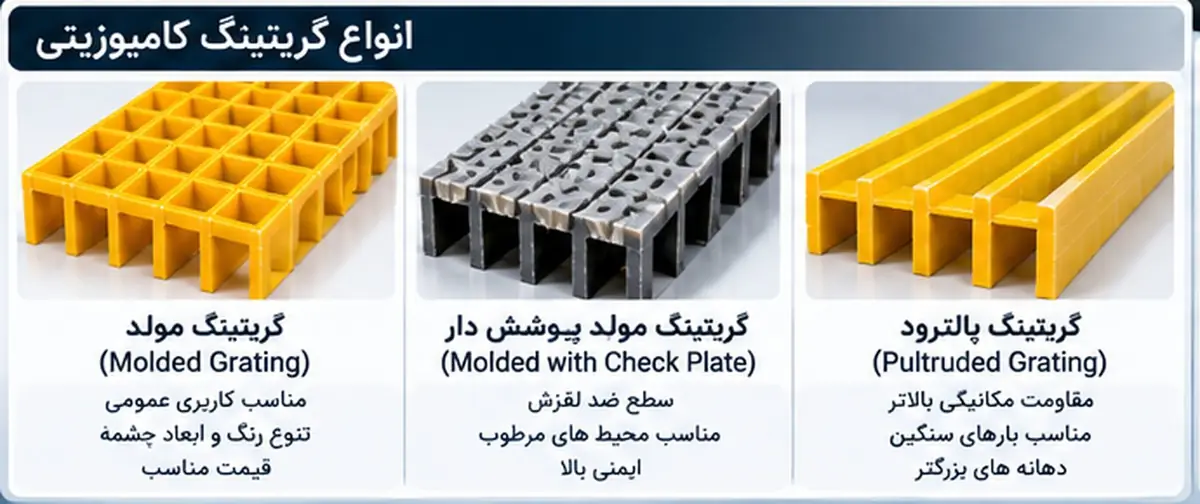
The first step in choosing grating is to decide its type. All three types of composite grating are made of glass fiber and resin, but the production method and fiber arrangement give them different mechanical behavior:
Molded grating
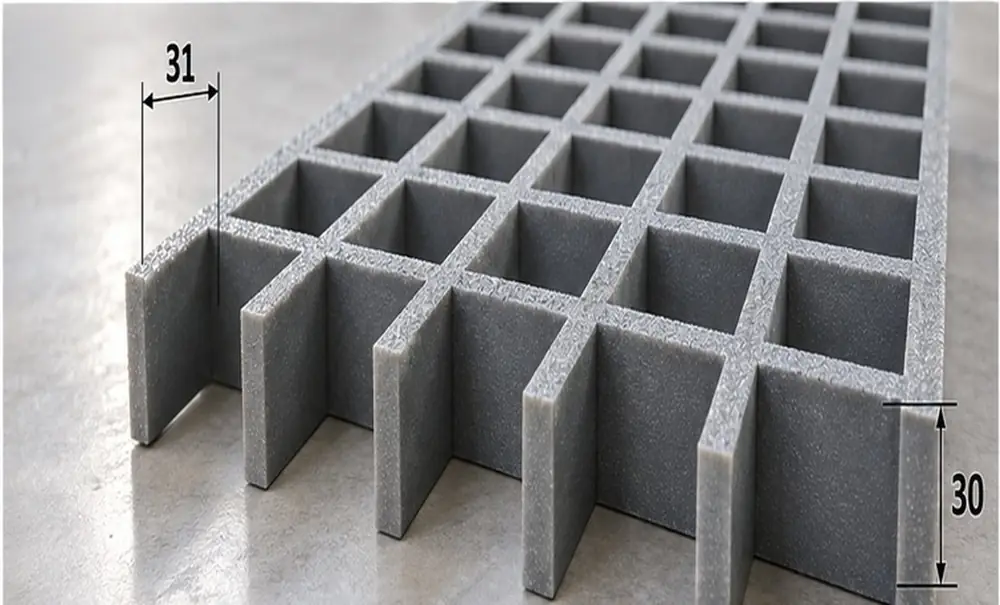
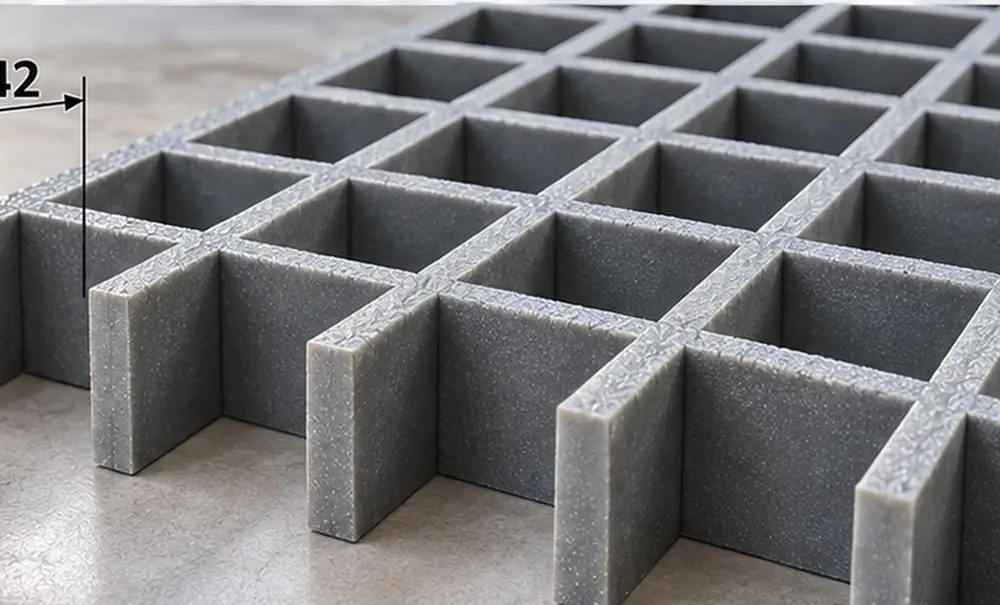
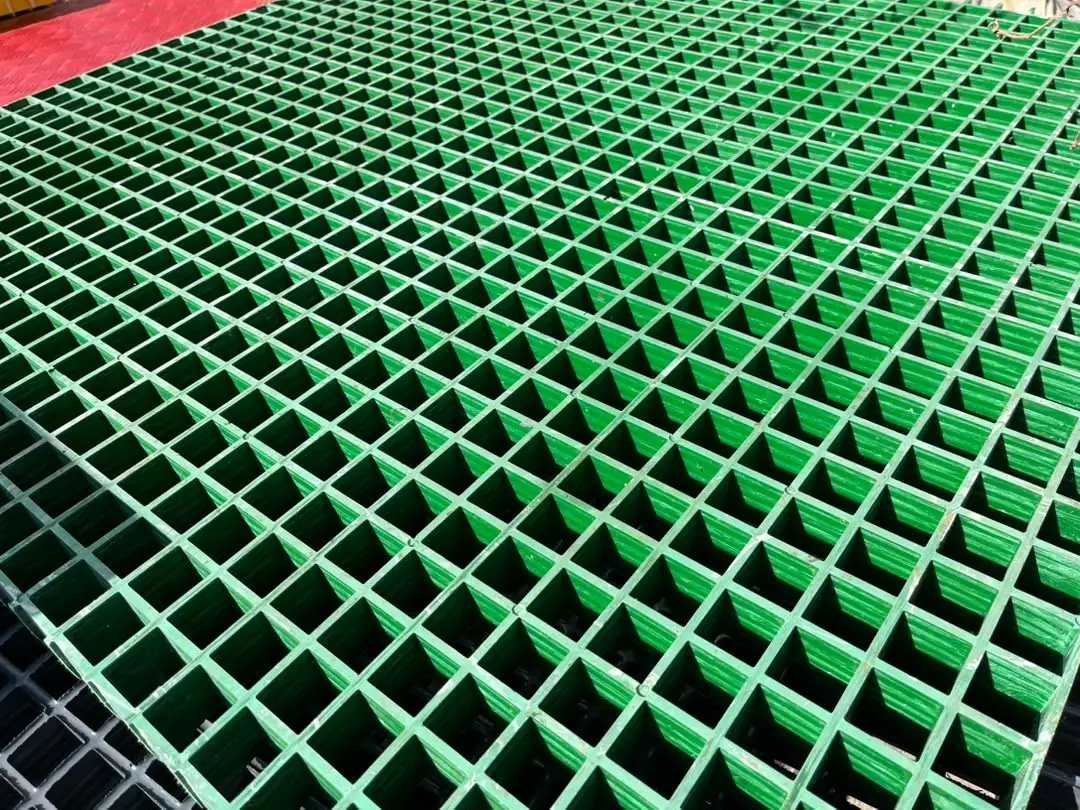
Produced as a single piece in a mold; continuous roving is laid in both directions, giving a panel with a square mesh and almost equal strength in both directions. High resin content gives excellent chemical resistance. An economical, all-purpose option for most applications.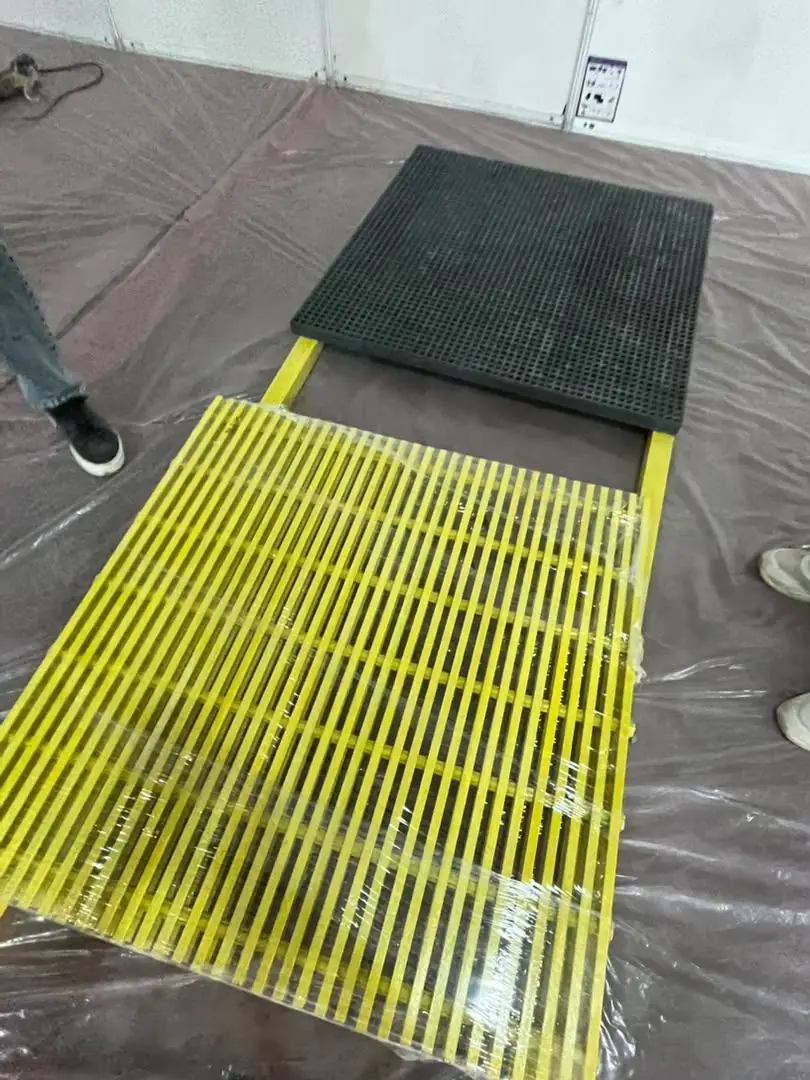
Covered molded grating (checker plate)
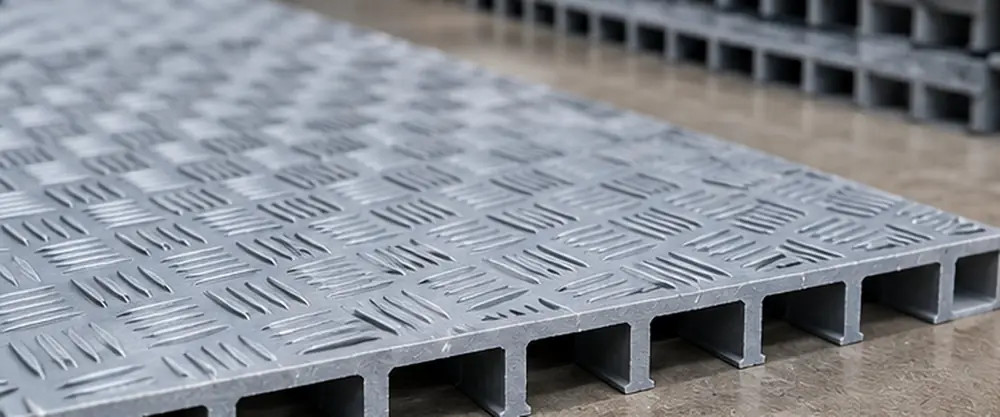
A molded grating whose surface is covered with an anti-slip composite plate (checker plate). Covered grating is chosen where small objects, liquid splashes or light from below must not pass through, or where there is traffic in heeled shoes or with trolleys.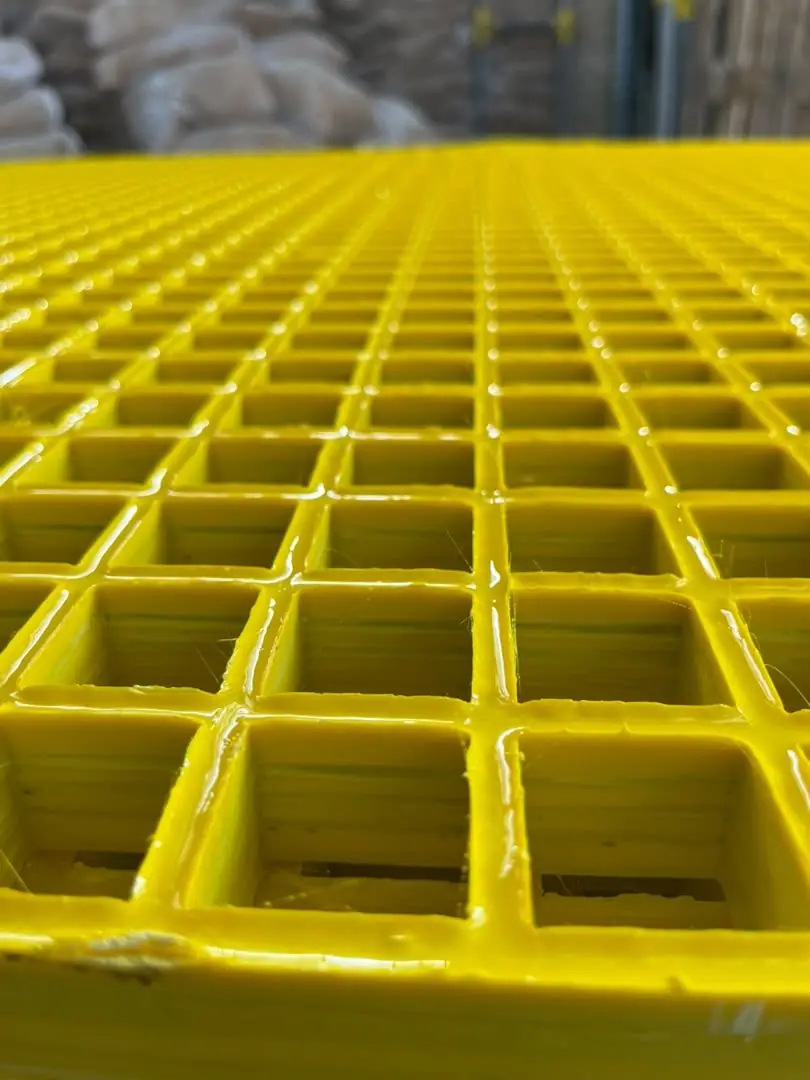
Pultruded grating
Made by assembling I- or T-shapedpultrudedprofiles with cross bars. The fibers are concentrated along the load-bearing bars, giving much higher bending stiffness; suitable for heavy loads, large spans and vehicle traffic.| Criterion | Molded grating | Covered molded | Pultruded grating |
|---|---|---|---|
| Fiber arrangement | Bidirectional | Two-way + top plate | Mainly one-way (longitudinal) |
| Stiffness and capacity at long spans | Moderate | Moderate to good | Very high |
| Chemical resistance | Excellent (high resin content) | Excellent | Good to excellent |
| On-site cutting and assembly | Easy; bars do not separate | Easy | Needs more care |
| Walking surface | Open, grooved or grit-coated | Closed and anti-slip | Open, grooved or grit-coated |
| Relative price | Suitable | Higher than molded | Higher, but economical for long spans |
Seven main criteria for selecting composite grating
Many constraints and factors play a role in using composite grating, and only by considering all of them can the best GFRP grating be chosen for each project. The most important criteria, in order of priority, are:
- Load and deflection: the load on the surface and the maximum allowable deflection at the center of the GRP grating panel
- Height: bearing bar height or grating thickness: 25, 30, 38 or 50 mm
- Surface: covered (checker plate) or uncovered
- Resin: according to the degree of corrosion and conditions of use
- Fire: if required, custom production to grade V-0 under UL94
- UV: UV-resistant additive for outdoor use
- Color: standard or custom color from the RAL chart
Bearing bar height and grating mesh size
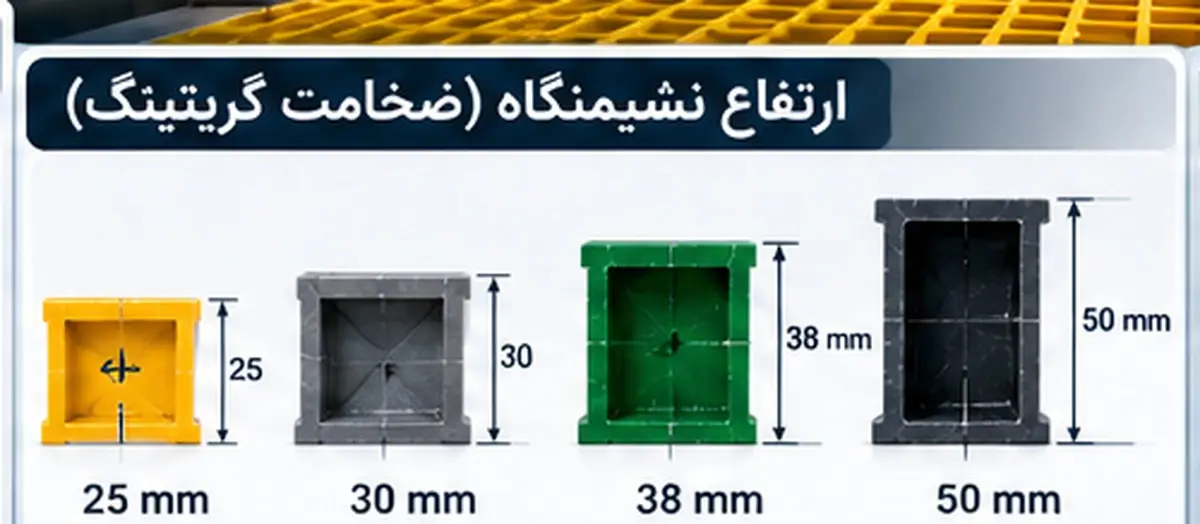
Grating height (the height of the load-bearing bars that rest on the bearing or support under the composite grating, i.e. the supporting beam or angle) is the most influential geometric parameter on stiffness, because the bars' moment of inertia increases with the cube of the height. That is why changing grating height from 38 to 50 mm increases stiffness by about 2.3 times.
| Grating height | Common mesh | Recommended use |
|---|---|---|
| 25 mm | 38×38 | Light use: pedestrian traffic, small hatches, short spans |
| 30 mm | 38×38 | General use: industrial walkways, platforms and stairs |
| 38 mm | 38×38 | Heavy use: heavy pedestrian traffic and light vehicles such as trolleys |
| 50 mm | 50×50 | Very heavy use: vehicles and large spans |
Mesh size also affects the allowable load. A smaller mesh (for example pultruded with a 10 or 15 mm opening) increases the number of load-bearing bars per meter of width, raising load capacity and stopping shoe heels and small objects from passing through; a larger mesh, by contrast, is lighter, drains water and lets light and air through better, and costs less.
Selecting grating by load
Before using load tables, we must understand four basic definitions precisely, because the figure we read in the table depends on the load type and acceptance criterion.
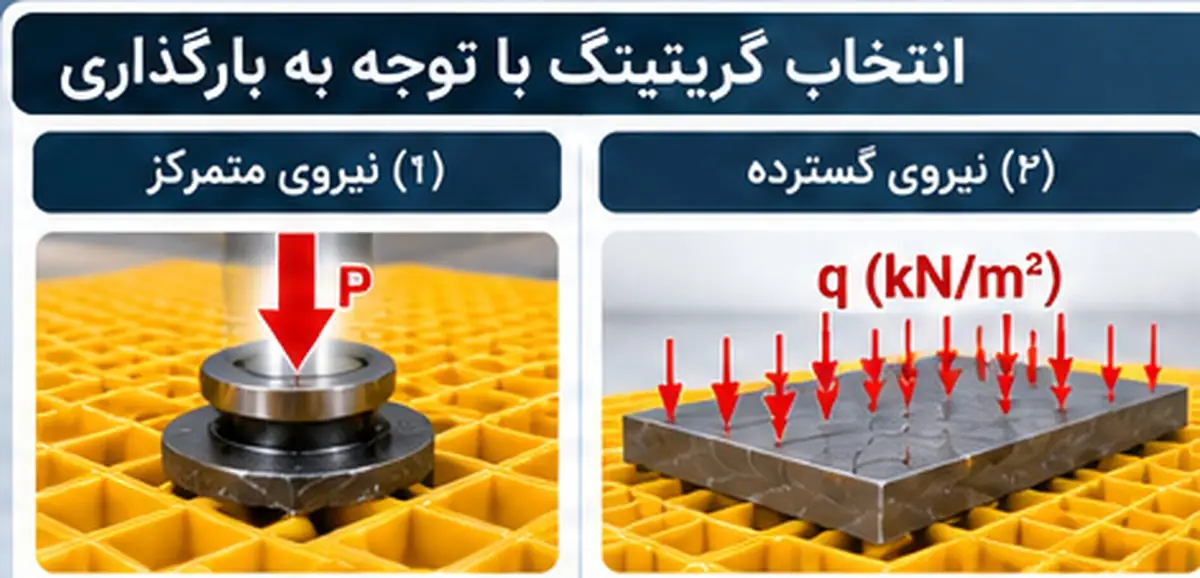
1 and 2. Concentrated load and uniform load
A concentrated load (P) is transmitted to the surface through a small area, such as a trolley wheel, an equipment foot or a shoe heel. A uniform load (q) is spread evenly over the whole surface, such as a crowd of people or stored goods. A grating may perform well under uniform load but show more local deflection under a concentrated load of the same total value. The tables in this article are for uniform load (kg/m²).
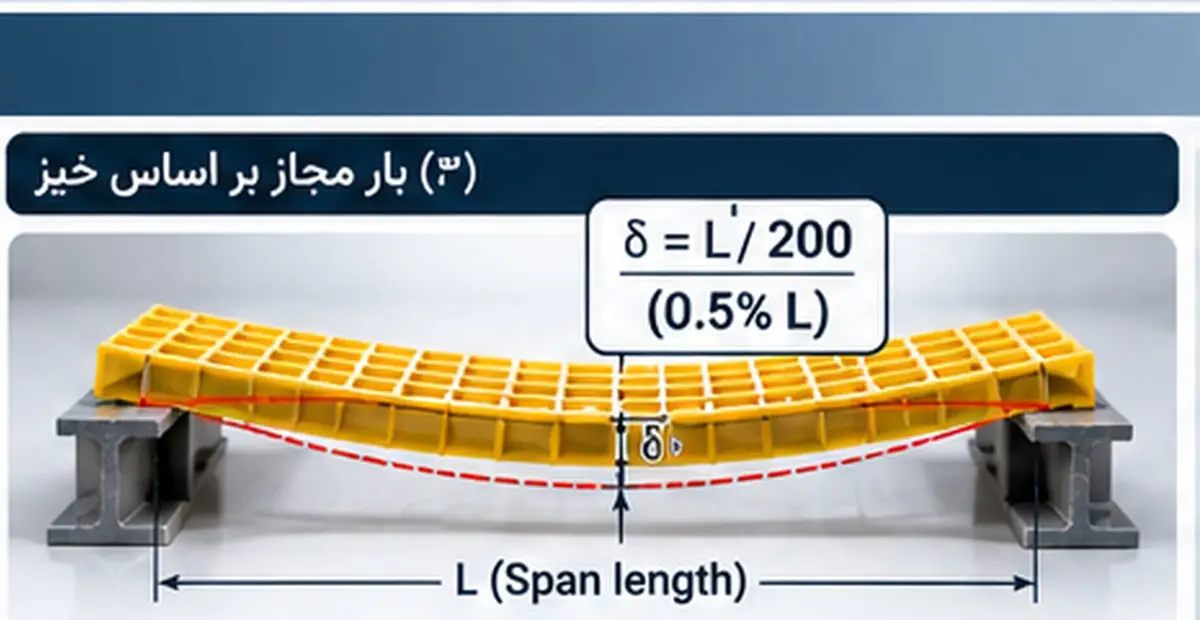
3. Allowable load based on deflection (L/200)
The allowable load is the load at which the deflection at the center of the panel (the vertical displacement of the center of the plate relative to its unloaded position) reaches 1/200 of the distance between supports (span length), i.e. a deflection equal to 0.5 percent of the span. For an 800 mm span, this deflection is 4 mm.
4. Failure load
This definition gives the ultimate load of the grating. The failure load is the maximum load at which the grating plate will certainly fail. This figure is not a design criterion; it is used to check the safety margin.

- Load ceiling: for safety, the maximum service load should not exceed 40 percent of the failure load, i.e. a safety factor of at least 2.5.
- Pedestrian comfort: maximum deflection of FRP grating is usually limited to 6 mm for pedestrian comfort.
- Clips: deflection of more than 12 mm is not recommended because clips may loosen and the panel may shift on its supports.
Important note: at spans of 1200 and 1400 mm, the L/200 deflection is 6 and 7 mm respectively. So for a pedestrian route on a 1400 mm span, the tabulated allowable load should be reduced in the ratio 6/7 (about 86 percent) so that deflection does not exceed 6 mm, since in the linear range deflection is proportional to load.
Composite grating load tables
Two factors determine the type and dimensions (height and mesh) of polymer grating: the distance between supports (bearings) and the load applied to the surface. Without considering the distance between supports, no judgment can be made on the choice of grating panel, because deflection under uniform load increases with the fourth power of the span. The tables below give the allowable load and failure load of the types of composite grating (molded, covered molded and pultruded) for six common spans. These load tables are based on polyester resin.
Table 1: allowable uniform load at L/200 deflection (kg/m²)
This table gives the load that brings the grating's center deflection to L/200. Green cells are options that carry the sample load of 500 kg/m² (industrial walkway):
| Dimensions (mm) | Span 400 | 600 span | 800 span | Span 1,000 | Span 1,200 | Span 1,400 |
|---|---|---|---|---|---|---|
| Molded grating | ||||||
| 25×38×38 | 1,607 | 476 | 201 | 103 | 60 | 37 |
| 30×38×38 | 2,800 | 830 | 350 | 180 | 110 | 70 |
| 38×38×38 | 5,700 | 1,700 | 750 | 400 | 250 | 150 |
| 50×50×50 | 10,000 | 3,000 | 1,250 | 650 | 400 | 250 |
| Covered molded grating | ||||||
| 28×38×38 | 2,100 | 650 | 300 | 150 | 90 | 60 |
| 33×38×38 | 3,500 | 1,050* | 460 | 240 | 140 | 100 |
| 41×38×38 | 7,100 | 2,100 | 930 | 500 | 300 | 190 |
| 53×50×50 | 12,600 | 3,800 | 1,600 | 850 | 500 | 340 |
| Pultruded grating | ||||||
| Height 25, mesh 15 | 12,150 | 3,750 | 1,600 | 850 | 550 | 350 |
| Height 25, mesh 25 | 9,000 | 3,000 | 1,250 | 680 | 400 | 260 |
| Height 38, mesh 10 | 23,300 | 6,800 | 2,800 | 1,450 | 870 | 550 |
| Height 38, mesh 23 | 15,400 | 4,600 | 1,900 | 990 | 570 | 360 |
| Height 50, mesh 10 | 45,400 | 12,900 | 5,540 | 2,650 | 1,450 | 1,000 |
| Height 50, mesh 23 | 30,000 | 8,900 | 3,700 | 1,850 | 1,000 | 650 |
Table 2: uniform failure load (kg/m²)
This table gives the failure load. The columns are the same spans as in Table 1; the maximum service load should not exceed 40 percent of these figures:
| Dimensions (mm) | Span 400 | 600 span | 800 span | Span 1,000 | Span 1,200 | Span 1,400 |
|---|---|---|---|---|---|---|
| Molded grating | ||||||
| 25×38×38 | 21,000 | 9,000 | 5,000 | 3,200 | 2,300 | 1,600 |
| 30×38×38 | 27,000 | 13,000 | 7,000 | 4,500 | 3,100 | 2,300 |
| 38×38×38 | 44,000 | 19,000 | 11,500 | 7,000 | 5,000 | 3,700 |
| 50×50×50 | 60,000 | 26,000 | 15,800 | 9,800 | 6,900 | 4,900 |
| Covered molded grating | ||||||
| 28×38×38 | 26,000 | 10,500 | 6,300 | 4,000 | 2,600 | 1,900 |
| 33×38×38 | 32,000 | 15,500 | 8,400 | 5,500 | 3,900 | 2,800 |
| 41×38×38 | 52,000 | 22,000 | 13,000 | 9,000 | 5,800 | 4,400 |
| 53×50×50 | 72,000 | 32,000 | 19,000 | 11,500 | 8,000 | 6,000 |
| Pultruded grating | ||||||
| Height 25, mesh 15 | 35,400 | 21,350 | 9,950 | 8,000 | 5,050 | 4,130 |
| Height 25, mesh 25 | 29,000 | 17,000 | 8,000 | 6,470 | 4,150 | 3,240 |
| Height 38, mesh 10 | 68,000 | 38,800 | 17,400 | 13,800 | 8,400 | 6,700 |
| Height 38, mesh 23 | 49,000 | 26,000 | 12,000 | 9,500 | 6,000 | 4,600 |
| Height 50, mesh 10 | 121,000 | 58,100 | 27,600 | 19,000 | 12,430 | 8,900 |
| Height 50, mesh 23 | 81,000 | 39,000 | 18,500 | 12,800 | 8,300 | 6,200 |
Chart comparison of the three grating types
The chart below shows the allowable load of three gratings of similar height versus support spacing. The vertical axis is logarithmic; the steep fall of the curves shows the effect of the fourth power of the span on deflection:
Practical grating selection examples
Example 1: industrial walkway in a treatment plant
Data: span 800 mm (support spacing), design uniform load 500 kg/m², pedestrian traffic.
- From Table 1, column 800: molded 25 (201) and molded 30 (350) are not enough; molded 38×38×38 (750) is the first acceptable molded grating option.
- Deflection: L/200 = 4 mm at a load of 750; at 500 the deflection is about 4 × 500/750 ≈ 2.7 mm, well below the 6 mm limit.
- Safety: 40 percent of failure load = 0.4 × 11500 = 4600 ≫ 500 ✓
- Resin: because of treatment chemicals (chlorine, etc.), isophthalic polyester, or vinyl ester at high concentrations.
Example 2: yard with trolley and light forklift traffic
Data: span 1000 mm, equivalent uniform load 1500 kg/m².
- In column 1000 of Table 1: no molded or covered grating reaches 1500 (maximum 850). Pultruded 38 with mesh 10 (1450) is also borderline.
- Acceptable options: pultruded 50 with mesh 23 (1850) or pultruded 50 with mesh 10 (2650).
- Alternative: reduce the span to 800 mm by adding a supporting beam; then molded 50×50×50 (1250) is still not enough, but covered molded 53 mm (1600), pultruded 25 with mesh 15 (1600) and pultruded 38 with mesh 10 (2800) are sufficient.
- For vehicles, besides the uniform load, the concentrated wheel load must be checked separately; contact Nabak's technical department for this check.
For more precise deflection calculations with beam relations and concentrated load tables, read the article composite grating load capacity table.
Choosing the resin type for grating
The resin is the matrix of composite grating and determines its chemical resistance. In general, polyester resin is suitable for most conditions, and vinyl ester resin is chosen for exposure to harsh chemicals and greater protection against corrosion. Importantly, vinyl ester and polyester resins do not differ appreciably in mechanical properties, so the load tables above (based on polyester resin) can also be used for vinyl ester grating; changing the resin changes only the chemical resistance.
| Resin type | Corrosion resistance level | Recommended environment and use |
|---|---|---|
| Orthophthalic polyester | Normal conditions | Water, air, immersion in water and non-industrial environments |
| Isophthalic polyester | Industrial grade | Common concentrations of acids and alkalis, treatment plants, car washes |
| Fire-retardant isophthalic polyester | Industrial grade + fire-retardant | Low to moderate acidic and alkaline environments needing greater fire resistance |
| Vinyl ester | Severe corrosion | High chemical concentrations, petrochemical and plating industries |
| Fire-retardant vinyl ester | Severe corrosion + fire-retardant | Corrosive environments with fire resistance requirements, oil and gas platforms |
If the composite grating is exposed to chemicals, send the following information with your purchase request so the best resin can be chosen:
For a comprehensive study of the chemical resistance of resin types and the environments each suits, the article safety in composite products is also useful.
Fire and UV resistance
Fire resistance
Standard composite grating is produced with fire-retardant additives. For projects with stricter requirements (offshore platforms, power plants, tunnels and escape routes), FRP grating can be custom-produced to grade V-0 under UL94. In this grade, the specimen self-extinguishes within 10 seconds of removing the flame and does not drip flaming particles. Combining fire-retardant resin with mineral additives also lowers the flame spread index.
Resistance to ultraviolet light
UV resistance is essential for any composite grating installed outdoors. Outdoors, ultraviolet (UV) radiation gradually erodes the resin surface and the surface fibers become exposed (fiber blooming). To prevent this, UV-absorbing additives are added to the resin during production. For greater resistance and appearance, a separate topcoat made for composite parts can also be applied to the surface; these coatings adhere fully to the surface and, outdoors, enhance the grating's resistance to sunlight as well as its appearance.
Choosing grating color
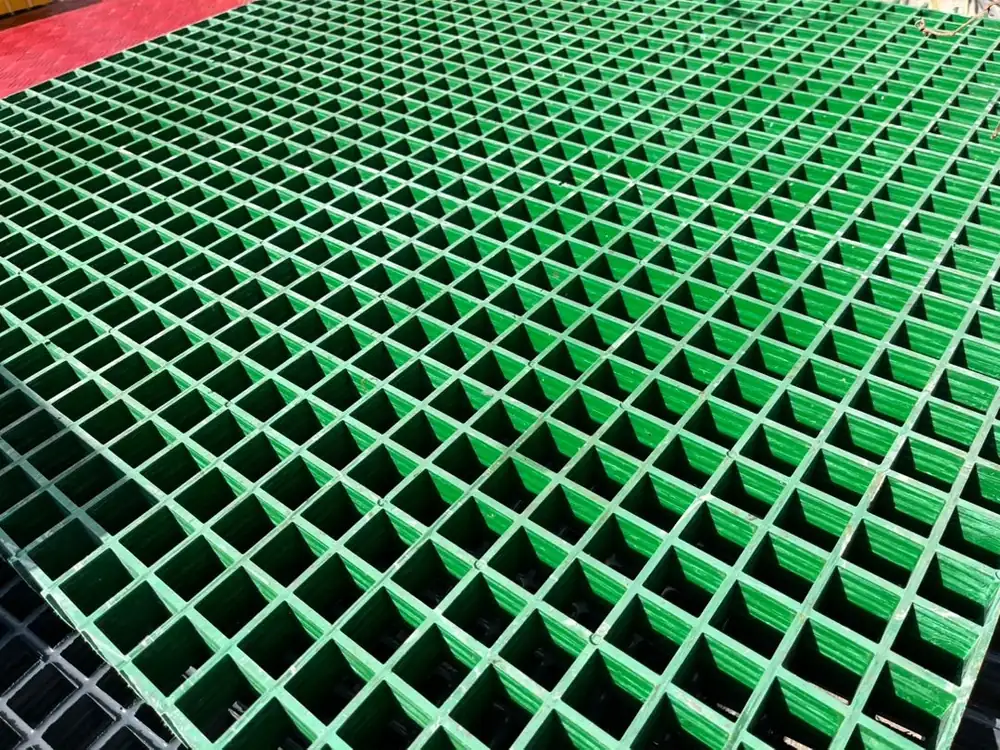
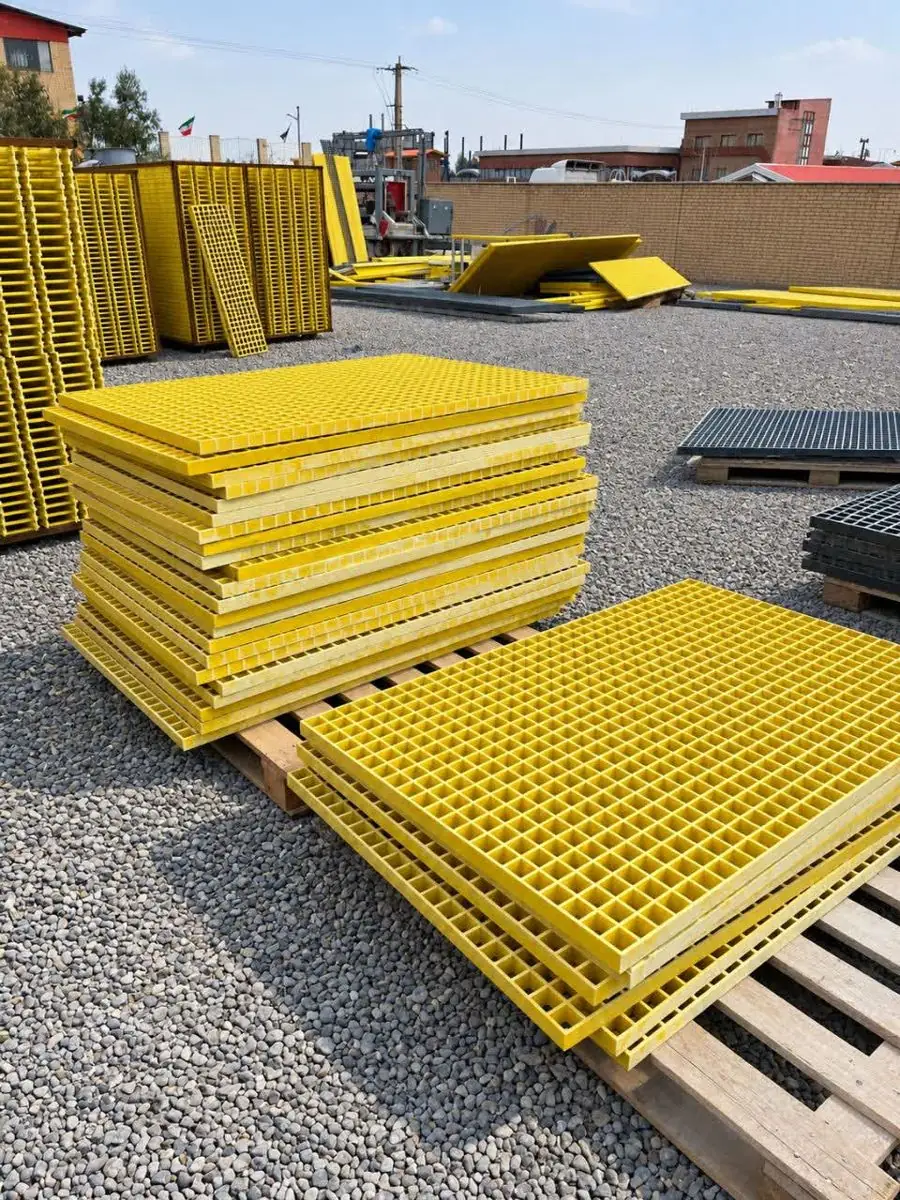
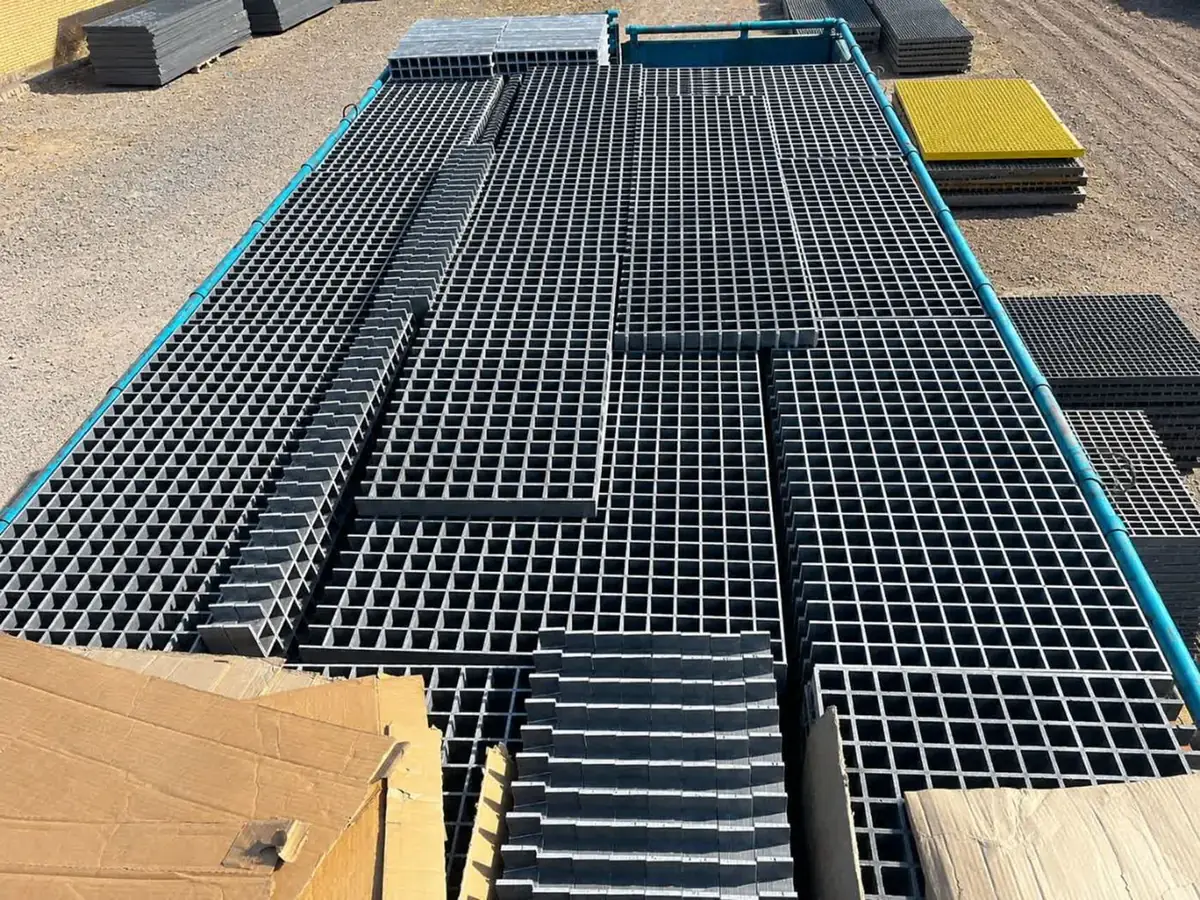
Composite grating can be produced in any color from the standard RAL charts, but the most common colors are gray and yellow: yellow for stairs and platform edges as a warning color, and gray for industrial environments and hatches. The pigment is mixed with the resin during production and the whole thickness of the grid is the same color, so surface scratches do not reveal a different color in the FRP grid. For a complete color guide by application, read the article FRP grating color selection guide.

FRP grating buying checklist
To receive a technical proposal and an accurate price, prepare the following information. This checklist summarizes the whole grating selection process in eight steps:
- Span: distance between supports and orientation of the load-bearing bars
- Load: type and amount of loading (uniform or concentrated)
- Deflection: allowable deflection limit (L/200, 6 mm or stricter)
- Type and height: selected from the load tables
- Surface: open, grit-coated or covered
- Environment: chemicals, temperature and resin choice
- Fire and UV: safety and outdoor requirements
- Dimensions, color and clips: panel layout drawing and RAL color
After delivery, panels must be cut on site with suitable tools and the edges sealed with resin; see the correct method in the article cutting composites.
Nabak Composite FRP grating
Nabak Composite produces molded, covered molded and pultruded FRP grating in heights of 25 to 50 mm, with orthophthalic polyester, isophthalic polyester and vinyl ester resins, in fire-retardant and UV-resistant grades, and in standard and custom RAL colors. Based on the project's span, load, chemical conditions and safety requirements, our team recommends the technically and economically optimal composite grating.
Frequently asked questions about choosing grating
What information is needed to choose FRP grating?
At least two pieces of information are essential: the distance between supports (span) and the load on the grating surface. After that, the type of traffic, corrosion and chemical conditions, need for fire resistance, outdoor exposure and desired color determine the grating type, height, resin and additives.
What is the difference between molded and pultruded grating?
Molded grating is produced as a single piece in a mold with a square mesh, and has fairly equal strength in both directions, excellent chemical resistance and a reasonable price. Pultruded grating is assembled from pultruded profiles; its fibers are concentrated lengthwise, and it has much higher stiffness and load capacity for larger spans and heavier loads.
What is the maximum allowable deflection of composite grating?
Allowable load tables are based on a deflection of L/200 (0.5 percent of the span). For pedestrian comfort, deflection is usually limited to 6 mm, and deflection over 12 mm is not recommended because clips may loosen.
Is polyester or vinyl ester resin better?
Polyester resin (orthophthalic or isophthalic) is suitable and economical for most conditions. Vinyl ester resin is chosen for severely corrosive environments and concentrated chemicals. The mechanical properties of the two resins do not differ appreciably; the main difference is chemical resistance.
Is 38 mm grating suitable for vehicle traffic?
25 and 30 mm grating is recommended for pedestrians and 38 and 50 mm grating for heavy traffic and vehicles; but for vehicles, besides height, the concentrated wheel load and support spacing must be checked, and pultruded grating or a shorter span is usually needed.
Summary
Choosing FRP grating starts with two figures: the distance between supports and the load. With these two figures, the grating type (molded, covered molded or pultruded) and its height are chosen from the load tables, checking the L/200 deflection criterion, the 6 mm ceiling for pedestrians, and the 40-percent-of-failure-load rule for safety. Then the resin is chosen according to chemical conditions (polyester for most applications, vinyl ester for severe corrosion), fire and UV additives according to the environment, and color according to the application. Following this path, the chosen composite grating will be safe, economical and durable. For advice on buying grating, contact the Nabak Composite team.

This article was prepared by the technical team of Nabak Composite, a manufacturer of FRP grating and composite products.