
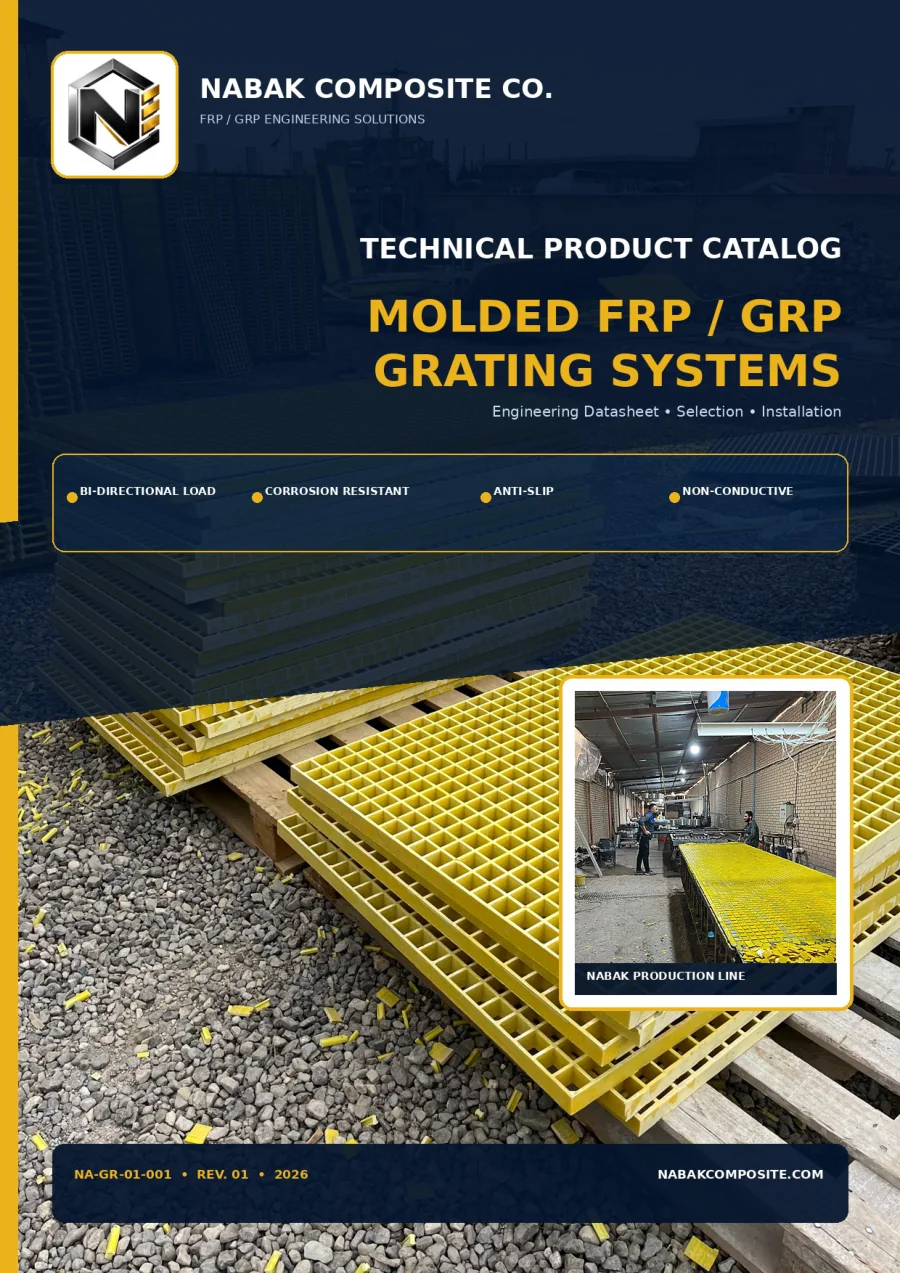
Molded FRP / GRP Grating Systems
Engineering Datasheet · Selection · Installation
02. Product Identification & Design Rationale
One-piece molded grid with continuous E-glass reinforcement in two principal directions.
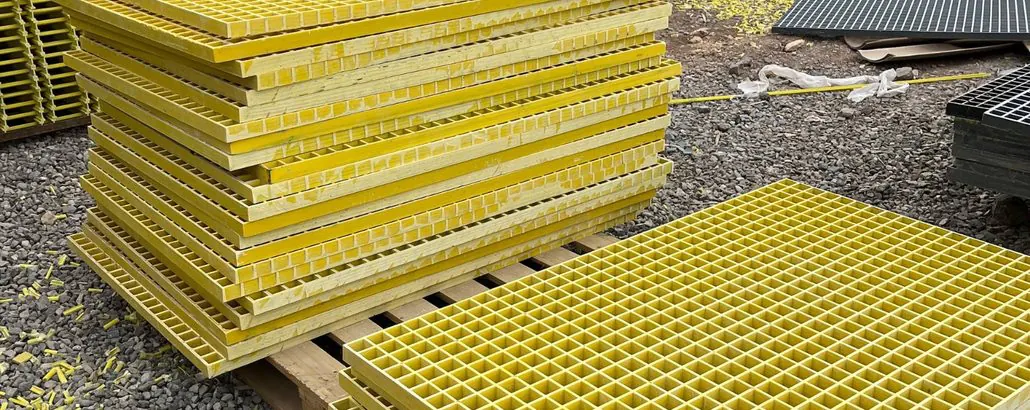
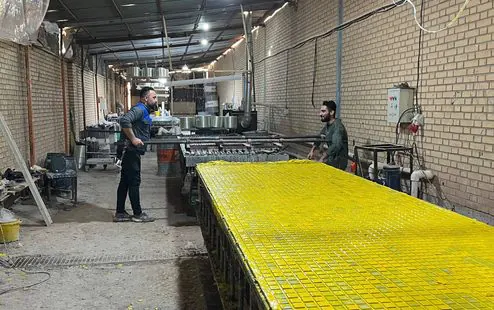
Molded FRP/GRP grating is manufactured by placing continuous glass roving in a precision mold and fully impregnating it with a thermoset resin system. Unlike assembled pultruded grids, the complete panel is formed in one molding cycle, producing balanced load distribution in both directions.
- Trade name: NABAK Molded FRP/GRP Grating
- Product code: NA-GR-01-001
- Primary use: platforms, walkways, access flooring, trenches and channel covers
- Target sectors: rail and metro, water and wastewater, oil and gas, petrochemical, marine, power, mining and food processing
03. Material Composition & Surface Finishes
Select the resin, reinforcement and walking surface to match the project environment.
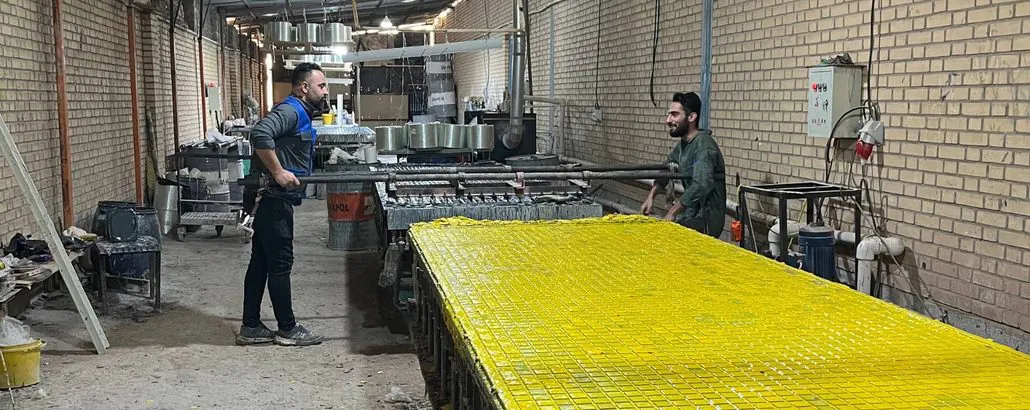
- Matrix: thermoset resin — isophthalic polyester, vinyl ester or phenolic
- Reinforcement: continuous E-glass roving, bi-axial; typical fiber content 35–45% by weight
- Fire-retardant grades may include alumina trihydrate (ATH) for smoke suppression
- Resin-rich surface layer protects glass reinforcement against moisture, UV and chemicals
| Surface | Recommended use |
|---|---|
| Concave | General dry access routes |
| Grit-top | Wet, oily or high-risk walkways |
| Covered | Small-object retention and heel/wheel access |
04. Mechanical Properties
Typical values for polyester or vinyl-ester molded grating with 35–45% glass reinforcement.
| Property | Typical value | Test |
|---|---|---|
| Tensile strength | 103–172 MPa | ASTM D638 |
| Tensile modulus | 8.3–11.0 GPa | ASTM D638 |
| Flexural strength | 117–207 MPa | ASTM D790 |
| Flexural modulus | 6.9–9.7 GPa | ASTM D790 |
| Compressive strength | 138–207 MPa | ASTM D695 |
| Interlaminar shear | 21–34 MPa | ASTM D2344 |
| Barcol hardness | 45–55 | ASTM D2583 |
| Density | 1750–1950 kg/m³ | ASTM D792 |
05. Physical, Thermal & Electrical
Low thermal conductivity and high electrical resistance support demanding industrial applications.
| Property | Typical value | Reference |
|---|---|---|
| Thermal expansion | 20–30 ×10⁻⁶ /°C | ASTM E831 |
| Thermal conductivity | 0.2–0.4 W/m·K | ASTM C177 |
| Heat deflection temp. | 100–140 °C | ASTM D648 |
| Polyester service temp. | Up to 80 °C | Resin-specific |
| Vinyl ester service temp. | 93–104 °C | Resin-specific |
| Volume resistivity | >10¹² ohm·cm | ASTM D257 |
| Dielectric strength | 10–20 kV/mm | ASTM D149 |
| CTI | 400–600 V | IEC 60112 |
06. Fire Performance
Fire behavior is controlled primarily by the selected resin formulation and panel thickness.
- ASTM D635: horizontal burning behavior
- ASTM D3801 / UL 94: self-extinguishing classification by grade
- EN 45545-2: European rail applications, subject to valid test report
- NFPA 130: transit applications, subject to valid test report
| Resin system | Flame / LOI | Typical use |
|---|---|---|
| Standard polyester | Non-FR / 20–22% | Areas without fire requirement |
| FR polyester / vinyl ester | Class I ≤25 / ≥28% | General industrial fire grade |
| Phenolic | Class I ≤25 / ≥35% | Rail, metro and enclosed areas |
07. Chemical Resistance
The resin system must be selected from the actual chemical, concentration, temperature and exposure time.
| Environment | Iso-polyester | Vinyl ester |
|---|---|---|
| Water / seawater | Very good | Very good |
| Dilute acids <10% | Good | Very good |
| Alkaline / caustic | Limited | Good |
| Chloride / brine | Good | Very good |
| Wastewater | Good | Very good |
| Dilute oxidizers | Limited | Good |
| Hydrocarbons / fuels | Good | Good |
| Strong organic solvents | Not recommended | Special review |
08. Durability & Service Conditions
A corrosion-free material platform for humid, saline and chemically aggressive facilities.
- No electrochemical corrosion and no rust staining
- UV-stabilized surface option for long-term outdoor exposure
- Resin-rich veil protects reinforcement at the panel surface
- No routine galvanizing or corrosion-paint renewal
- Low maintenance when supports, clips and cut edges are correctly detailed
- Expected performance depends on resin selection, temperature, loading, UV exposure and installation quality
09. Dimensions, Mesh, Weight & Color
Standard configurations and custom fabrication for project-specific openings and supports.
| Item | Typical options |
|---|---|
| Panel depth | 25, 30, 38, 40 and 50 mm |
| Mesh | 38 × 38 mm; mini-mesh options |
| Standard colors | Safety yellow, grey, green |
| Surface | Concave, grit-top, covered |
| Resin | Polyester, vinyl ester, phenolic |
| Fabrication | Cut panels, penetrations and edge sealing |
10. Design Data & Load Guidance
Final span selection must use the load table for the exact panel geometry and support condition.
- Define clear span, support width and panel bearing length
- State uniformly distributed load and concentrated load separately
- Check both strength and serviceability deflection limits
- Apply the project-required design factor; typical industry practice is 4:1 to 5:1 against ultimate failure
- Account for cut-outs, openings, impact, dynamic loads and edge conditions
- Provide intermediate supports where calculated deflection exceeds the project limit
| Design input | Project requirement |
|---|---|
| Support span | State clear distance |
| Load case | UDL / concentrated / impact |
| Deflection limit | As specified by designer |
| Environment | Chemical + temperature |
| Safety factor | Project / code requirement |
11. Installation, Cutting & Fasteners
Simple field fabrication with controlled cutting, sealed edges and corrosion-resistant clips.
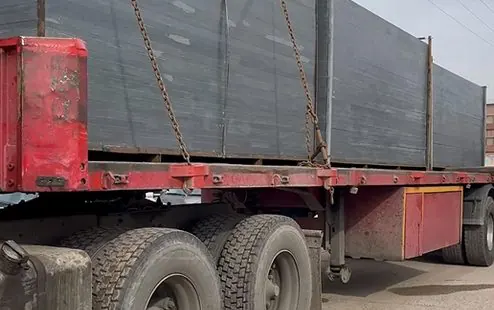
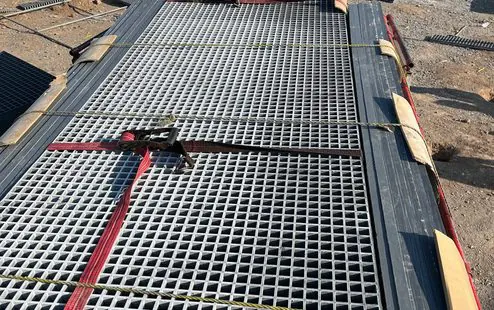
- Use diamond or carbide tooling with local dust extraction and appropriate PPE
- Seal all field-cut edges with compatible resin
- Provide continuous, level support and adequate bearing at panel edges
- Use stainless-steel 316 or FRP clips suitable for the environment
- Typical guide torques: M8 8–10 N·m; M10 15–18 N·m; M12 25–30 N·m
- Do not over-tighten fasteners or locally crush the resin-rich surface
12. Packaging, Handling, QA/QC & Standards
Controlled production, protected delivery and documented inspection.
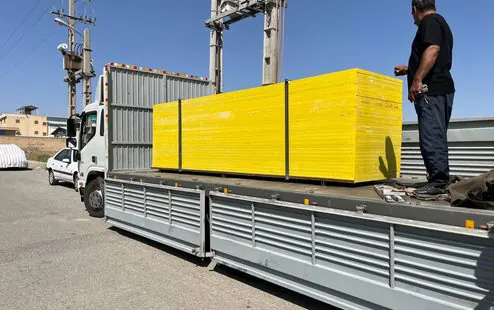
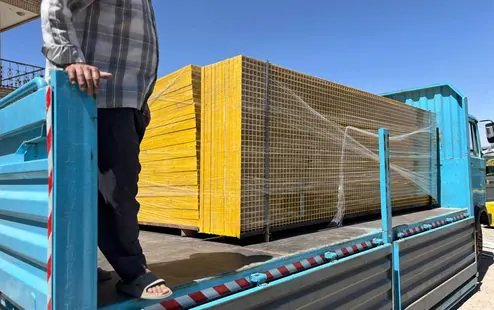
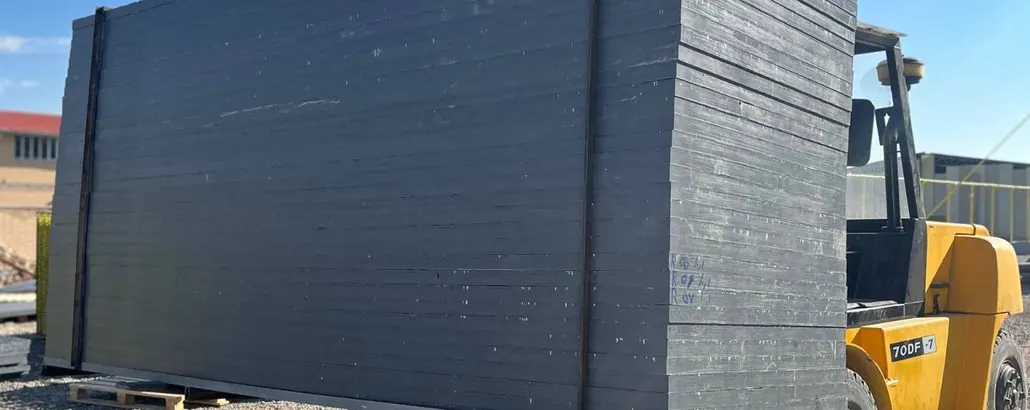
- Store panels horizontally on a flat, level support without point loads
- Lift with at least two support points and protect edges from impact
- Standard packing: timber pallet, secure straps and protective wrapping
- Incoming inspection: resin, glass roving, fillers and additives
- In-process inspection: impregnation, molding, cure and surface finish
- Final inspection: dimensions, thickness, color, visual condition and Barcol hardness
13. Applications & Product Advantages
Engineered access flooring for corrosive and electrically sensitive environments.
- Metro and railway platforms, inspection routes and service areas
- Water and wastewater treatment plants
- Oil, gas, petrochemical and chemical facilities
- Marine structures, cooling towers and power installations
- Mining, food processing, stairs, ramps, trenches and channel covers
- High corrosion resistance, low weight and high strength-to-weight ratio
- Anti-slip surface options, rapid installation and no welding
- Long service life with low maintenance demand
14. Maintenance & Ordering
Simple periodic inspection preserves safe access and long-term performance.
- Inspect panels visually every 6–12 months or per the asset-maintenance plan
- Clean oil, grease and deposits to preserve anti-slip performance
- Check clips for looseness or corrosion; sample torque annually where required
- Assess deep cracking or local breakage before continued service
- No periodic anti-corrosion painting is required
| Order segment | Meaning |
|---|---|
| NA | NABAK Composite |
| GR | Grating |
| 01 | Molded FRP/GRP series |
| 001 | Base product model |
15. Contact & Technical Disclaimer
Engineering support for specification, quotation and project documentation.
- Company: NABAK COMPOSITE CO.
- Website: nabakcomposite.com
- Sales email: sales@nabakcomposite.com
- Technical email: nabakcomposite@gmail.com
- Telephone: +98 912 396 3078
- Address: No. 52, 14th Alley, Central Sazman Barnameh St., West Ferdows Blvd., Tehran, Iran
HTML edition of the NABAK technical datasheet NA-GR-01-001 (16-page PDF). The original PDF remains available for download on this page.