
FRP/GRP Handrail & Guardrail Systems
What is an FRP/GRP handrail?
An FRP/GRP handrail (fiberglass guardrail or safety railing) is a safety system made of vertical posts, a top rail and one or more mid rails, produced by pultrusion from continuous glass fibers and polyester or vinyl ester resin. It is installed to protect personnel at the edges of walkways, platforms, stairs and industrial grating and, unlike steel handrail, it does not rust in humid, coastal or chemical environments and needs no periodic painting.
Nabak FRP handrail range
Two-rail handrail
A top rail and one mid rail; the most common configuration for general industrial walkways and platforms.
Three-rail handrail
A top rail and two mid rails; for areas with stricter safety requirements or greater fall heights.
Industrial handrail
A reinforced configuration for heavy industrial areas with heavy traffic or higher lateral loads.
Platform and walkway handrail
Designed for direct installation on steel or composite platforms and walkways.
Grating perimeter handrail
Matched to Nabak FRP grating panels for a fully integrated flooring and safety system.
Advantages over steel handrail
- Corrosion resistance: no rust in humid, coastal or chemical environments; no galvanizing or periodic painting.
- Light weight: about one-quarter the weight of equivalent steel handrail; faster installation with a smaller crew.
- Electrical insulation: non-conductive, suitable near electrical equipment or where sparks are a hazard.
- High-visibility safety colors: usually produced in safety yellow or orange so it is visible from a distance; the color runs through the material and does not fade or flake.
- Maintenance-free: unlike steel handrail, no repainting over the life of the project.
- Easy assembly: bolted, pre-formed modular connectors with no welding at height.
Typical dimensions
| Component | Typical diameter/size (mm) | Overall system height |
|---|---|---|
| Post | 40–50 | To drawing (typically 1000–1100 mm) |
| Top rail | 40–50 | — |
| Mid rail | 32–40 | — |
| Standard post spacing | — | 1500–2000 mm (to drawing) |
These are the most common specifications; height, post spacing and number of rails can be adjusted to the drawing and safety requirements of each project.
FRP handrail vs steel / galvanized handrail
| Property | FRP/GRP handrail | Steel / galvanized handrail |
|---|---|---|
| Corrosion in coastal environments | Resistant, no rust | Prone to corrosion |
| Relative weight | About ¼ of steel | Heavier |
| Electrical conductivity | Insulating | Conductive |
| Welding needed on site | No (bolted assembly) | Usually yes |
| Periodic maintenance | None | Repainting/re-galvanizing |
Applications
- Refineries and petrochemical plants: walkway and platform safety in corrosive vapors and spark-hazard areas.
- Jetties and offshore platforms: resists humidity and salt water, where steel handrail corrodes quickly.
- Water and wastewater treatment: safety around basins in constant contact with moisture and disinfectants.
- Grating and raised industrial floors: an integrated safety system with composite flooring.
- Industrial stairs and walkways: protecting personnel on elevated routes.
Manufacture and installation
Nabak handrail components (posts, top rails, mid rails) are pultruded to give a uniform section with consistent strength along each part. They are installed with pre-formed modular connectors (brackets, clamps and stainless bolts) on grating, steel platforms or concrete, with no welding on site, which matters especially at height and in spark-hazard areas.
Choosing the right handrail
- Safety requirements: choose two or three rails based on fall height and the project’s HSE rules.
- Environment: in coastal or chemical areas, the resin is chosen for the chemical resistance required.
- Mounting surface: connector and bracket type depend on the surface (grating, concrete or steel).
- Run length and number of posts: post spacing is set by the lateral load required by code.
If you are unsure, send the route drawing and safety requirements to Nabak’s engineers and we will propose a suitable configuration.
Standards and quality control
Nabak FRP handrail is produced with reference to EN 13706 for pultruded profiles. Lateral load design is usually checked against industrial safety codes such as OSHA or the client’s own HSE standards. Before shipping, every batch is inspected for dimensions, connection strength and surface finish.
Why Nabak FRP handrail?
Nabak Composite produces two-rail and three-rail handrail with matching modular connectors for grating, concrete and steel structures. Our engineers help choose the number of rails, post spacing and connection type for your safety requirements and environment, and support installation after delivery.
Frequently asked questions
- How long does FRP handrail last? In corrosive environments, far longer than steel, because it does not corrode and its color does not fade or flake.
- Two rails or three? It depends on safety requirements and fall height; three rails are recommended for higher-risk areas.
- Does installation need welding? No; bolted modular connectors remove the need, which matters at height and in spark-hazard areas.
- Can the color be changed? Safety yellow or orange is most common, but other colors can be produced on request.
- Is it compatible with Nabak grating? Yes; the grating perimeter handrail is designed to integrate with Nabak FRP grating panels.
Packing, price and ordering
Components are bundled and wrapped in protective film; being much lighter than steel, freight costs are noticeably lower. Price depends on the number of rails, run length, connectors and quantity.
- Send the route drawing and define the safety requirements.
- Choose the configuration (two or three rails) and connection type, with free technical advice if needed.
- Request a quotation and lead time.
- Confirm the order; handrail is produced to your drawing.
- Shipping and delivery to your site.
Contact us through the contact form or see our technical documents.
Summary
For any project facing moisture, chemicals, coastal conditions or a need for electrical insulation, FRP/GRP handrail is a more reliable choice than steel or galvanized handrail: lighter, corrosion-proof, installed without welding and lower-cost over the project life.
For the complete technical specifications, dimensions and engineering tables of the products in this category, see FRP/GFRP Composite Handrail — Technical Datasheet and Composite Handrail Technical & Installation Handbook.
Related technical datasheets
Products in this category

FRP/GRP Grating Perimeter Handrail
The FRP/GRP grating perimeter handrail is an integrated safety system for walkways, access platforms and struc
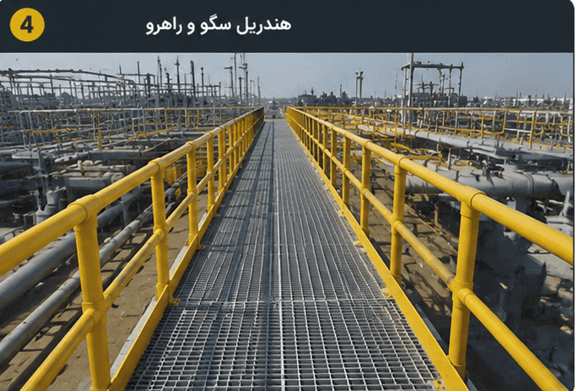
FRP/GRP Platform & Walkway Handrail
The FRP/GRP platform and walkway handrail protects people on walkways, maintenance platforms, access bridges,
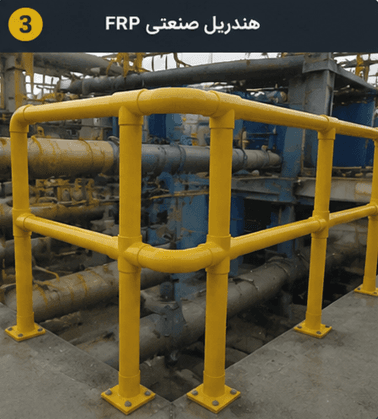
FRP/GRP Industrial Handrail
The FRP/GRP industrial handrail is an advanced safety system and a modern replacement for steel, galvanized an
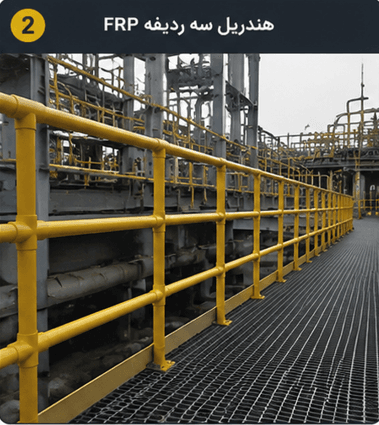
FRP/GRP Three-Rail Handrail
The FRP/GRP three-rail handrail is an advanced safety system for protecting personnel on operating platforms,
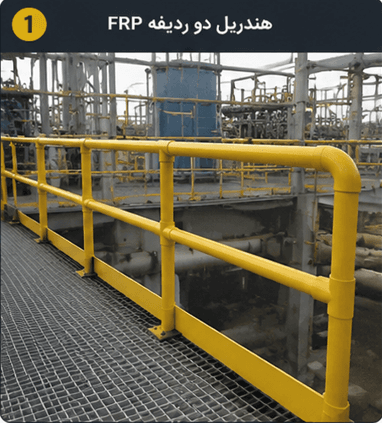
FRP/GRP Two-Rail Handrail
The FRP/GRP two-rail handrail is an engineered safety system for walkways, work platforms and elevated areas i