
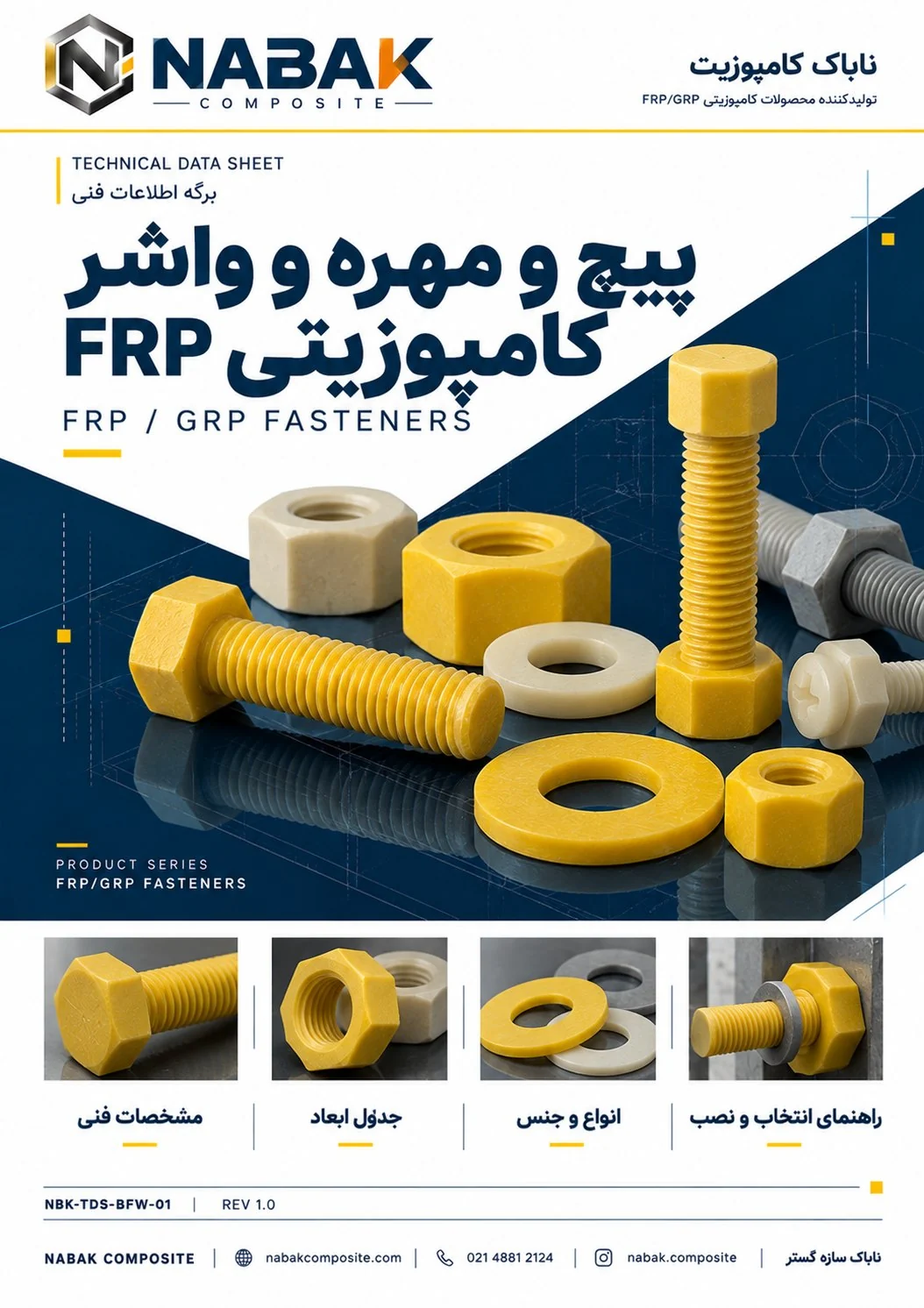
Nabak Composite FRP bolts, nuts and washers (FRP / GRP Fasteners) are fasteners made of GFRP composite that give a lightweight, insulating, non-magnetic and corrosion-proof connection where a steel bolt would rust, conduct current or disturb a magnetic field.
What Are FRP Composite Bolts and Nuts?
Composite bolts and nuts — also known as FRP bolts and nuts, composite bolts, composite nuts, composite washers, GFRP bolts and fiberglass bolts and nuts — are made from glass-fiber-reinforced polymer. The shank of an FRP bolt is a pultruded rod in which continuous glass fibers run lengthwise in a vinyl ester resin; the thread is machined or formed on this composite rod, and a molded hexagonal head is bonded onto it with structural adhesive to form one integral piece.
FRP is the general name for fiber-reinforced polymers, and GFRP (or GRP) is the FRP composite reinforced with glass fiber. Unlike metals, FRP composite stays stable in acidic, chloride and damp environments, does not suffer galvanic corrosion, and its threads do not gall. That is why FRP bolts and nuts are the natural complement to composite grating, FRP handrail and GFRP structures.
Construction and Manufacturing of the Components
Types of FRP Bolts, Nuts and Washers
Benefits of FRP Bolts and Nuts
- Fully corrosion-proof: FRP bolts and nuts do not rust in acid, chlorine, seawater or chemical vapors, and the thread never seizes.
- Electrical insulation: FRP bolts and composite washers break the current path; suited to switchgear, substations and cathodic protection.
- Non-magnetic and radio-transparent: suitable for MRI rooms, measuring equipment, radar and antennas.
- No galvanic corrosion: a GFRP fastener between two dissimilar metals creates no galvanic cell.
- Lightweight: a fiberglass bolt and nut weigh about one-quarter of a steel bolt.
- Compatible with composite structures: same expansion and chemical behavior as FRP grating, handrail and GFRP profiles.