
FRP/GFRP Composite Handrail – Technical Datasheet | Nabak Composite
دیتاشیت محصولات

FRP/GFRP Composite Handrail – Technical Datasheet | Nabak Composite

مقاله1405/08/12English
مشاهده‌ی آنلاین سند

FRP / GFRP Composite Handrail Technical Datasheet — FRP Handrail and GFRP Composite Railing by Nabak Composite

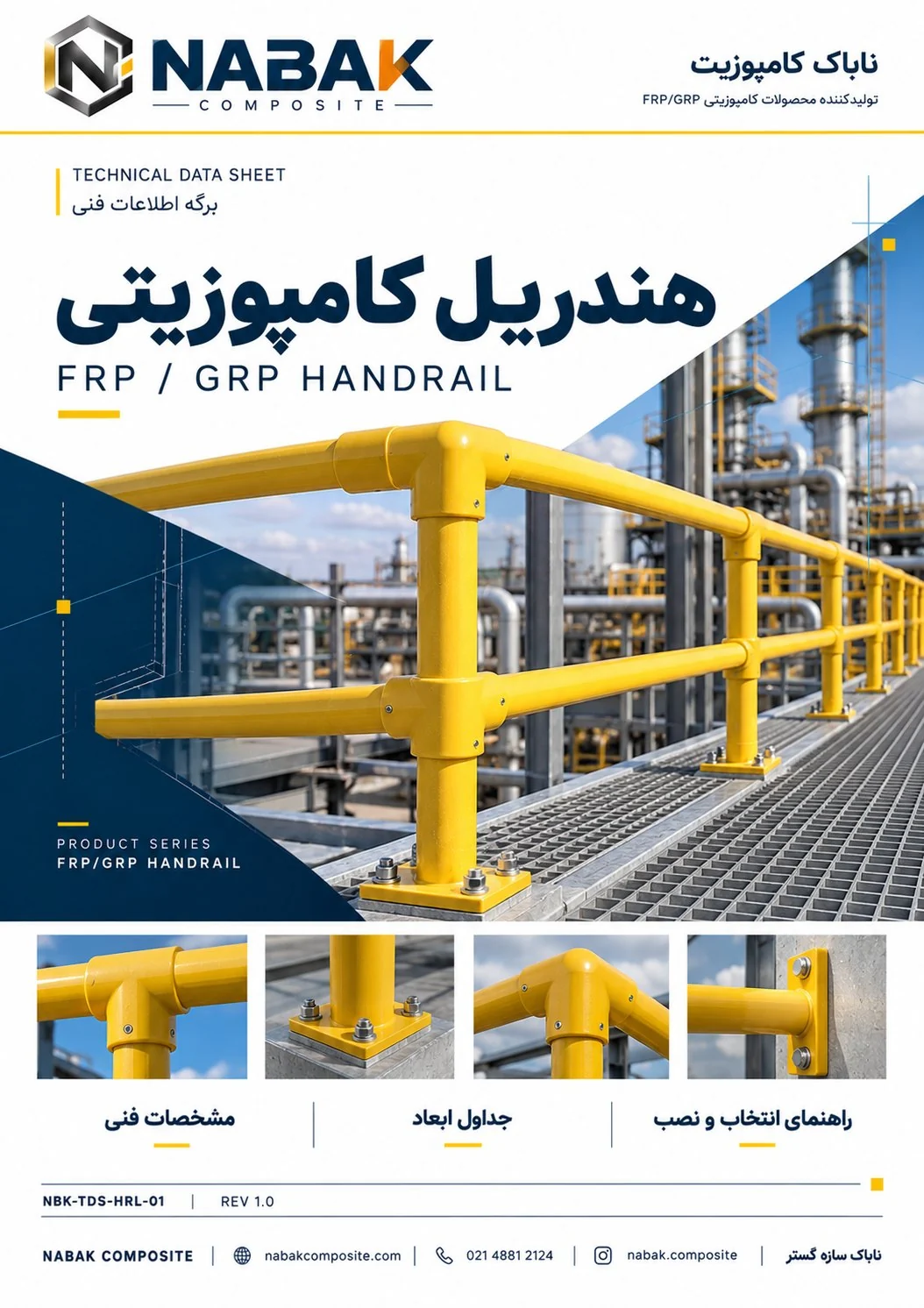
Cover of the FRP composite handrail technical datasheet by Nabak Composite - FRP / GRP Handrail, code NBK-TDS-HRL-01
TECHNICAL DATA SHEET

FRP/GFRP Composite Handrail

Components, fittings, profile and dimension tables, ISO 14122-3 and OSHA requirements, post and rail design formulas and installation guide for FRP composite handrail

NBK-TDS-HRL-01-ENRev 1.0  ·  2026
FRP/GFRP Composite Handrail – Technical DatasheetIntroduction, Components & Advantages  |  Page 1 of 5

The Nabak Composite FRP handrail (FRP / GRP Handrail) is an industrial safety railing system built from pultruded GFRP composite tubes and profiles, composite fittings, toe boards and base plates — a lightweight, corrosion-proof, electrically insulating, paint-free alternative to steel and galvanized railing on platforms, walkways and industrial stairs.

1100 mmstandard handrail height
≈ 5.3 kg/mweight per metre of the complete system
≤ 1500 mmpost centre-to-centre spacing
0.89 kNconcentrated load resistance (OSHA)

What Is an FRP Composite Handrail (GFRP Railing)?

A composite handrail — also known as an FRP handrail, GFRP handrail, fiberglass handrail, composite railing or composite guardrail — is built from pultruded FRP composite members: tubes and profiles in which continuous glass fibers are drawn lengthwise and cured with isophthalic polyester, vinyl ester or phenolic resin. The result is a member with longitudinal strength above 207 MPa and a density of about one quarter that of steel.

The members of an FRP handrail are joined with molded composite fittings (tees, elbows, crosses and end caps) and with structural epoxy adhesive plus stainless steel rivets or bolts, and the posts are fixed to the platform or to composite grating with a base plate or a side-mount bracket. FRP is the generic name for fiber-reinforced polymers, and GFRP (or GRP) is FRP composite reinforced with glass fiber; every component of the Nabak Composite handrail is made of GFRP composite.

Main Components of the FRP Handrail System

Top railØ50 mm round GFRP tube that serves as the grab rail and the main member resisting horizontal load.
Mid rail (knee rail)Composite tube at mid-height that limits the clear opening to less than 500 mm.
PostPultruded FRP square tube (or round tube) that transfers load to the base plate and the structure.
Toe boardComposite flat bar or channel, 100 to 150 mm high, to stop tools and parts from falling.

Composite Handrail Fittings

Tee connector (T-Connector)Joins the top or mid rail to an intermediate post of the FRP handrail
90° elbowCorner connection and the start and end of a composite railing run
Cross connector and corner fittingRail intersections and three-dimensional platform corners
Base plateFixes the post to a platform, concrete or GFRP grating with 4 bolts
Side-mount bracketFixes the post to the beam web or platform edge for more usable floor space
End cap and expansion jointCloses the tube ends and absorbs thermal expansion in long runs

Advantages of FRP Handrail over Steel Railing

  • Corrosion-proof: GFRP handrail does not rust in seawater, acid vapors or chemical environments, and needs no paint.
  • Lightweight and fast to install: composite railing weighs about 40 percent of steel railing; no welding and no crane required.
  • Electrical and thermal insulation: fiberglass handrail does not conduct electricity, and the grab rail stays comfortable to touch in both hot and cold weather.
  • Lasting safety color: safety yellow throughout the full thickness of the FRP composite; no peeling and no repainting.
composite handrail | FRP handrail | GFRP composite railingnabakcomposite.com  |  +98 21 4881 2124  |  @nabak.composite
FRP/GFRP Composite Handrail – Technical DatasheetProfile Table, Dimensions & Safety Requirements  |  Page 2 of 5

Pultruded Composite Handrail Profile Table

Table 1 — Section dimensions and properties of common FRP handrail profiles (ρ = 1.85 g/cm³)
ProfileApplicationDimensions (mm)Area A (mm²)Moment of inertia I (mm⁴)Section modulus S (mm³)Weight (kg/m)
Round tube Ø50×4Top and mid railOD 50 / ID 425781.54×10⁵6.16×10³1.07
Round tube Ø50×5Heavy rail, round postOD 50 / ID 407071.81×10⁵7.25×10³1.31
Round tube Ø42×4Stair handrail, light mid railOD 42 / ID 344788.71×10⁴4.15×10³0.88
Square tube 50×5Standard post50 × 50 × 59003.08×10⁵1.23×10⁴1.67
Square tube 50×6Heavy post, end post50 × 50 × 610563.47×10⁵1.39×10⁴1.95
Toe board stripToe board150 × 4600——1.11

The dimensions are common sizes of pultruded handrail profiles in the FRP industry, and the section properties are calculated with the formulas on page 4. Standard stock length of GFRP tube and profile: 6000 mm.

Standard FRP Handrail Dimensions and Safety Requirements

Table 2 — Dimensions of the Nabak Composite handrail compared with common requirements
ParameterISO 14122-3OSHA 1910.29Nabak Composite FRP handrail
Top rail height above floor≥ 1100 mm1067 ± 76 mm1100 mm
Clear opening between rails≤ 500 mmMid rail at mid-heightMid rail at a height of ≈ 550 mm
Toe board height≥ 100 mm≥ 89 mm100 or 150 mm
Toe board gap above floor≤ 10 mm≤ 6 mm≤ 6 mm
Post centre-to-centre spacingPreferably ≤ 1500 mm—≤ 1500 mm
Concentrated load on top rail—890 N (200 lbf)Designed for 890 N
Concentrated load on mid rail—667 N (150 lbf)Designed for 667 N
Uniform horizontal load (IBC / ASCE 7)0.73 kN/m (50 plf)Designed for 0.73 kN/m

The values are quoted from the common text of ISO 14122-3, OSHA 29 CFR 1910.29 and the IBC; for each project, check the valid edition of the standard and the national building code.

Color, Surface and Durability of GFRP Handrail

The standard color of composite handrail is safety yellow; gray, green, blue and white are also available to order. The pigment is dispersed through the full thickness of the FRP composite, and a polyester surface veil with a UV-inhibiting additive prevents the glass fibers from showing through (fiber blooming) and the surface from dulling in sunlight. In environments with intense radiation, an aliphatic polyurethane coating on the FRP handrail keeps its gloss and color for years.

Applications of Composite Handrail

Oil, gas & petrochemicalHandrail for platforms, pipe racks and stairs, using corrosion-proof FRP railing
Water & wastewater treatmentComposite railing around basins and channels
Offshore & jettiesPhenolic GFRP handrail for offshore platforms
Power plants & substationsInsulating composite guards around energized equipment
Cooling towersHandrail for the fan deck and access stairs
Food & pharmaceuticalHygienic, washable fiberglass railing
fiberglass handrail | FRP railing | pultruded composite tubenabakcomposite.com  |  +98 21 4881 2124  |  @nabak.composite
FRP/GFRP Composite Handrail – Technical DatasheetMechanical & Physical Properties and Comparison  |  Page 3 of 5

Mechanical Properties of Pultruded FRP Handrail Profiles

Table 3 — Reference mechanical properties of pultruded GFRP composite in composite handrail
PropertyTest standardUnitLongitudinal (LW)Transverse (CW)
Glass fiber content by weightASTM D2584%55 – 70
Tensile strengthASTM D638MPa207 – 35048 – 70
Tensile modulusASTM D638GPa17 – 255.5 – 8
Flexural strengthASTM D790MPa207 – 35070 – 100
Compressive strengthASTM D695MPa207 – 300100 – 140
Short-beam shear strengthASTM D2344MPa25 – 35
Bearing strengthASTM D953MPa200 – 240140 – 170
Barcol hardnessASTM D2583—45 – 50

Composite Handrail vs Metal Railing

Table 4 — FRP handrail vs galvanized steel, stainless steel and aluminum railing
PropertyGFRP handrailGalvanized steelStainless steelAluminum
Density (g/cm³)1.8 – 2.07.858.02.7
Approx. system weight (kg/m)≈ 5.3≈ 12≈ 11≈ 5
Corrosion resistanceExcellentLimitedGoodGood
Electrical conductivityNon-conductiveConductiveConductiveConductive
Thermal conductivity (W/m·K)0.3 – 0.6≈ 50≈ 16≈ 205
Longitudinal expansion coefficient (10⁻⁶ /°C)8 – 10121623
Painting requiredNoYesNoNo
Welding required for installationNoUsuallyUsuallyUsually
Maintenance cost in corrosive environmentsVery lowHighLowLow
Table 5 — Reference fire indices
TestStandardFlame-retardant resinPhenolic
Flame spreadASTM E84≤ 25≤ 10
Extinguishing behaviorASTM D635Self-extinguishingSelf-extinguishing
Oxygen indexASTM D2863≥ 30%≥ 40%
Table 6 — Resin selection for FRP handrail
ResinService temperatureApplication
Isophthalic polyester≈ 80 °CGeneral, water and wastewater
Vinyl ester≈ 100 °CPetrochemical, chemical
Phenolic≈ 150 °COffshore, tunnels

The values in Tables 3 to 6 are common reference ranges from technical sources on the pultruded FRP and GFRP composite industry and are not Nabak Composite's own laboratory results; for design, the test results of each composite handrail order govern.

Outdoor durability: the color and surface stability of composite handrail is evaluated by accelerated UV aging per ASTM G154 or ASTM G155. The surface veil and UV-inhibiting additive in Nabak Composite GFRP profiles, together with the optional polyurethane coating, extend the service life of FRP handrail to several decades in intense sun and coastal environments — with no paint peeling and no rusting of stainless steel bolts and fittings.

FRP handrail specifications | pultruded GFRP composite | composite safety railingnabakcomposite.com  |  +98 21 4881 2124  |  @nabak.composite
FRP/GFRP Composite Handrail – Technical DatasheetSection Formulas, Weight & Post Design  |  Page 4 of 5

Section Formulas for Composite Handrail Profiles

1. Round tube (top and mid rail)
I = π (D⁴ − d⁴)64 ,   S = 2ID

Ø50×4: π(50⁴ − 42⁴)/64 ≈ 1.54×10⁵ mm⁴ and S ≈ 6 160 mm³

2. Square tube (post)
I = B⁴ − b⁴12 ,   S = 2IB

50×50×6: (50⁴ − 38⁴)/12 ≈ 3.47×10⁵ mm⁴ and S ≈ 13 880 mm³

3. Weight per metre of a GFRP profile
w = ρ · A × 10⁻³   [kg/m]

ρ in g/cm³ and A in mm². Ø50×4: 1.85 × 578 × 10⁻³ ≈ 1.07 kg/m

4. Weight per metre of the FRP handrail system
wsys = wtop + wmid + wtoe + wpost · Hs + wfit

1.07 + 1.07 + 1.11 + (1.95 × 1.1 / 1.5) + 0.6 ≈ 5.3 kg/m; comparable steel railing ≈ 12 kg/m

Composite Handrail Post Design (Cantilever Beam)

5. Moment, bending stress and post factor of safety
M = P · H ,   σ = MS ,   FS = σuσ ≥ 2.5

P is the horizontal concentrated load at the top of the post, H the post height to the top rail, and σu the longitudinal flexural strength of the pultruded composite.

Example — 50×50×6 post, H = 1100 mm, P = 890 N (OSHA): M = 890 × 1100 = 979 000 N·mm σ = 979 000 / 13 880 ≈ 70.5 MPa  →  FS = 207 / 70.5 ≈ 2.9 The 50×50×6 FRP handrail post carries the OSHA concentrated load with a suitable factor of safety. For lone end and corner posts, a heavier profile or a supporting post (kicker) is recommended.
6. Horizontal deflection at the top of the post, including rail continuity
δ = η · P H³3 E I

η is the share of the load taken by the loaded post (about 0.5 for a rail that is continuous over several posts; 1.0 for a lone post). For the example above with E = 17 GPa: a lone post gives δ ≈ 67 mm and an intermediate post with a continuous rail gives δ ≈ 33 mm. GFRP composite returns to its original shape when the load is removed and shows no permanent deformation.

7. Mid rail check
σmid = Pmid L / 4S

Ø50×4, L = 1500, Pmid = 667 N (OSHA): σ ≈ 40.6 MPa and FS ≈ 5.1

8. Shear stress of the adhesive rail joint at the tee
τ = Pπ · D · lb

D = 50 mm, bond length lb = 60 mm, P = 890 N: τ ≈ 0.09 MPa; far below the shear strength of epoxy adhesive (≥ 10 MPa)

composite handrail design | FRP and GFRP pultruded profilenabakcomposite.com  |  +98 21 4881 2124  |  @nabak.composite
FRP/GFRP Composite Handrail – Technical DatasheetRail & Base Plate Design and Installation Guide  |  Page 5 of 5

Top Rail, Base Plate and Expansion Design

9. Top rail under a mid-span concentrated load
σ = P L / 4S ,   δ = P L³48 E I

Ø50×4, L = 1500, P = 890 N: σ ≈ 54 MPa (FS ≈ 3.8) and δ ≈ 24 mm (simple-support assumption, conservative)

10. Top rail under a uniform horizontal load
σ = w L² / 8S ,   δ = 5 w L⁴384 E I

w = 0.73 N/mm (IBC): σ ≈ 33 MPa and δ ≈ 18 mm for a 1500 mm span

11. Tensile force in the base plate bolts
Tb = Mz · nt

z is the lever arm between the bolt rows and nt the number of tension bolts. 150×150 base plate with z = 110 mm and 2 bolts: 979 000 / (110 × 2) ≈ 4.45 kN per M10 or M12 stainless steel bolt

12. Thermal expansion of the handrail run
ΔL = α · L · ΔT

α ≈ 9×10⁻⁶ /°C, 6000 mm length, ΔT = 40 °C → ΔL ≈ 2.2 mm; provide an expansion joint every 6 to 9 metres.

Installing FRP Composite Handrail

  1. Layout: mark the post positions at a maximum centre-to-centre spacing of 1500 mm, with extra posts at corners and on both sides of joints.
  2. Fix the base plates: fasten each base plate to the platform with 4 stainless steel bolts or chemical anchors, or onto composite grating with a dedicated clip.
  3. Cutting: cut the GFRP tubes and profiles with a diamond blade, then sand the cut surface and seal it with resin.
  4. Assemble the fittings: seat the rails in the composite tees and elbows with epoxy adhesive and lock them with stainless steel rivets or bolts.
  5. Fit the toe board: fix the toe board to the posts with stainless steel brackets; its gap above the floor must not exceed 6 mm.
  6. Inspection: check the plumb of the posts, the tightness of the bolts and the uniform height of the FRP handrail, and inspect annually.

Note on installation over composite grating: the base plate of an FRP handrail must not be bolted to GFRP grating alone; provide a backing plate under each base plate or a direct connection to a structural beam so that the post moment is transferred to the main structure. Make a 6 mm drain hole at the bottom of tubular posts to let water out. In corrosive environments or where electrical insulation is required, you can use FRP composite bolts, nuts and washers instead of metal bolts.

What is the standard height of a composite handrail?

Under ISO 14122-3 the handrail height is at least 1100 mm, and under OSHA 1910.29 the top rail height is 1067 mm (42 in) with a tolerance of ±76 mm. The Nabak Composite FRP handrail is manufactured as standard at a height of 1100 mm.

How much does an FRP handrail weigh compared with steel railing?

One metre of GFRP composite handrail with top rail, mid rail, posts and toe board weighs about 5 to 6 kg, while a comparable steel railing weighs about 12 kg per metre — so FRP handrail is roughly 55 to 60 percent lighter.

Does a fiberglass handrail need painting?

No; the color of composite handrail runs through the full thickness of the FRP composite and is protected by a UV-inhibiting surface layer, so unlike steel railing it does not need periodic repainting.

Is composite handrail also made for stairs?

Yes; with Ø42 or Ø50 tube and adjustable angled fittings, FRP stair handrail is built for any slope between 30 and 45 degrees.

How long is the service life of GFRP handrail?

With the right resin and UV protection, composite railing in corrosive environments typically lasts several decades — many times longer than galvanized railing.

What post spacing should an FRP composite handrail have?

Post centre-to-centre spacing is limited to 1500 mm, with extra posts at corners and on either side of joints. For long runs, an expansion joint is provided every 6 to 9 metres.

Request a quote for FRP composite handrail: please state the run length, number of corners and stairs, installation type (base plate or side mount), height, whether a toe board is needed, resin, color and service environment.
Nabak Sazeh Gostar  |  nabakcomposite.com  |  +98 21 4881 2124  |  Instagram @nabak.composite

Disclaimer: the information in this technical datasheet is based on common, publicly available data for the FRP and GFRP composite industry and on common safety-standard requirements, and is intended as guidance. Nabak Composite reserves the right to revise the specifications of its composite handrail without prior notice.

© Nabak Composite — FRP composite handrail and GFRP railingnabakcomposite.com  |  +98 21 4881 2124  |  @nabak.composite
‹ بازگشت به مرکز اسناد فنی