
FRP Grating FAQ — Fiberglass Grating Questions Answered
Straight answers to the questions engineers, contractors and buyers ask us most about FRP/GRP fiberglass grating, from resin selection and load capacity to anti-slip surfaces, installation and cost. Can't find your answer? Ask our technical team.
What is FRP grating and why is it replacing steel grating?
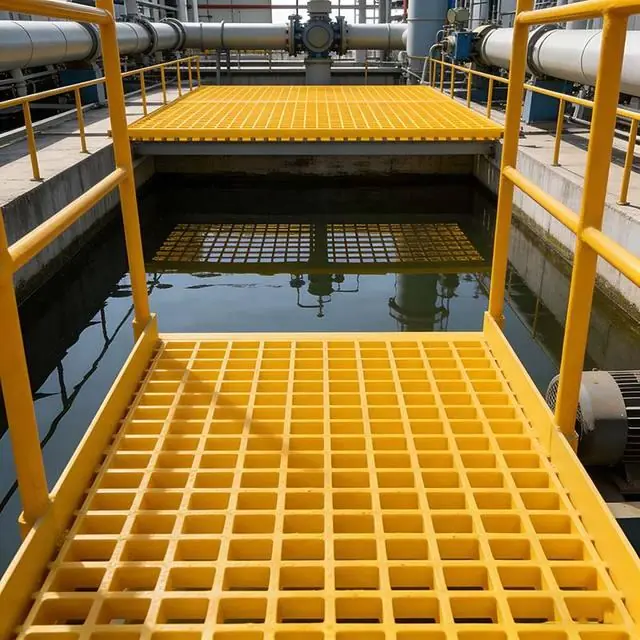
FRP grating (also called fiberglass grating or GRP grating) is an engineered open-mesh panel made from glass-fiber reinforced polymer. It is used for industrial flooring, walkways, work platforms, stair treads and trench covers.
Unlike steel grating, which corrodes in wet and chemical environments, FRP grating is non-metallic and highly resistant to corrosion, acids, alkalis, salt water and chemical vapors. That is why it is used as a long-term engineering solution in oil and gas, petrochemical plants, power plants, water and wastewater treatment, food processing and mining.
Why is FRP grating better than galvanized steel in corrosive environments?
Galvanizing is only a thin protective layer on the surface. Once it is scratched or worn, the steel underneath starts to corrode and the corrosion keeps spreading.
FRP is corrosion-resistant through its entire thickness. Its polymer structure has no rusting mechanism, so surface damage does not lead to corrosion.
Can FRP grating be used in marine and offshore environments?
Yes. FRP grating is one of the best choices for marine environments: it resists salt water, does not rust, is light and needs no periodic painting. It is widely used on jetties, offshore platforms, in shipbuilding and in desalination plants.
Is FRP grating electrically non-conductive?
Yes. FRP grating is made from polymer resin and glass fibers and has very low electrical conductivity. This improves safety in power plants, around switchgear and electrical panels, and anywhere there is a risk of electric shock.
Is FRP grating UV resistant for outdoor use?
Yes. With the right resin, UV-stable pigments and good manufacturing quality, FRP grating is designed for long-term outdoor use. The key factors are resin type, UV-resistant pigment and production quality.
What is the difference between molded and pultruded FRP grating?
Molded FRP grating has a one-piece mesh structure that carries load in two directions. It suits general industrial walkways, platforms and chemical areas.
Pultruded FRP grating is assembled from pultruded bearing bars with continuous longitudinal fibers. It has higher bending strength in the span direction and suits longer spans and heavier loads.
The choice between the two should be based on structural calculations and load tables.
What spans is pultruded FRP grating suitable for?
It depends on the product design, but pultruded grating is generally better where you need wider spacing between supports, higher loads or fewer supports. The final choice should be made from the manufacturer's load tables and engineering calculations.
What is heavy-duty FRP grating?
Heavy-duty FRP grating is designed to carry higher loads than standard grating. It usually has deeper bearing bars, thicker bars, more reinforcement and a stronger mesh design.
It is used where the grating must carry not only foot traffic but also heavy loads such as industrial equipment, heavy carts, machinery or high point loads.
Can FRP grating carry vehicle loads?
Some heavy-duty FRP grating designs can carry wheel loads when correctly specified. You need to check the vehicle weight, axle load, wheel footprint and support spacing before selecting a product.
How do I choose the mesh size of FRP grating?
Mesh size is chosen based on the type of traffic, the load, safety requirements and the risk of objects falling through. Smaller meshes suit areas where walking safety matters most; larger meshes reduce weight and allow more air and light through.
Why is vinyl ester resin used in FRP grating?
Vinyl ester resin has a more chemically resistant structure than polyester and lower permeability to chemicals. That is why vinyl ester FRP grating is used around acid tanks, in petrochemical process units, in treatment plants and in marine environments.
Polyester or vinyl ester FRP grating: which should I choose?
The main difference is chemical resistance and service life in harsh conditions.
Polyester (isophthalic) grating suits general environments, industrial halls and access walkways.
Vinyl ester grating suits petrochemical plants, acid areas, mining and marine environments, where its higher resistance to chemical attack is recommended for severe corrosion.
Is FRP grating fire resistant?
Fire performance depends on the resin, fire-retardant additives and the standard required, for example surface flame spread to ASTM E84. For fire-sensitive projects, a fire-retardant grade should be specified from the start.
How is an anti-slip surface made on FRP grating?
FRP grating can be made slip-resistant in several ways: a concave (meniscus) top surface formed in the mold, a gritted surface with bonded silica or other hard mineral grit, or both. The right surface depends on how wet or oily the area is and how it is used.
What is the difference between a concave and a gritted surface?
A concave surface has molded dimples on the top of the bars that increase friction. A gritted surface has a bonded abrasive grit coating and gives the highest slip resistance. For very slippery areas, a gritted surface is usually chosen.
How is the load capacity of molded FRP grating determined?
Load capacity depends on bearing bar depth, bar thickness, mesh size, support spacing, the mechanical properties of the composite, and resin type and glass content.
In engineering design, the allowable deflection matters as much as the ultimate load. Limiting deflection so the walkway stays safe and comfortable is one of the main selection criteria.
Why are bolts and clips used instead of welding to install FRP grating?
FRP cannot be welded like metal. Panels are fixed with bolts, hold-down clips and saddle clamps. This protects the composite structure from heat damage and makes installation faster, with no hot work on site.
Can FRP grating be cut on site?
Yes, using the right tools such as a diamond cutting disc or tools made for composites. After cutting, the cut edges should be sealed with resin as the manufacturer recommends.
Is FRP grating better than aluminum grating?
Both are lighter than steel, but they differ in important ways. Aluminum grating is light, looks good and machines well, but it has limits in some chemical environments, conducts electricity and usually costs more.
FRP grating offers higher chemical resistance, is non-conductive and does not corrode, making it the better choice for process industries and corrosive environments.
How does FRP grating compare with stainless steel grating?
Stainless steel has good corrosion resistance, but it is heavier, has a higher initial cost and conducts electricity. FRP grating is much lighter, easier to install, has excellent chemical resistance and needs no polishing or surface maintenance. Where weight and environmental resistance matter, FRP is usually more economical over the project life.
Is FRP grating cheaper than steel grating?
Compare life-cycle cost, not just purchase price. Steel may cost less up front, but painting, corrosion repairs, part replacement and production downtime add up over time. Because FRP grating does not corrode and needs little maintenance, it often gives a lower total cost on many projects.
What technical data should I ask for when buying FRP grating?
Do not judge only by price or appearance. Ask the manufacturer for documented data on: resin type (polyester, vinyl ester or epoxy), reinforcement type, approximate glass content, mesh size, bearing bar depth and thickness, weight per square meter, load capacity tables, and the production and test standards used.
Is the weight of FRP grating a good indicator of quality?
Not on its own. Heavier grating is not necessarily better. Bearing bar design, grating depth, fiber type, resin content and mechanical properties matter more; two products of similar weight can have different load capacities.
How long does FRP grating last and does it need maintenance?
Service life depends on the environment, but because FRP does not corrode it lasts far longer than steel in most industrial applications. Maintenance is minimal: routine cleaning, checking for mechanical damage and checking fasteners.
Browse our FRP grating range, read the FRP grating load table and selection guide, or request a quotation.