What is the chemical resistance of polymer composites?
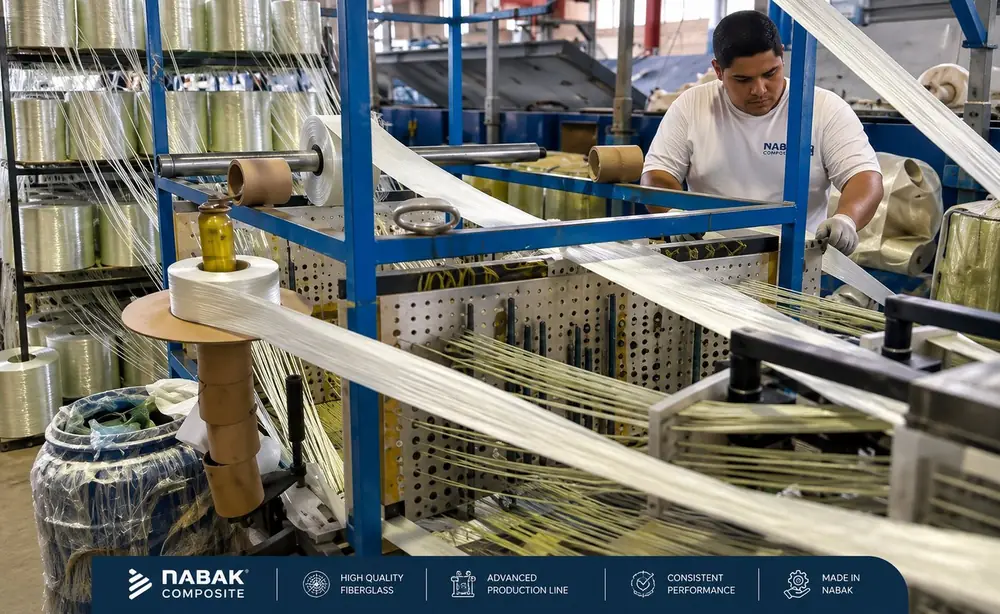
Chemical resistance is the ability of a material to retain its mechanical, visual and dimensional properties during prolonged contact with a chemical environment (a solution, gas or vapor) at a given concentration and temperature. In polymer composites this property depends mainly on the resin, because the resin is the continuous phase that covers the fibers and is the first barrier against the environment. Glass fibers are damaged only if the environment gets through the resin barrier. For an introduction to resin types and their differences, see the article types of composite resin.
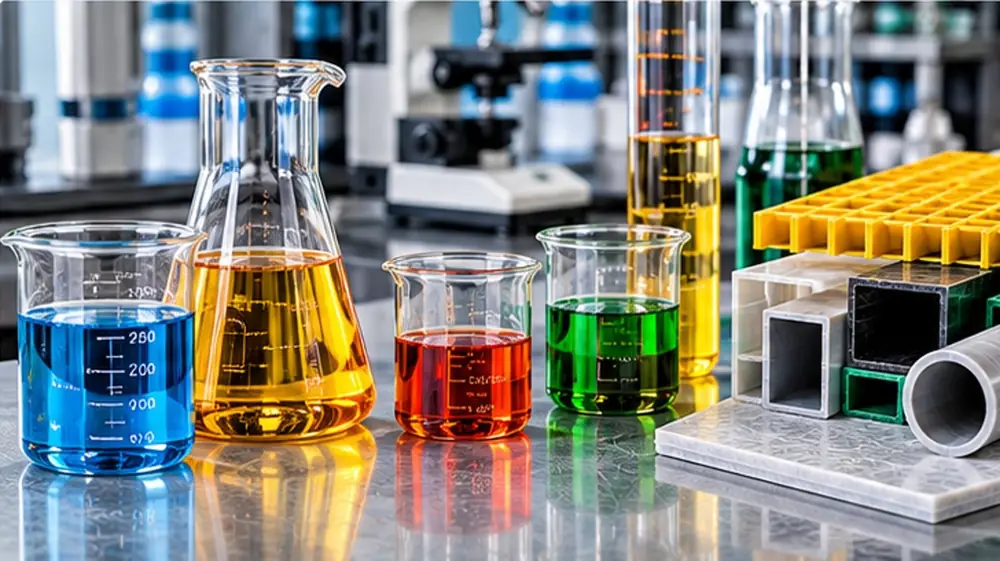
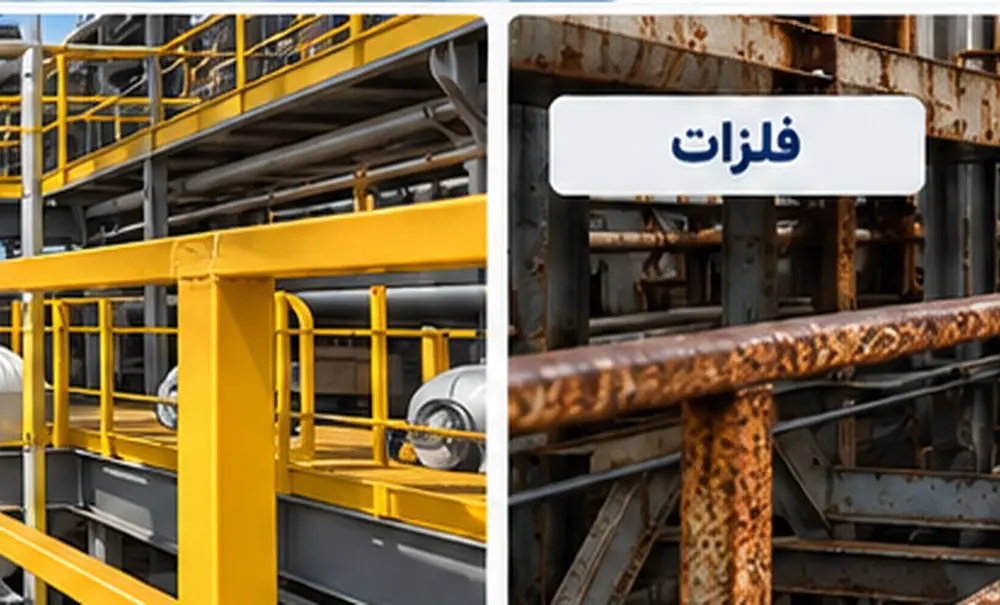
Unlike metals, which are destroyed by an electrochemical reaction (corrosion), polymer composites do not form galvanic cells and perform excellently in salty, chloride and dilute acid environments that are highly destructive to steel. This property has made composites the first choice for water and wastewater treatment plants, chemical units, electroplating, mines, cooling towers and offshore platforms.
How do chemicals attack composites?
Understanding the degradation mechanisms is the key to reading a chemical resistance chart correctly. The five main mechanisms are:
- Diffusion and swelling: molecules of the solution (especially water and solvents) diffuse into the resin network, swell and soften it, and lower its glass transition temperature. Strong solvents such as MEK and carbon disulfide do this to all common resins.
- Hydrolysis: the ester groups in the resin chain break in the presence of water, especially in alkaline environments (saponification) and at high temperature. Polyester resin, with its many ester groups, is the most sensitive; that is why in the chart the polyester column shows "–" for alkaline solutions such as sodium hydroxide and potassium hydroxide at 50 degrees.
- Oxidation: strong oxidizers such as hypochlorite, chromic acid, concentrated nitric acid and permanganate break the resin's bonds and leave the surface powdery and pitted.
- Attack on glass fibers: strong alkalis, hydrofluoric acid and solutions containing fluoride ions dissolve the silicate structure of glass; mineral acids can also cause stress corrosion cracking in E-glass fibers under stress. ECR-glass fibers (boron-free) are much more resistant in acidic environments.
- Osmosis and blistering: water diffusing into voids and under-cured spots forms a concentrated solution there, creating osmotic pressure and surface blisters — a common phenomenon in hot water and in parts with poor cure quality.
Resin grades and their level of chemical resistance
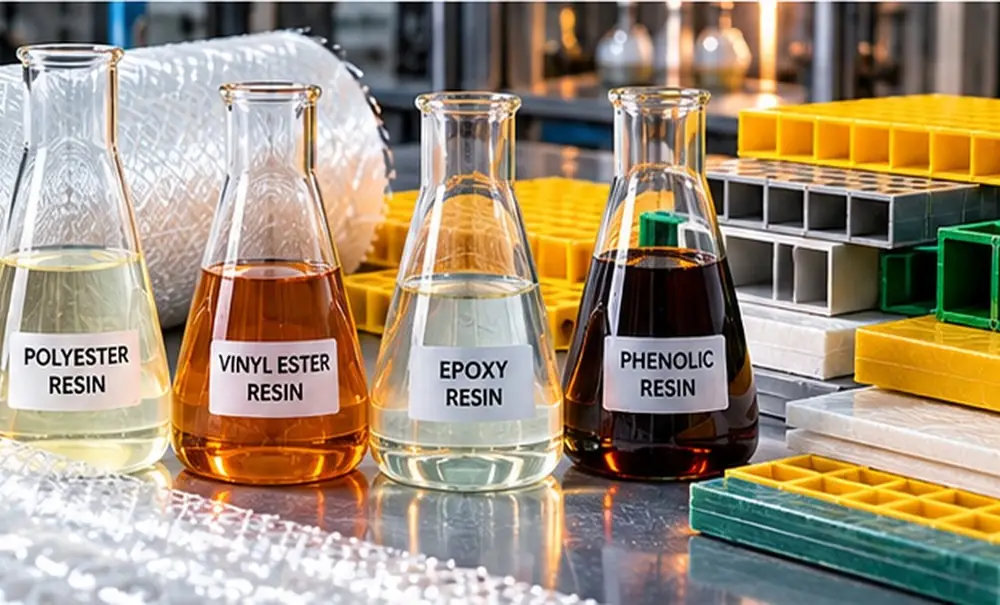
The chemical resistance of polymer composites depends first and foremost on the resin grade. The table below presents common resin grades in the composites industry by level of chemical resistance and application:
| Resin type | Recommended application | Resistance level |
|---|---|---|
| Orthophthalic polyester (Ortho) | Varied weather environments, fresh water and immersion in ordinary water | Corrosion resistance for ordinary conditions |
| Isophthalic polyester (Iso) | Acidic, salt and alkaline environments at low to moderate concentration and ambient temperature | Industrial-grade corrosion resistance |
| Fire-retardant isophthalic polyester | Mild acidic and alkaline environments where flame resistance is also required | Industrial grade + self-extinguishing |
| Vinyl ester (bisphenol A) | Severely corrosive environments, high chemical concentrations, alkalis and higher temperatures | Severe-service corrosion resistance |
| Fire-retardant vinyl ester | Severely corrosive environments that also need better flame resistance | High corrosion and flame resistance |
| Novolac vinyl ester | Solvents, oxidizing acids and high temperatures | The highest resistance in the vinyl ester family |
| Epoxy | Alkalis and certain solvents; high-pressure pipes | Good to excellent (depending on hardener) |
In terms of chemical families, the general behavior of the resins can be summarized as follows:
| Environment family | Ortho polyester | Iso polyester | Vinyl ester | Epoxy |
|---|---|---|---|---|
| Fresh water and seawater (ambient temperature) | Good | Excellent | Excellent | Excellent |
| Hot water (above 60°C) | Poor | Moderate | Excellent | Good |
| Dilute mineral acids (HCl, H₂SO₄) | Moderate | Good | Excellent | Moderate to good |
| Alkalis (NaOH, KOH) | Poor | Poor to moderate | Excellent | Excellent |
| Oxidizers (hypochlorite, chlorine) | Poor | Moderate | Good (with a suitable cure system) | Poor to moderate |
| Neutral salts | Good | Excellent | Excellent | Excellent |
| Strong solvents (ketones, chlorinated) | Poor | Poor | Moderate (novolac better) | Moderate |
Chemical resistance chart for isophthalic polyester and vinyl ester resin
The table below shows the chemical resistance of polymer composites made with iso-grade polyester resin and vinyl ester resin in 82 substances and solutions at 20 and 50 °C. Where a concentration is given, the solution is aqueous. To find a substance quickly, use the search box (name or formula).
| Formula and concentration | Substance | English name | Isophthalic polyester resin (Iso) | Vinyl ester resin | ||
|---|---|---|---|---|---|---|
| 20°C | 50°C | 20°C | 50°C | |||
| AgNO3 | Silver nitrate | Silver nitrate | + | o | + | + |
| AlCl3 | Aluminum chloride | Aluminum chloride | + | + | + | + |
| Al(NO3)3 | Aluminum nitrate | Aluminum nitrate | + | + | + | + |
| Al2(SO4)3 | Aluminum sulfate | Aluminum sulfate | + | + | + | + |
| BaCl2 | Barium chloride | Barium chloride | + | + | + | + |
| BaCO3 | Barium carbonate | Barium carbonate | + | – | + | + |
| Ba(OH)2 | Barium hydroxide | Barium hydroxide | + | – | + | + |
| Ba(NO3)2 | Barium nitrate | Barium nitrate | + | + | + | + |
| BaS | Barium sulfide | Barium sulfide | + | o | + | + |
| BaSO4 | Barium sulfate | Barium sulfate | + | + | + | + |
| CaCl2 | Calcium chloride | Calcium chloride | + | + | + | + |
| Ca(ClO)2, 15% | Calcium hypochlorite | Calcium hypochlorite | + | – | + | + |
| Ca(OH)2, 20% | Calcium hydroxide (limewater) | Calcium hydroxide | + | o | + | + |
| Ca(NO3)2 | Calcium nitrate | Calcium nitrate | + | + | + | + |
| CCl4, 100% | Carbon tetrachloride | Carbon tetrachloride | + | – | + | + |
| CH3-COOH, 5% | Acetic acid | Acetic acid | + | + | + | + |
| CH3-COOH, 50% | Acetic acid | Acetic acid | + | o | + | + |
| CH3-COOH, 75% | Acetic acid | Acetic acid | o | – | + | + |
| C4H8O MEK, 100% | Methyl ethyl ketone (MEK) | Methyl ethyl ketone | – | – | – | – |
| HCOOH, 10% | Formic acid | Formic acid | + | – | + | + |
| C2H5OH, 10% | Ethanol | Ethanol | + | + | + | + |
| CH3OH, 100% | Methanol | Methanol | + | – | + | o |
| CO2 | Carbon dioxide | Carbon dioxide | + | + | + | + |
| CuCl, CuCl2 | Copper chloride | Copper (I, II) chloride | + | + | + | + |
| CuSO4 | Copper sulfate | Copper(II) sulfate | + | + | + | + |
| CS2, 100% | Carbon disulfide | Carbon disulfide | – | – | – | – |
| FeCl2 | Iron(II) chloride | Iron(II) chloride | + | + | + | + |
| Fe(NO3)3 | Iron(III) nitrate | Iron(III) nitrate | + | + | + | + |
| FeSO4 | Iron(II) sulfate | Iron(II) sulfate | + | + | + | + |
| HBr, 10% | Hydrobromic acid | Hydrobromic acid | + | o | + | + |
| HCN, 10% | Hydrogen cyanide | Hydrogen cyanide | + | o | + | + |
| HCl, 5% | Hydrochloric acid | Hydrochloric acid | + | + | + | + |
| HCl, 20% | Hydrochloric acid | Hydrochloric acid | + | + | + | + |
| H2CrO4, 5% | Chromic acid | Chromic acid | + | o | + | + |
| H2CrO4, 10% | Chromic acid | Chromic acid | + | – | + | + |
| HNO3, 5% | Nitric acid | Nitric acid | + | o | + | + |
| H2O2, 3% | Hydrogen peroxide | Hydrogen peroxide | + | o | + | + |
| H2O+Cl2 | Chlorinated water | Chlorinated water | + | o | + | + |
| H3PO4, 10% | Phosphoric acid | Phosphoric acid | + | + | + | + |
| H2SO4, 10% | Sulfuric acid | Sulfuric acid | + | + | + | + |
| H2SO4, 30% | Sulfuric acid | Sulfuric acid | + | o | + | + |
| KCl | Potassium chloride | Potassium chloride | + | + | + | + |
| KOH, 5% | Potassium hydroxide (potash) | Potassium hydroxide | + | – | + | + |
| KOH, 10% | Potassium hydroxide (potash) | Potassium hydroxide | o | – | + | + |
| KOH, 25% | Potassium hydroxide (potash) | Potassium hydroxide | o | – | + | + |
| KOH, 50% | Potassium hydroxide (potash) | Potassium hydroxide | – | – | + | + |
| K2CO3, 10% | Potassium carbonate | Potassium carbonate | + | – | + | + |
| KNO3 | Potassium nitrate | Potassium nitrate | + | + | + | + |
| KMnO4 | Potassium permanganate | Potassium permanganate | o | – | + | + |
| K2SO4 | Potassium sulfate | Potassium sulfate | + | + | + | + |
| MgCl2 | Magnesium chloride | Magnesium chloride | + | + | + | + |
| MgCO3 | Magnesium carbonate | Magnesium carbonate | + | + | + | + |
| Mg(NO3)2 | Magnesium nitrate | Magnesium nitrate | + | + | + | + |
| MgSO4 | Magnesium sulfate | Magnesium sulfate | + | + | + | + |
| NaBr | Sodium bromide | Sodium bromide | + | + | + | + |
| NaCl | Sodium chloride (salt) | Sodium chloride | + | + | + | + |
| NaCN | Sodium cyanide | Sodium cyanide | + | + | + | + |
| Na2CO3, 10% | Sodium carbonate | Sodium carbonate | + | – | + | + |
| NaHCO3, 10% | Sodium bicarbonate | Sodium bicarbonate | + | + | + | + |
| NaHSO3 | Sodium bisulfite | Sodium bisulfite | + | + | + | + |
| NaNO3 | Sodium nitrate | Sodium nitrate | + | + | + | + |
| NaNO2 | Sodium nitrite | Sodium nitrite | + | + | + | + |
| NaOH, 5% | Sodium hydroxide (caustic soda) | Sodium hydroxide | + | – | + | + |
| NaOH, 10% | Sodium hydroxide (caustic soda) | Sodium hydroxide | o | – | + | + |
| NaOH, 25% | Sodium hydroxide (caustic soda) | Sodium hydroxide | o | – | + | + |
| NaOCl, 20% | Sodium hypochlorite (bleach) | Sodium hypochlorite | + | o | + | + |
| Na2SO4 | Sodium sulfate | Sodium sulfate | + | + | + | + |
| Na2SO3 | Sodium sulfite | Sodium sulfite | + | + | + | + |
| Na2S2O3 | Sodium thiosulfate | Sodium thiosulfate | + | + | + | + |
| NH3, 1% | Ammonia | Ammonia | + | – | + | + |
| NH4Br | Ammonium bromide | Ammonium bromide | + | + | + | + |
| NH4Cl | Ammonium chloride | Ammonium chloride | + | + | + | + |
| NH4F | Ammonium fluoride | Ammonium fluoride | + | + | + | + |
| (NH4)2CO3 | Ammonium carbonate | Ammonium carbonate | + | – | + | + |
| NH4NO3 | Ammonium nitrate | Ammonium nitrate | + | + | + | + |
| (NH4)3PO4 | Ammonium phosphate | Ammonium phosphate | + | + | + | + |
| (NH4)2SO4 | Ammonium sulfate | Ammonium sulfate | + | + | + | + |
| NiCl2 | Nickel chloride | Nickel(II) chloride | + | + | + | + |
| Ni(NO3)2 | Nickel nitrate | Nickel nitrate | + | + | + | + |
| NiSO4 | Nickel sulfate | Nickel(II) sulfate | + | + | + | + |
| ZnCl2 | Zinc chloride | Zinc chloride | + | + | + | + |
| ZnSO4 | Zinc sulfate | Zinc sulfate | + | + | + | + |
Critical environments: alkalis, oxidizers and solvents
The largest differences in chemical resistance between polymer composites made with polyester and vinyl ester resin appear in three groups. The table below isolates these rows:
| Substance | Concentration | Iso polyester at 50°C | Vinyl ester at 50°C | Recommendation |
|---|---|---|---|---|
| Caustic soda (sodium hydroxide) | 5 to 25% | – | + | Vinyl ester + synthetic veil |
| Potash (potassium hydroxide) | 5 to 50% | – | + | Vinyl ester |
| Sodium carbonate | 10% | – | + | Vinyl ester |
| Ammonia | 1% | – | + | Vinyl ester |
| Calcium hypochlorite | 15% | – | + | Vinyl ester with special cure |
| Chromic acid | 10% | – | + | Vinyl ester |
| Formic acid | 10% | – | + | Vinyl ester |
| Acetic acid | 75% | – | + | Vinyl ester |
| Methanol | 100% | – | o | Limited contact; novolac vinyl ester |
| MEK and carbon disulfide | 100% | – | – | Standard composites not suitable |
By contrast, in neutral salt solutions such as sodium chloride, potassium chloride, magnesium sulfate, zinc sulfate, sodium nitrate and ammonium nitrate, and in dilute acids such as 10% sulfuric acid and 10% phosphoric acid, both resins have good resistance even at 50 degrees; in these environments isophthalic polyester resin is the more economical choice.
Chemical resistance of polymer composites in salt solutions
Neutral salt solutions, which are highly corrosive to steel, pose the least challenge for composites. The table below summarizes the main salt families in the chemical resistance chart; in these environments even ortho-grade polyester resin performs acceptably at ambient temperature, and the iso grade is reliable up to 50 degrees:
| Family | Examples in the chart | Composite behavior |
|---|---|---|
| Chlorides | Sodium chloride, potassium chloride, calcium chloride, magnesium chloride, aluminum chloride, zinc chloride, nickel(II) chloride, ammonium chloride | Both resins resistant up to 50°C; unlike stainless steel, no chloride pitting |
| Sulfates | Sodium sulfate, magnesium sulfate, zinc sulfate, aluminum sulfate, copper(II) sulfate | Both resins resistant up to 50°C |
| Nitrates | Sodium nitrate, potassium nitrate, calcium nitrate, ammonium nitrate | Both resins resistant up to 50°C |
| Hydroxides and alkaline salts | Calcium hydroxide, barium hydroxide, sodium carbonate | Polyester limited or unsuitable at 50°C; vinyl ester resistant |
Designing the corrosion barrier
The chemical resistance of polymer composites does not depend on the resin alone; the laminate structure is also decisive. In hand lay-up and filament-wound parts such as tanks and pipes, according to ASTM C582 and EN 13121, the wall is built from three layers:
- Resin-rich surface layer (liner): C-glass or synthetic surface veil with about 90 percent resin and a thickness of about 0.25 to 0.5 mm; the first barrier against the environment.
- Resistant interior layer: chopped strand mat with about 70 to 75 percent resin and a thickness of about 2 to 2.5 mm; the second barrier if the surface layer cracks.
- Structural layer: continuous fibers or fabric with a high fiber content to carry the load.
In pultrusion, the equivalent of this structure is a polyester (Nexus) or C-glass surface veil on the profile surface, which creates a resin-rich layer and keeps the fibers away from the environment. In addition, sealing cut edges and holes with the same resin is essential, because at a cut edge the fibers are directly exposed to the chemical environment and the solution penetrates into the part along the fiber–resin interface (wicking).
Testing and evaluating the chemical resistance of composites
Chemical resistance charts for polymer composites are based on standard immersion tests. The most important standard is ASTM C581: laminate specimens are immersed in the chemical solution at the target temperature and removed at intervals (for example 1, 3, 6 and 12 months), and the change in Barcol hardness, flexural strength and modulus, weight, thickness and appearance (discoloration, blisters, cracks, fiber exposure) is measured. ISO 175 and ASTM D543 are also used to evaluate the effect of chemicals on plastics. See the full list of standards in the article composite testing standards.
| Evaluation criterion (ASTM C581) | Sign of good resistance | Sign of degradation |
|---|---|---|
| Barcol hardness | Small drop that stabilizes after a few months | Continuous, severe drop |
| Flexural strength and modulus | Most of the initial properties retained and the trend stabilizes | Continuous loss over time |
| Change in weight and thickness | Slight increase (absorption) that stabilizes | Large swelling or weight loss (resin dissolving) |
| Surface appearance | Slight discoloration | Blisters, cracks, softening, fiber exposure |
Nabak composite products for chemical environments
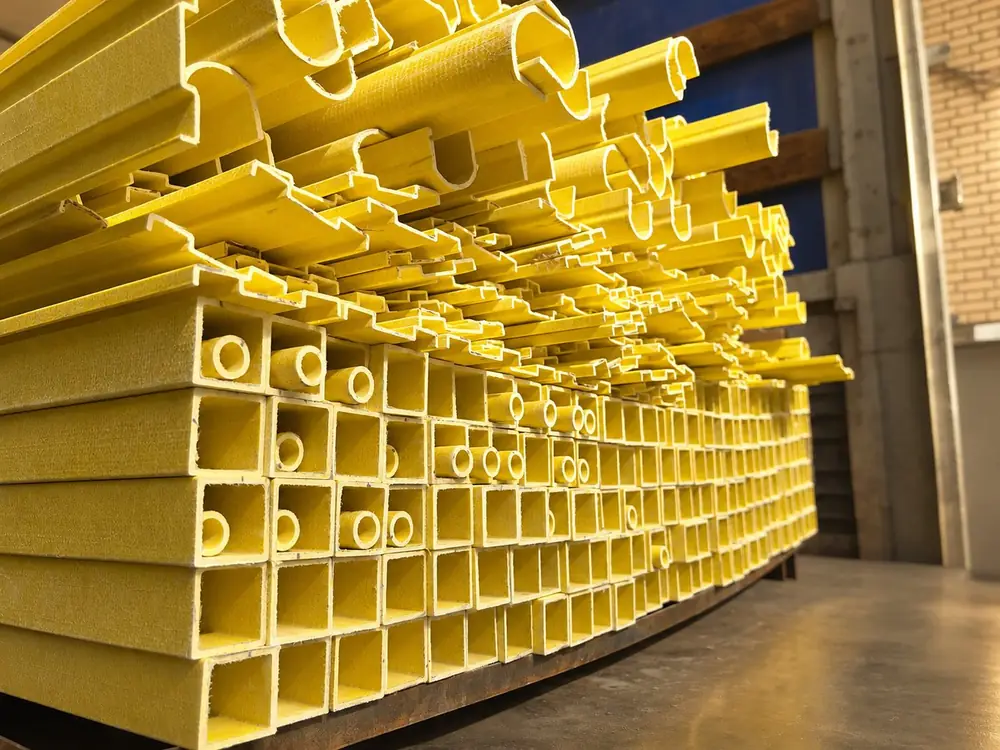
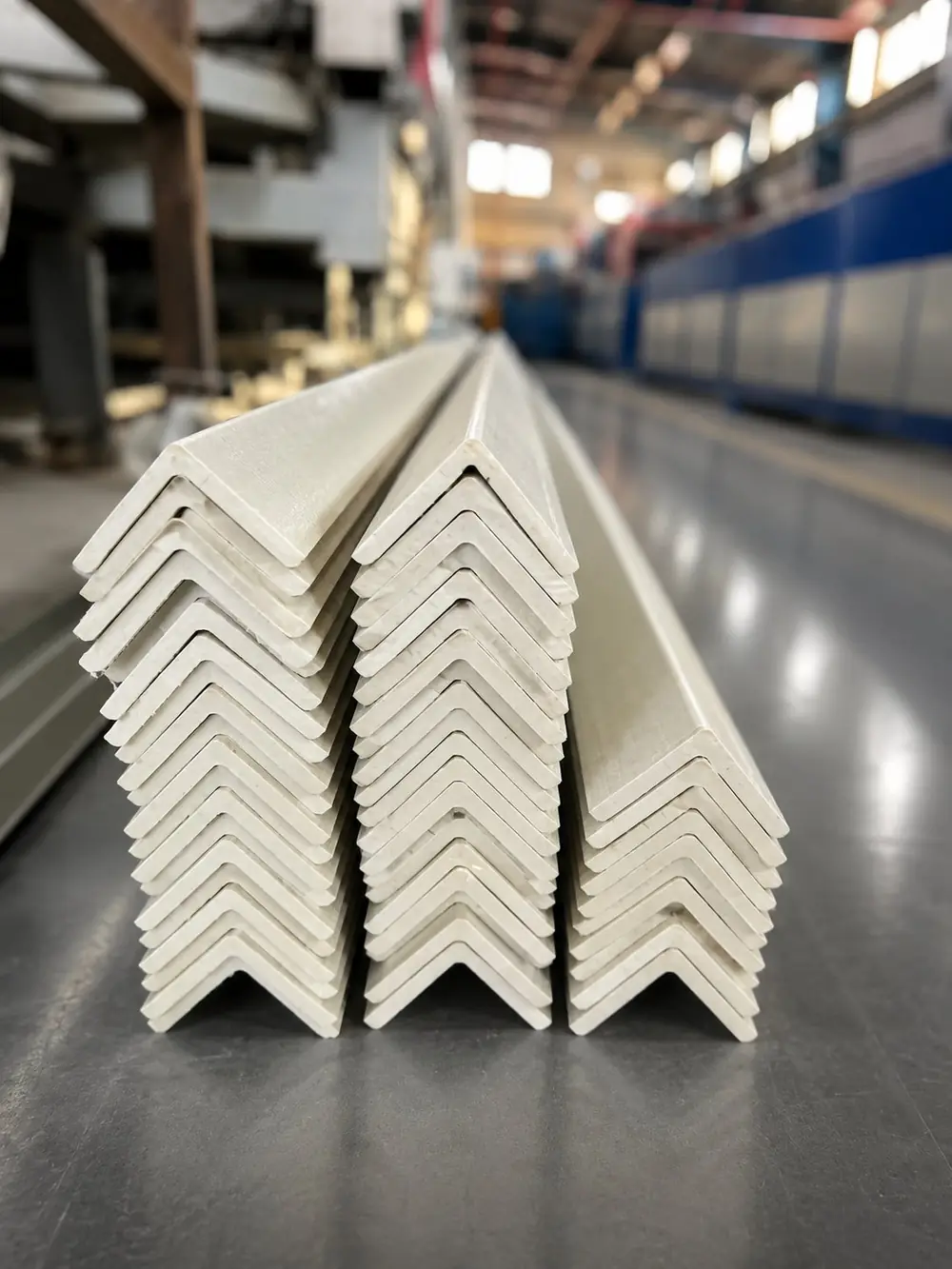
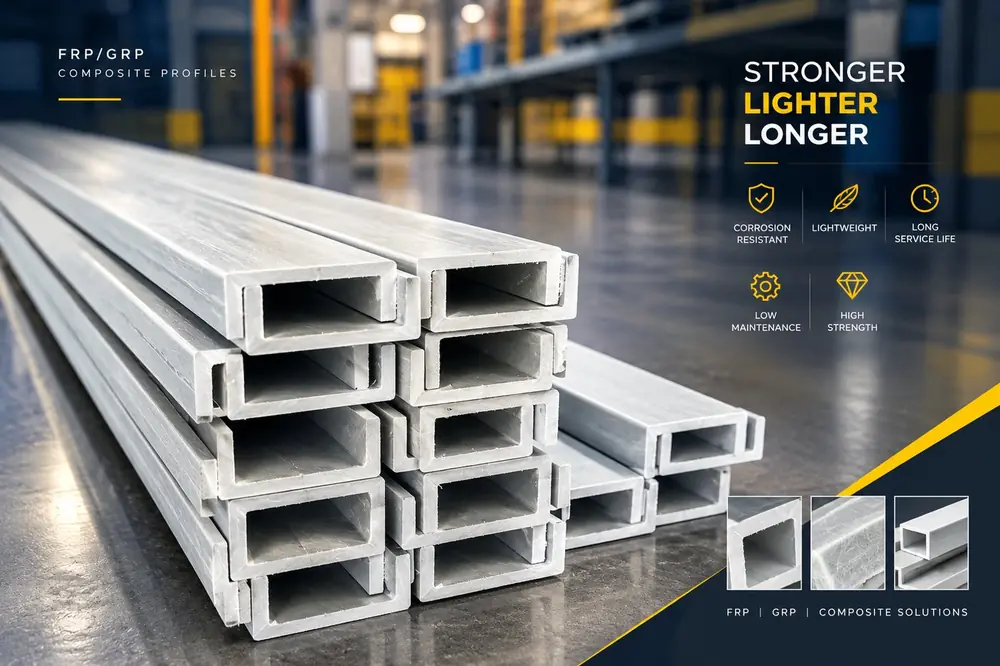
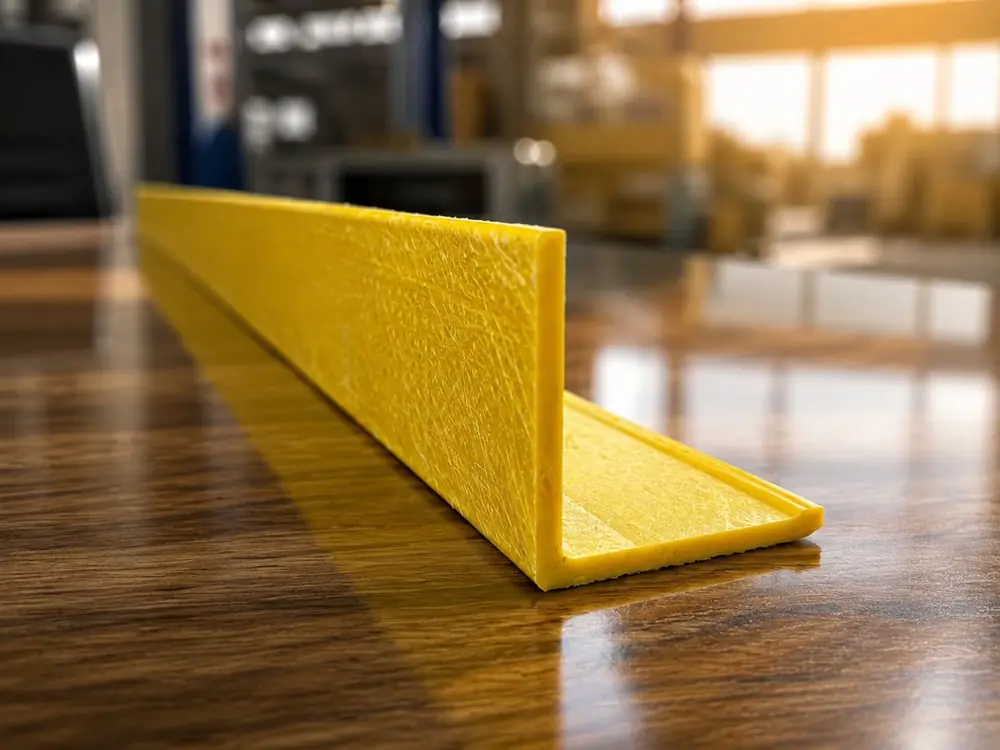
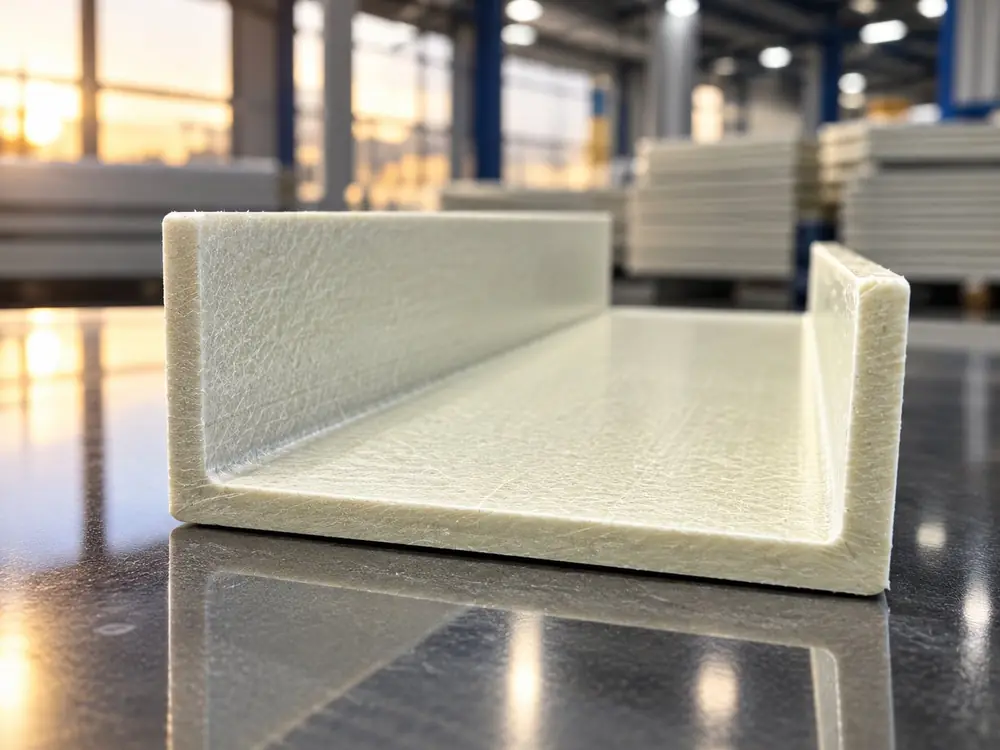
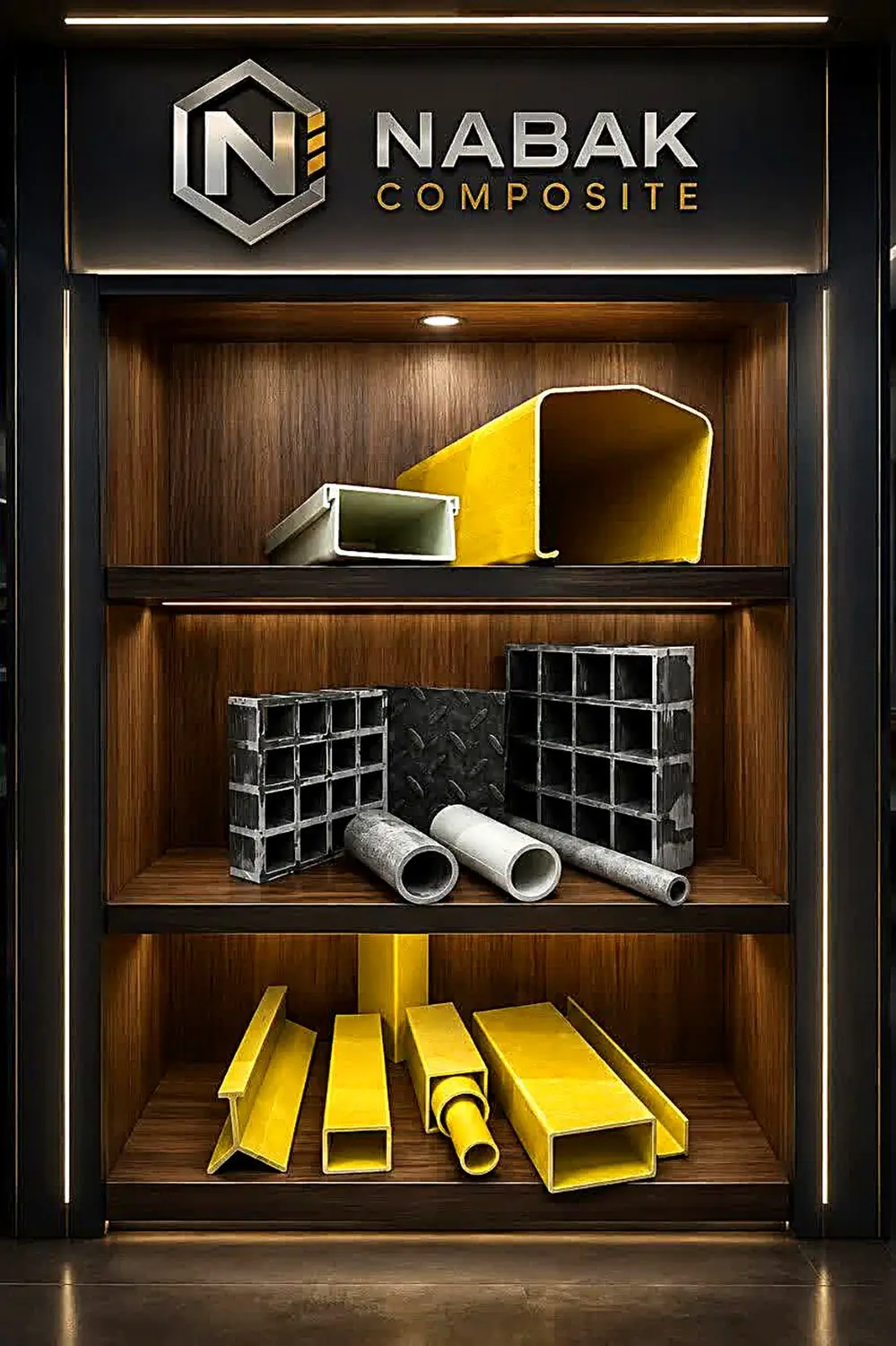
Polyester and vinyl ester resins are used to produce chemical-resistant composite products, including fiberglass sheet (corrugated fiberglass roofing), composite grating, composite box sections, fiberglass angles, composite channels, composite beams, fiberglass tubes, composite flat bars, polymer rods, composite rods, and cable trays and ladders. At Nabak Composite, isophthalic polyester resin is recommended for salt and mild acidic environments, and vinyl ester resin for alkaline, oxidizing and hot environments. Profiles such as composite box sections, channels and beams are produced in both grades.
Choosing a resin for a chemical environment in five steps
- Define the environment precisely: the names of all substances (even in small amounts), concentration, pH, normal and maximum temperature, and the type of exposure (continuous immersion, splash, vapor or occasional spillage).
- Read the chart: choose a resin marked "+" at the project's maximum temperature; "o" is acceptable only for occasional contact and non-critical parts.
- Confirm with the resin manufacturer's data: check the chemical resistance guide of the resin used and the maximum allowable temperature for each environment.
- Specify the surface structure: surface veil, resin-rich layer, edge sealing and fiber type (ECR-glass for acids).
- Test a sample: in unknown or mixed environments, test a specimen in the project's actual solution according to ASTM C581.
Frequently asked questions about the chemical resistance of composites
Is FRP composite resistant to chemicals?
Yes. Polymer composites do not suffer electrochemical corrosion and resist a wide range of acids, salts and many alkalis. However, the chemical resistance of a composite depends on the resin type, solution concentration, temperature and exposure time, and some solvents such as MEK and carbon disulfide attack all common resins.
What is the difference in chemical resistance between isophthalic polyester and vinyl ester resin?
Vinyl ester has fewer ester groups and is much more resistant to hydrolysis, alkalis, oxidizers and higher temperatures. In the chart in this article, isophthalic polyester has good resistance to 48 of 82 substances at 50 degrees, while vinyl ester resists 79.
Which chemicals are harmful to polymer composites?
The most important harmful substances are strong solvents such as methyl ethyl ketone (MEK), acetone, carbon disulfide, and chlorinated and aromatic solvents; hot concentrated alkalis for polyester resin; strong concentrated oxidizers; and solutions containing fluoride or hydrofluoric acid, which attack glass fibers.
How does temperature affect the chemical resistance of composites?
Rising temperature sharply increases the rate of diffusion and chemical reaction; roughly, every 10 degrees of temperature rise doubles the rate of degradation. That is why a substance that is harmless at 20 degrees may attack polyester resin at 50 degrees.
Which standard is used to measure the chemical resistance of composites?
The most common standard is ASTM C581, in which a laminate is immersed in the chemical solution and the change in Barcol hardness, flexural strength and modulus, weight and appearance is measured at set intervals. ISO 175 and ASTM D543 are also used to evaluate the effect of chemicals on plastics.
Summary
The chemical resistance of polymer composites is the main reason FRP replaces steel in the chemical, water and wastewater, and marine industries. This resistance depends first on the resin: isophthalic polyester resin is an economical choice for salt solutions, dilute acids and ambient temperature, but becomes limited quickly in alkalis, oxidizers and at 50 degrees, whereas vinyl ester resin has good resistance to 79 of the 82 substances in the chart even at 50 degrees. Solvents such as MEK and carbon disulfide are destructive to all common resins. Alongside resin selection, a resin-rich surface layer, full cure, edge sealing and the right fiber determine the real service life of the part. With this approach, Nabak composite products work for decades in chemical environments without corrosion or maintenance.

This article was prepared by the technical team of Nabak Composite, a manufacturer of grating, pultruded profiles, sheets and composite products.