What are composite standards and why do they matter in purchasing and design?
Composite standards are a set of test methods, technical specifications and design codes that define how the properties of a composite product are measured, reported and accepted. Each test standard specifies the shape and dimensions of the specimen, the number of specimens, the loading rate, the temperature and humidity conditions and how the result is calculated. Without a reference standard, comparing two datasheets or two suppliers is practically impossible.
The reference standards for polymer composites are published by a few main bodies. Knowing these bodies helps you understand where each standard code comes from and what its equivalent is in another system:
| Body | Code prefix | Main area in composites | Example |
|---|---|---|---|
| American Society for Testing and Materials | ASTM D / E / C / G | Mechanical, physical, fire and pultrusion test methods | ASTM D3039, ASTM D7745 |
| International Organization for Standardization | ISO | International equivalents of tests and product standards | ISO 527-4, ISO 14125 |
| European Committee for Standardization | EN / DIN EN | Product specifications (pultruded profiles) and fire classification | EN 13706, EN 13501-1 |
| International Electrotechnical Commission | IEC | Electrical insulation and thermal properties | IEC 60243-1, IEC 60112 |
| UL laboratories | UL | Flammability rating | UL 94 |
| ACI, ASCE, NEMA, ANSI, ACMA | — | Structural design, rebar, cable trays, ladders and grating | ASCE/SEI 74-23, NEMA FG 1 |
Three levels of quality control for composite products
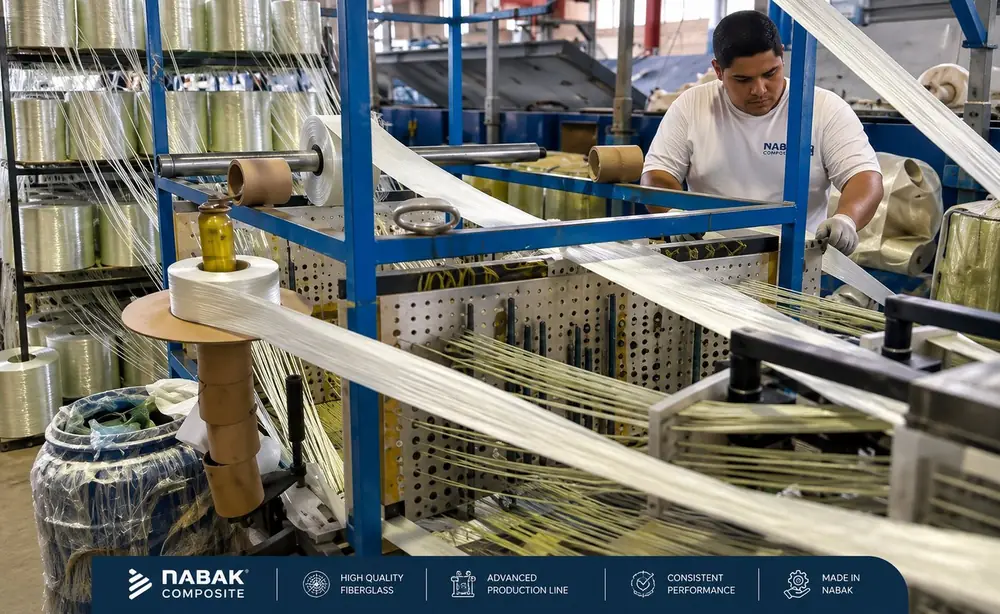
Quality control of composites is not just testing the final product. In composite manufacturing plants, including Nabak Composite, quality control is carried out at three continuous levels, and each level has its own standards:
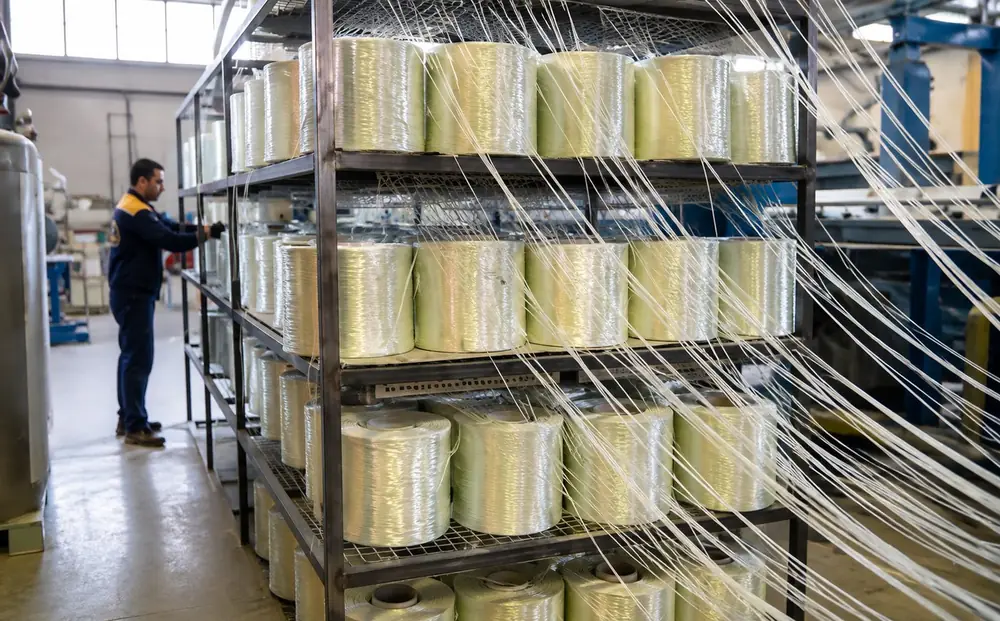
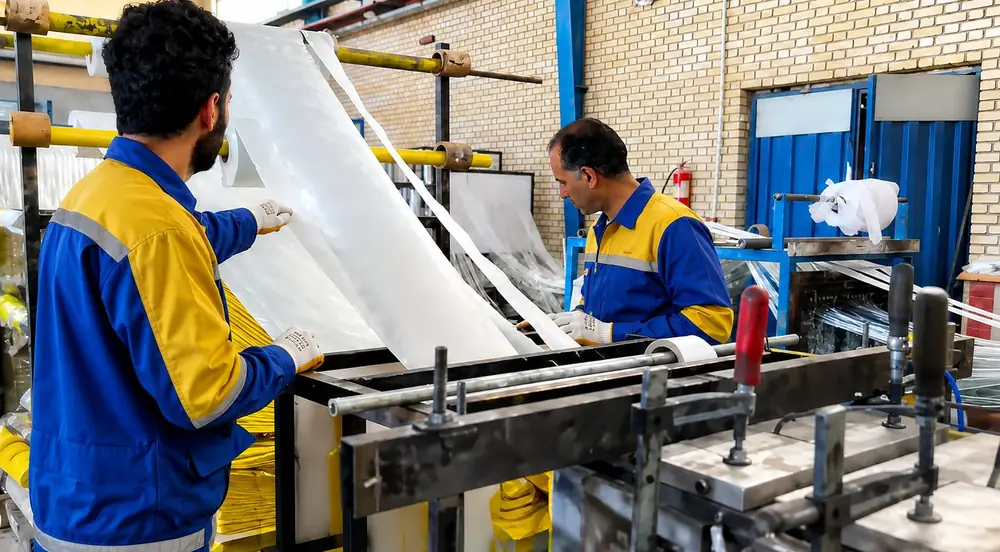
- Level 1: raw material quality control. Glass roving and mat, resin, catalyst, fillers and pigments are checked before use: roving tex, sizing content, fiber moisture, resin viscosity and gel time. An error at this level cannot be corrected in the final product.
- Level 2: production process quality control. Die zone temperatures, pull speed, fiber tension and arrangement, resin bath temperature and degree of cure are continuously monitored and recorded. In pultrusion, quick tests such as Barcol hardness and ILSS on samples from each shift show the stable process window.
- Level 3: final product quality control. This is the most important level for the buyer, because its results can be measured and compared directly. If levels 1 and 2 were not done properly, standard tests on the final product will reveal it. The main part of this article covers the standards at this level.
Raw material quality control standards
Reinforcement yarns — Determination of linear density
Reference standard: ISO 1889
Incoming inspection of glass roving; roving tex directly determines the fiber content of the pultruded profile.
Textile glass — Determination of combustible-matter content
Reference standard: ISO 1887
The amount of surface coating (sizing) on the fibers, which determines fiber–resin compatibility.
Reinforcement products — Determination of moisture content
Reference standard: ISO 3344
Fiber moisture causes voids and reduces fiber-to-resin adhesion.
Plastics — Resins in the liquid state or as emulsions or dispersions — Determination of apparent viscosity using a single cylinder type rotational viscometer method
Reference standard: ISO 2555
International / equivalent standard: ASTM D2196
Resin viscosity controls how quickly the fibers wet out in the pultrusion resin bath.
Plastics — Unsaturated-polyester resins — Measurement of gel time at ambient temperature
Reference standard: ISO 2535
Checking the reactivity of each resin batch before it enters the production line.
Specimen preparation: the common basis of all tests
Before any test, specimens must be cut and prepared by a standard method and conditioned at a specified temperature and humidity. A difference in specimen moisture can change shear and flexural results by several percent, which is why every test standard refers to one of the standards below. The reference standards for this stage are:
Standard Practice for Conditioning Plastics for Testing
Reference standard: ASTM D618
International / equivalent standard: ISO 291
Standard conditions: 23 °C and 50% relative humidity, for at least 40 hours before testing.
Standard Test Method for Moisture Absorption Properties and Equilibrium Conditioning of Polymer Matrix Composite Materials
Reference standard: ASTM D5229
For bringing specimens to equilibrium moisture before "hot-wet" tests.
Fibre-reinforced plastics — Methods of producing test plates
Reference standard: ISO 1268
Methods of making test plates (hand lay-up, pressing, RTM, etc.) for comparative material tests.
Rubber and plastics test equipment — Tensile, flexural and compression types (constant rate of traverse) — Specification
Reference standard: ISO 5893
Accuracy requirements for the universal testing machine (UTM) and grips.
Standards for mechanical properties of composites
Mechanical properties are the core of evaluating composite parts: tensile, flexural and compressive strength and modulus, shear strength, shear modulus, Poisson's ratio, impact, bolt-hole bearing, mechanical and adhesive joints, wear, creep and fatigue. For each property the reference standard, its official title, the equivalent international standard and a practical note are given:
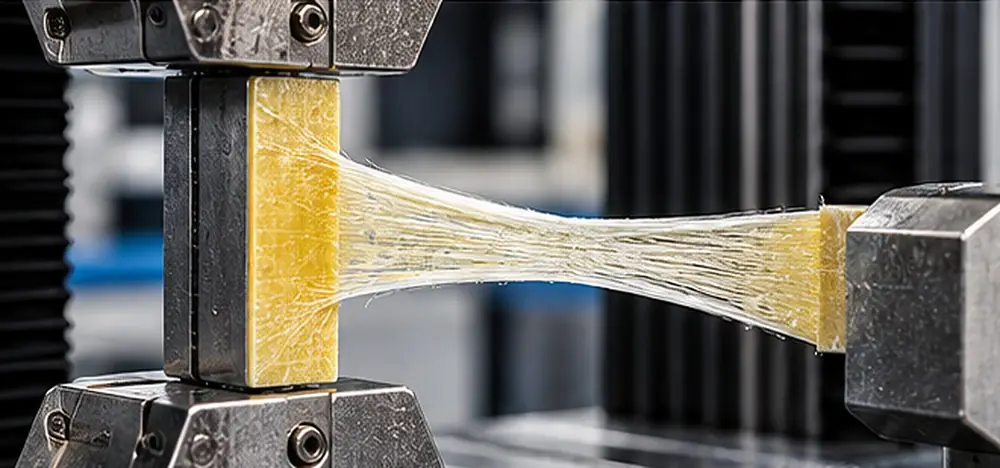
Standard Test Method for Tensile Properties of Polymer Matrix Composite Materials
Reference standard: ASTM D3039
International / equivalent standard: ISO 527-4 / ISO 527-5
The main method for FRP sheets, profiles and laminates; a straight rectangular strip specimen with end tabs. Poisson's ratio is obtained from the same test with a biaxial (longitudinal and transverse) extensometer or strain gauges.
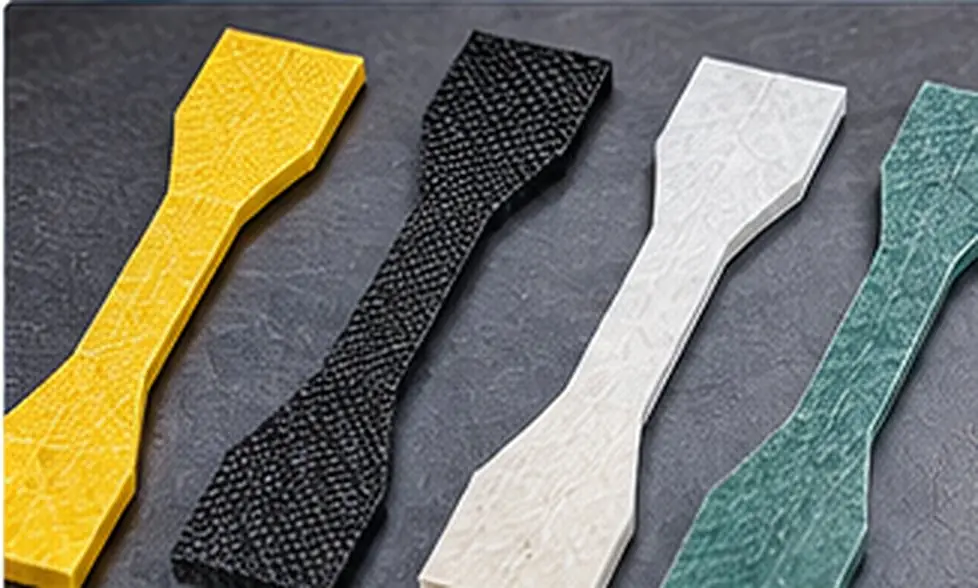
Standard Test Method for Tensile Properties of Plastics
Reference standard: ASTM D638
International / equivalent standard: ISO 527-1 / ISO 527-2
Suitable for plastics and composites with short, random fibers (BMC, SMC and some mat laminates); for high-modulus laminates and pultruded profiles, ASTM D3039 is preferred.
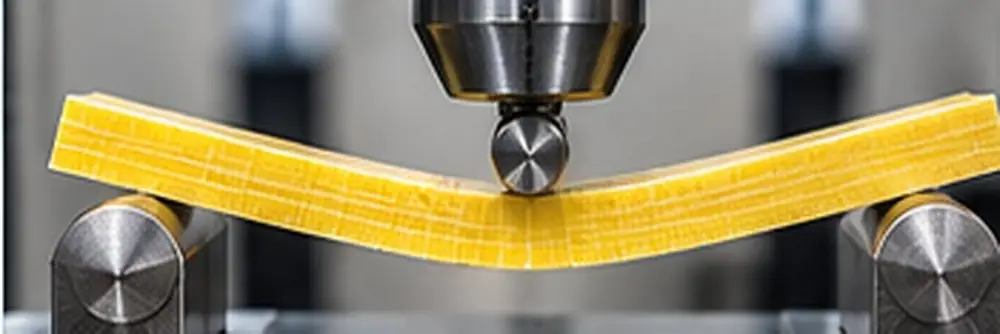
Standard Test Methods for Flexural Properties of Unreinforced and Reinforced Plastics and Electrical Insulating Materials
Reference standard: ASTM D790
International / equivalent standard: ISO 178 / ISO 14125
The basic span-to-thickness ratio is 16:1; for highly anisotropic composites a ratio of 32:1 or 40:1 is recommended to reduce the effect of shear.
Standard Test Method for Flexural Properties of Polymer Matrix Composite Materials
Reference standard: ASTM D7264
International / equivalent standard: ISO 14125
The composite-specific version; three- or four-point with a 32:1 span-to-thickness ratio.
Standard Test Method for Compressive Properties of Rigid Plastics
Reference standard: ASTM D695
International / equivalent standard: ISO 604
For plastics and lower-strength composites; in high-strength laminates, buckling and end crushing of the specimen spoil the result.
Standard Test Method for Compressive Properties of Polymer Matrix Composite Materials Using a Combined Loading Compression (CLC) Test Fixture
Reference standard: ASTM D6641
International / equivalent standard: ISO 14126
The modern compression test method for composites; load is introduced both at the ends and through shear in the grips.
Standard Test Method for Short-Beam Strength of Polymer Matrix Composite Materials and Their Laminates
Reference standard: ASTM D2344
International / equivalent standard: ISO 14130
Span-to-thickness ratio of 4:1; the test most sensitive to wet-out quality, voids and incomplete cure — an excellent daily quality control tool for a pultrusion line.
Standard Test Method for In-Plane Shear Strength of Reinforced Plastics
Reference standard: ASTM D3846
A double-notched specimen in compression; complements D2344 for measuring shear between the notches.
Standard Test Method for Shear Strength of Plastics by Punch Tool
Reference standard: ASTM D732
Measures through-thickness shear in sheets and thin plates.
Standard Test Method for Shear Properties of Composite Materials by the V-Notched Beam Method
Reference standard: ASTM D5379
International / equivalent standard: ISO 15310 (plate twist method)
In-plane shear modulus G; ISO 15310 measures the same property with the different plate twist method.
Standard Test Methods for Determining the Izod Pendulum Impact Resistance of Plastics
Reference standard: ASTM D256
International / equivalent standard: ISO 180
A pendulum test on a notched specimen; ISO 179 is the Charpy method and ISO 6603 is falling-weight (puncture) impact.
Standard Test Method for Bearing Strength of Plastics
Reference standard: ASTM D953
International / equivalent standard: EN 13706-2
Bolt-hole capacity against crushing; the basis for designing bolted connections in pultruded structures.
Standard Test Method for Bearing Response of Polymer Matrix Composite Laminates
Reference standard: ASTM D5961
The composite version of the bearing test, with single-shear and double-shear configurations.
Standard Test Method for Measuring the Fastener Pull-Through Resistance of a Fiber-Reinforced Polymer Matrix Composite
Reference standard: ASTM D7332
Assesses the fastener head pulling through the plate thickness; determines washer diameter and minimum thickness.
Standard Test Method for Determining Strength of Adhesively Bonded Rigid Plastic Lap-Shear Joints in Shear by Tension Loading
Reference standard: ASTM D3163
International / equivalent standard: ISO 4587
Lap-shear test for structural adhesives on rigid plastics.
Standard Test Method for Lap Shear Adhesion for Fiber Reinforced Plastic (FRP) Bonding
Reference standard: ASTM D5868
The specific method for adhesive bonding of FRP parts to each other or to metal — the right choice for evaluating composite adhesive joints.
Standard Test Method for Resistance of Organic Coatings to the Effects of Rapid Deformation (Impact)
Reference standard: ASTM D2794
For gelcoat, paint and UV-protective coatings on composite products.
Plastics — Friction and wear by sliding — Identification of test parameters
Reference standard: ISO 6601
International / equivalent standard: ISO 9352 / ASTM D4060
ISO 9352 is the abrasive wheel (Taber) method; it applies to grating surfaces and heavy-traffic flooring.
Plastics — Determination of creep behaviour
Reference standard: ISO 899
International / equivalent standard: ASTM D2990
ISO 899-1 is tensile creep and ISO 899-2 is three-point flexural creep; the basis for long-term reduction factors in design.
Fibre-reinforced plastics — Determination of fatigue properties under cyclic loading conditions
Reference standard: ISO 13003
International / equivalent standard: ASTM D3479
S-N curve for structures under vibration, traffic or wind.
Standards for composite rebar and pultruded rod
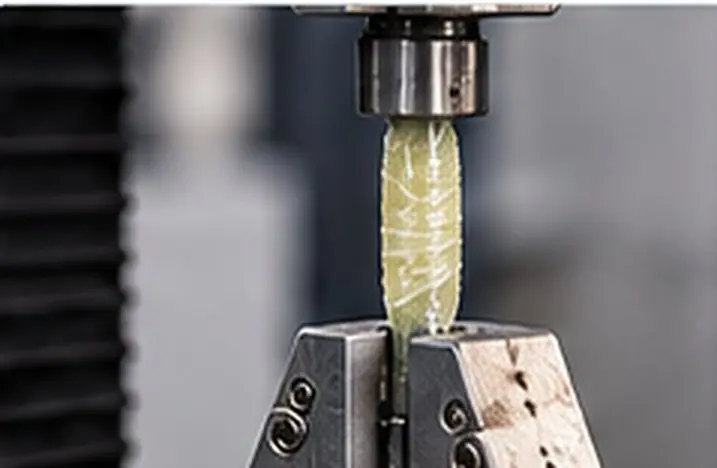
Solid composite rods are made by pultrusion, but because of their round section and stress concentration at the grips they cannot be evaluated with strip and laminate standards. There are separate reference standards for insulating rods and wire and for GFRP rebar for concrete reinforcement; using a laminate standard for composite rods gives unrealistic results, usually below the true value. See the technical specifications of Nabak rods in GFRP rod technical specifications.
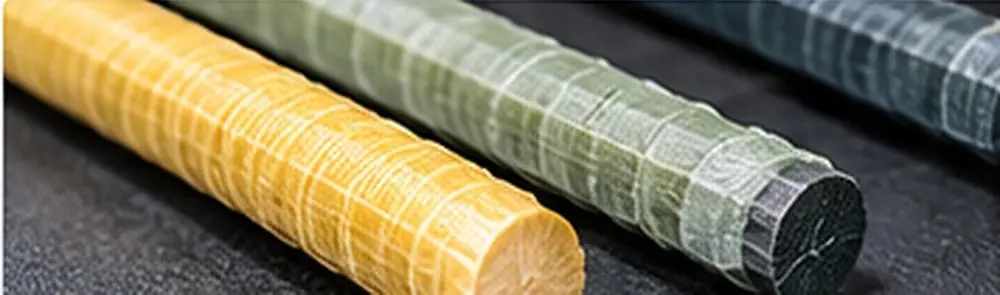
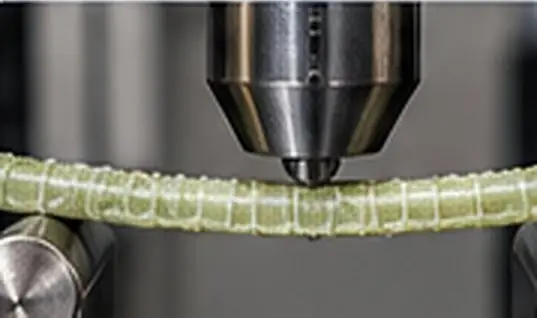
Standard Test Method for Tensile Properties of Pultruded Glass-Fiber-Reinforced Plastic Rod
Reference standard: ASTM D3916
Specific to solid composite rods; the specimen is tested with special grips or bonded end anchors.
Standard Test Method for Flexural Properties of Fiber Reinforced Pultruded Plastic Rods
Reference standard: ASTM D4476
Three-point bending of a round section; for wire, insulating rods and GFRP composite rods.
Standard Test Method for Apparent Horizontal Shear Strength of Pultruded Reinforced Plastic Rods By the Short-Beam Method
Reference standard: ASTM D4475
The ILSS equivalent for a round section; quality control of core wet-out in composite rods.
Standard Test Method for In-Plane Shear Strength of Pultruded Glass-Reinforced Plastic Rod
Reference standard: ASTM D3914
Shear along the length of composite rods; sensitive to voids and longitudinal cracks.
Standard Test Method for Tensile Properties of Fiber Reinforced Polymer Matrix Composite Bars
Reference standard: ASTM D7205
International / equivalent standard: ISO 10406-1
Tensile test of ribbed GFRP rebar with anchor tubes filled with adhesive or grout.
Standard Specification for Solid Round Glass Fiber Reinforced Polymer Bars for Concrete Reinforcement
Reference standard: ASTM D7957
International / equivalent standard: CSA S807 / ACI 440.11
Minimum properties, fiber content, water absorption and glass transition temperature of GFRP rebar; the basis for acceptance on concrete projects.
Standards for physical properties and composition of composites
Physical properties are the quickest way to judge manufacturing quality: density, Barcol hardness (completeness of cure), water absorption, UV resistance, fiber weight content and void content. Many hidden defects of pultrusion or lay-up first show up in these tests. The reference standard for each test and its equivalent are given in the cards below:
Standard Test Methods for Density and Specific Gravity (Relative Density) of Plastics by Displacement
Reference standard: ASTM D792
International / equivalent standard: ISO 1183-1
Immersion (Archimedes) method; the density of a pultruded composite is usually 1.7 to 2.0 g/cm³.
Standard Test Method for Indentation Hardness of Rigid Plastics by Means of a Barcol Impressor
Reference standard: ASTM D2583
International / equivalent standard: EN 59 / EN 13706-2
A quick, non-destructive indicator of complete cure; Rockwell and Shore methods can also be used for composites.
Standard Test Method for Water Absorption of Plastics
Reference standard: ASTM D570
International / equivalent standard: ISO 62
24-hour immersion or to saturation; water absorption of a quality profile is usually below 0.5%.
Standard Practice for Operating Fluorescent Ultraviolet (UV) Lamp Apparatus for Exposure of Nonmetallic Materials
Reference standard: ASTM G154
International / equivalent standard: ISO 4892-3
Accelerated weathering with fluorescent UV lamps and condensation cycles; ASTM G155 / ISO 4892-2 is the xenon-arc method.
Standard Test Method for Ignition Loss of Cured Reinforced Resins
Reference standard: ASTM D2584
International / equivalent standard: ISO 1172
Burning off the resin in a 565 °C furnace and weighing the remaining glass fiber.
Standard Test Methods for Constituent Content of Composite Materials
Reference standard: ASTM D3171
For carbon fiber, which does not burn off in a furnace; the resin is digested with acid.
Standard Test Methods for Void Content of Reinforced Plastics
Reference standard: ASTM D2734
International / equivalent standard: ISO 7822
Calculated by comparing actual density with theoretical density; every 1% of voids can reduce ILSS by several percent.
Standards for electrical properties of composites
Insulation is one of the main advantages of glass composites; for insulating ladders, cable trays, insulating rods and substation equipment, electrical properties must be proven to ASTM and IEC standards. In technical documents, state the reference standard and the test voltage or frequency for every figure:
Standard Test Method for Dielectric Breakdown Voltage and Dielectric Strength of Solid Electrical Insulating Materials at Commercial Power Frequencies
Reference standard: ASTM D149
International / equivalent standard: IEC 60243-1
The most important test for insulating ladders, rods and electrical equipment; in kV/mm.
Standard Test Methods for AC Loss Characteristics and Permittivity (Dielectric Constant) of Solid Electrical Insulation
Reference standard: ASTM D150
International / equivalent standard: IEC 60250 (superseded by: IEC 62631-2-1)
For radome, antenna and high-frequency applications.
Standard Test Methods for DC Resistance or Conductance of Insulating Materials
Reference standard: ASTM D257
International / equivalent standard: IEC 60093 (superseded by: IEC 62631-3-1 / 3-2)
Determines whether a product is insulating or antistatic.
Standard Test Method for High-Voltage, Low-Current, Dry Arc Resistance of Solid Electrical Insulation
Reference standard: ASTM D495
International / equivalent standard: IEC 61621
Time until a conductive path forms under a dry arc.
Method for the determination of the proof and the comparative tracking indices of solid insulating materials
Reference standard: IEC 60112
International / equivalent standard: ASTM D3638
Behavior of an insulating surface under wet, contaminated conditions; important for insulators and cable trays.
Electrical insulation — Thermal evaluation and designation
Reference standard: IEC 60085
Classification of insulation by permissible operating temperature (classes B, F, H, etc.).
Standards for thermal properties of composites
Thermal properties determine the service temperature range and dimensional behavior of composite parts: coefficient of thermal expansion, thermal conductivity, heat deflection temperature, glass transition temperature and long-term thermal endurance. For each property the ASTM or IEC reference standard and its ISO equivalent are given:
Standard Test Method for Coefficient of Linear Thermal Expansion of Plastics Between −30°C and 30°C with a Vitreous Silica Dilatometer
Reference standard: ASTM D696
International / equivalent standard: ISO 11359-2
For a wider temperature range, ASTM E831 (TMA method) applies.
Standard Test Method for Steady-State Heat Flux Measurements and Thermal Transmission Properties by Means of the Guarded-Hot-Plate Apparatus
Reference standard: ASTM C177
International / equivalent standard: ISO 8302
The thermal conductivity of glass composite is about 0.2 to 0.4 W/m·K.
Standard Test Method for Deflection Temperature of Plastics Under Flexural Load in the Edgewise Position
Reference standard: ASTM D648
International / equivalent standard: ISO 75-3
ISO 75-3 is specific to high-strength thermoset laminates.
Standard Test Method for Assignment of the Glass Transition Temperature By Dynamic Mechanical Analysis
Reference standard: ASTM E1640
International / equivalent standard: ISO 6721-11
A more precise indicator than HDT of maximum service temperature and resin cure quality.
Electrical insulating materials — Thermal endurance properties — Part 1: Ageing procedures and evaluation of test results
Reference standard: IEC 60216-1
Predicting the thermal life of insulation by ageing at several elevated temperatures (Arrhenius plot).
Standards for fire behavior and flammability
Polymer composites are not fireproof, but with fire-retardant resins and additives they can reach high safety ratings. Flammability, flame spread, smoke and oxygen index are measured with the standards below. Read about safety considerations in safety when working with composites. Note that a fire rating only has meaning when the reference standard is stated; "fire-retardant" without a standard number is not a measurable claim:
Standard Test Method for Rate of Burning and/or Extent and Time of Burning of Plastics in a Horizontal Position
Reference standard: ASTM D635
International / equivalent standard: IEC 60695-11-10
A preliminary burning behavior test; equivalent to the HB rating in UL 94.
Standard for Safety of Flammability of Plastic Materials for Parts in Devices and Appliances Testing
Reference standard: UL 94
International / equivalent standard: IEC 60695-11-10 / 11-20
V-0 means self-extinguishing in less than 10 seconds with no flaming drips.
Standard Test Method for Surface Burning Characteristics of Building Materials
Reference standard: ASTM E84
International / equivalent standard: UL 723
Flame spread index (FSI) and smoke developed index (SDI); Class 1 (A) means FSI ≤ 25 — the most common fire requirement for grating and profiles.
Standard Test Method for Surface Flammability of Materials Using a Radiant Heat Energy Source
Reference standard: ASTM E162
The specimen is assessed under radiant heat (without direct flame contact); common in the rail transport industry.
Standard Test Method for Specific Optical Density of Smoke Generated by Solid Materials
Reference standard: ASTM E662
International / equivalent standard: ISO 5659-2 / ASTM D2843
How much visibility is reduced by smoke; important for tunnels, metros and enclosed spaces.
Standard Test Method for Measuring the Minimum Oxygen Concentration to Support Candle-Like Combustion of Plastics (Oxygen Index)
Reference standard: ASTM D2863
International / equivalent standard: ISO 4589-2
An index above 21% means the material barely burns in normal air; fire-retardant resins are usually above 30%.
Standard Test Method for Heat and Visible Smoke Release Rates for Materials and Products Using an Oxygen Consumption Calorimeter
Reference standard: ASTM E1354
International / equivalent standard: ISO 5660-1
The most complete fire engineering data: time to ignition, peak heat release rate and smoke.
Fire classification of construction products and building elements — Part 1: Classification using data from reaction to fire tests
Reference standard: EN 13501-1
The European classification A1 to F, with smoke class (s1–s3) and flaming droplets class (d0–d2).
Standards for chemical and corrosion resistance
Chemical resistance is the main reason composites are chosen in the chemical, water treatment and petrochemical industries. The choice of resin (isophthalic polyester, vinyl ester or epoxy) should be based on the results of these tests and the relevant reference standard:
Standard Practice for Determining Chemical Resistance of Thermosetting Resins Used in Glass-Fiber-Reinforced Structures Intended for Liquid Service
Reference standard: ASTM C581
International / equivalent standard: ISO 175
Immersing a laminate in a chemical solution and measuring the loss of Barcol hardness and flexural strength over time.
Standard Specification for Contact-Molded Reinforced Thermosetting Plastic (RTP) Laminates for Corrosion-Resistant Equipment
Reference standard: ASTM C582
Ply structure (corrosion barrier, structural layer) in hand lay-up and spray-up parts.
Standard Practices for Evaluating the Resistance of Plastics to Chemical Reagents
Reference standard: ASTM D543
Evaluates changes in weight, dimensions, appearance and mechanical properties after exposure to chemicals.
Standard Practice for Operating Salt Spray (Fog) Apparatus
Reference standard: ASTM B117
International / equivalent standard: ISO 9227
Composites do not suffer electrochemical corrosion; this test applies to metal fittings, bolts and coatings in a composite assembly.
General standards: visual defects, terminology and laboratories
This group of composite standards defines the common language of buyer, manufacturer and laboratory: which defects are acceptable, what each term means and which laboratory's test report is valid. These standards are usually cited in contracts as the reference for visual acceptance.
Standard Practice for Classifying Visual Defects in Glass-Reinforced Plastic Laminate Parts
Reference standard: ASTM D2563
Defects such as voids, cracks, dry spots, wrinkles and inclusions, at three acceptance levels.
Standard Practice for Classifying Visual Defects in Parts Molded from Reinforced Thermosetting Plastics
Reference standard: ASTM D2562
For pressed and molded parts such as molded grating.
Standard Terminology for Composite Materials
Reference standard: ASTM D3878
International / equivalent standard: ISO 472
Consistent definitions for contracts, datasheets and test reports.
General requirements for the competence of testing and calibration laboratories
Reference standard: ISO/IEC 17025
A valid test report must be issued by a laboratory accredited to this standard.
Standards for pultrusion and pultruded profiles
Pultruded profiles (box sections, angles, channels, I-beams, flat bars and pultruded grating) are the most important group of structural composite products, and a full set of ASTM and EN 13706 standards exists for them. Read about the production process in what is pultrusion.
EN 13706: the comprehensive European reference for pultruded profiles
EN 13706, titled Reinforced plastic composites — Specifications for pultruded profiles, is the most complete product standard for pultruded profiles and is published in three parts:
- EN 13706-1 (designation): the coding of a profile by shape, dimensions and grade.
- EN 13706-2 (test methods and general requirements): dimensional tolerances, visual defects, Barcol hardness and property test methods — including the pin-bearing test and full-section flexural modulus in its technical annexes.
- EN 13706-3 (specific requirements): two quality grades, E23 and E17, with specified minimum mechanical properties.
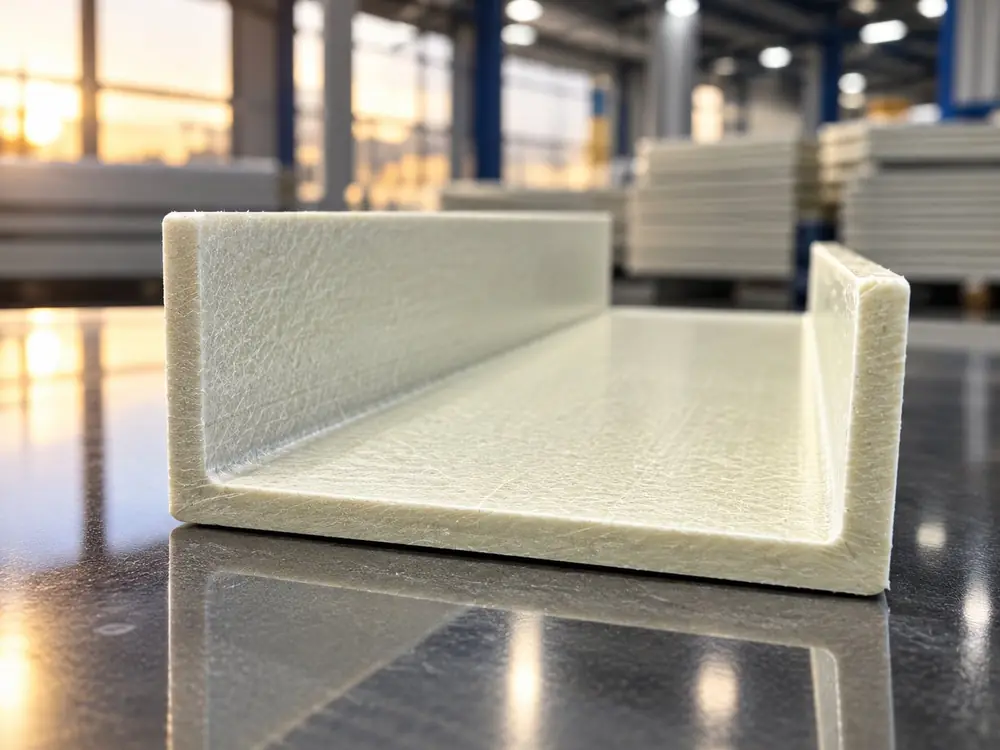
The table below shows the minimum properties of pultruded profiles under EN 13706-3; grade E23 is for structural applications and grade E17 for general applications. The test method for each property is specified in EN 13706-2 and the related ISO standards:
| Property (EN 13706-3) | Direction | Grade E23 | Grade E17 | Test method |
|---|---|---|---|---|
| Tensile modulus (GPa) | Longitudinal 0° | 23 | 17 | ISO 527-4 |
| Tensile modulus (GPa) | Transverse 90° | 7 | 5 | ISO 527-4 |
| Tensile strength (MPa) | Longitudinal 0° | 240 | 170 | ISO 527-4 |
| Tensile strength (MPa) | Transverse 90° | 50 | 30 | ISO 527-4 |
| Pin-bearing strength (MPa) | Longitudinal 0° | 150 | 90 | EN 13706-2 |
| Pin-bearing strength (MPa) | Transverse 90° | 70 | 50 | EN 13706-2 |
| Flexural strength (MPa) | Longitudinal 0° | 240 | 170 | ISO 14125 |
| Flexural strength (MPa) | Transverse 90° | 100 | 70 | ISO 14125 |
| Interlaminar shear strength ILSS (MPa) | Longitudinal 0° | 25 | 15 | ISO 14130 |
How to check a profile's compliance with EN 13706
A claim of "produced to EN 13706" must be backed by measurable evidence. When checking compliance, first verify the profile designation code under EN 13706-1 (shape, dimensions and grade); then ask for test reports under EN 13706-2 covering dimensions and tolerances, visual defects, Barcol hardness (at least 90% of the value declared by the resin manufacturer) and mechanical properties; and finally compare the results with the E23 or E17 minimums in EN 13706-3. For structural composite parts such as beams, columns and platforms, grade E23 is recommended; for non-structural composite parts such as covers, ducts and light handrails, grade E17 is sufficient. EN 13706 measures composite properties on specimens cut from the profile itself, not on a separate test plate, so its results show the properties of the composite in the real product — making it the most accurate reference for evaluating pultruded polymer composites.
Pultrusion-specific ASTM standards
Standard Practice for Testing Pultruded Composites
Reference standard: ASTM D7745
A roadmap for choosing the test method for each property of a pultruded profile.
Standard Practice for Classifying Reinforced Plastic Pultruded Shapes According to Composition
Reference standard: ASTM D3647
Coding a section by resin type, fiber type and content, and filler.
Standard Specification for Dimensional Tolerance of Thermosetting Glass-Reinforced Plastic Pultruded Shapes
Reference standard: ASTM D3917
International / equivalent standard: EN 13706-2
Tolerances on thickness, dimensions, flatness, twist and angle; details in Nabak's article on pultrusion dimensional tolerances.
Standard Terminology Relating to Reinforced Plastic Pultruded Products
Reference standard: ASTM D3918
Technical terms for roving, mat, surface veil and pultrusion defects.
Standard Practice for Classifying Visual Defects in Thermosetting Reinforced Plastic Pultruded Products
Reference standard: ASTM D4385
International / equivalent standard: EN 13706-2
Defects such as exposed fibers, surface cracks, pits, burns and resin streaks.
Standard Test Method for Dye Penetration of Solid Fiberglass Reinforced Pultruded Stock
Reference standard: ASTM D5117
Reveals fine longitudinal cracks and channels by capillary dye penetration; a control test for insulating rods.
Standard Test Method for Curing Properties of Pultrusion Resins by Thermal Analysis
Reference standard: ASTM D5028
By DSC; degree of cure and the exothermic peak — the basis for setting die temperature and pull speed.
Standard Test Method for Determining Flexural Modulus of Full Section Pultruded Fiber Reinforced Polymer (FRP) Composite Members with Doubly Symmetric Cross Sections under Bending
Reference standard: ASTM D8069
International / equivalent standard: EN 13706-2
A test on the profile itself with no specimen cutting; the most realistic stiffness data for beam design.
Standard Practice for Elevated Temperature and Moisture Conditioning of Pultruded Fiber Reinforced Polymer (FRP) Composites Used in Structural Designs
Reference standard: ASTM D7992
Determining property reduction factors under hot-wet conditions.
Standard Practice for Freeze/Thaw Conditioning of Pultruded Fiber Reinforced Polymer (FRP) Composites Used in Structural Designs
Reference standard: ASTM D7792
The effect of cold and heat cycles on the properties of structural profiles.
Standard Test Method for Translaminar Fracture Toughness of Laminated and Pultruded Polymer Matrix Composite Materials
Reference standard: ASTM E1922
Resistance to crack growth perpendicular to the fibers; important around holes and cut-outs.
Standard for Load and Resistance Factor Design (LRFD) for Pultruded Fiber Reinforced Polymer (FRP) Structures
Reference standard: ASCE/SEI 74-23
International / equivalent standard: EN 1990 / CEN/TS 19101
The official code for pultruded structural design (successor to the 2010 LRFD pre-standard); CEN/TS 19101 is the European technical specification for the design of FRP structures.
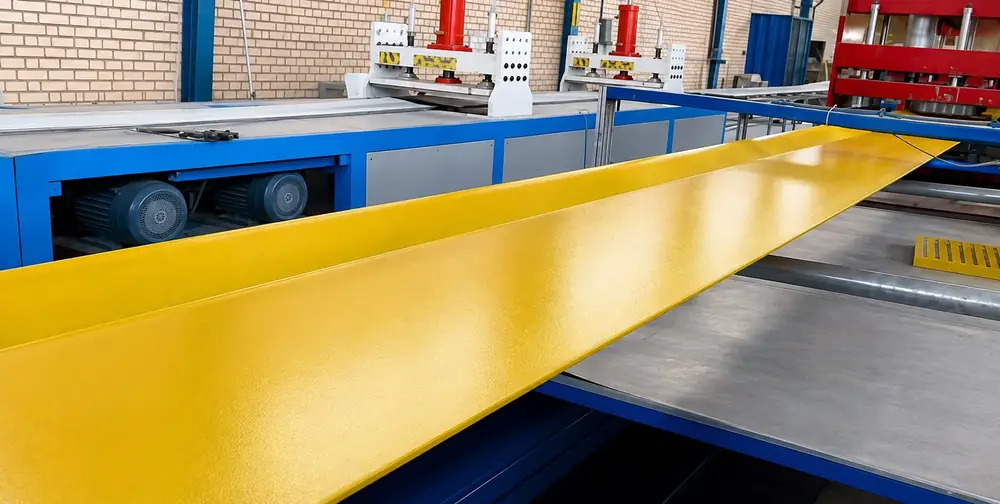
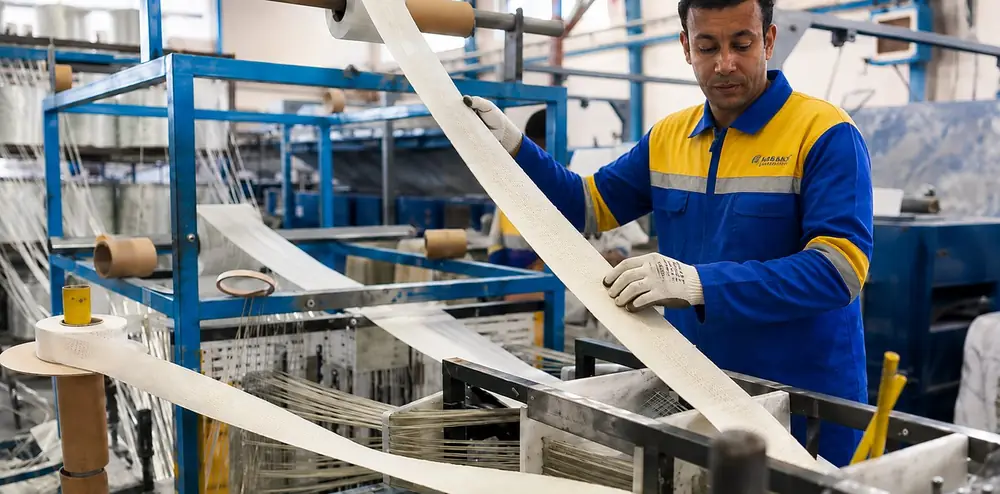
Meeting tolerances and defect classifications directly affects installation and the finished look of a project; see the details in pultrusion dimensional tolerances.
Composite product standards: grating, handrails, ladders, cable trays and pipe
Besides material test standards, many composite products have a product standard or design guide that sets the design load, the full-part test method and safety requirements. In tenders, the product reference standard should be cited alongside the material test standards:
Standard Specification for Fiberglass (GRP) Pultruded Open-Weather Storm and Guard, Square Railing Systems
Reference standard: ASTM F1092
International / equivalent standard: ISO 14122-3
Design load, post spacing and point-load testing of railings.
Safety of machinery — Permanent means of access to machinery — Part 3: Stairs, stepladders and guard-rails
Reference standard: ISO 14122-3
Guard rail height (at least 1100 mm), toe board and knee rail.
Standard Specification for Fiber-Reinforced Polymer (FRP) Gratings Used in Marine Construction and Shipbuilding
Reference standard: ASTM F3059
Mechanical, fire and smoke requirements for marine composite grating.
FRP Composites Grating Manual for Pultruded and Molded Grating and Stair Treads
Reference standard: ACMA FG01-17
Test methods for load, deflection, slip resistance and fire for composite grating.
Standard Test Methods for Determining the Full Section Flexural Modulus and Bending Strength of Fiber Reinforced Polymer Crossarms Assembled with Center Mount Brackets
Reference standard: ASTM D8019
For composite crossarms on power distribution poles.
American National Standard for Ladders — Portable Reinforced Plastic — Safety Requirements
Reference standard: ANSI ASC A14.5
Load, stability and dielectric test requirements for fiberglass ladder rails.
Fiberglass Cable Tray Systems
Reference standard: NEMA FG 1
Load class, span, fittings and testing of composite cable trays and cable ladders.
Petroleum and natural gas industries — Glass-reinforced plastics (GRP) piping
Reference standard: ISO 14692
International / equivalent standard: AWWA M45
Pressure rating, 20 to 50 year design and pipe acceptance tests; AWWA M45 is the design guide for fiberglass water pipe.
GRP tanks and vessels for use above ground
Reference standard: EN 13121
International / equivalent standard: ASME RTP-1
Materials, design, fabrication and testing of industrial composite tanks.
Summary table of composite standards: which property, which standard?
The table below shows all the reference standards in this guide at a glance, for quick reference when preparing technical specifications, purchase requests or reviewing datasheets:
| Property / subject | Reference standard | International / equivalent standard |
|---|---|---|
| Linear density (tex) of roving (raw materials) | ISO 1889 | — |
| Combustible matter (sizing) content of glass fiber (raw materials) | ISO 1887 | — |
| Moisture content of fiber and mat (raw materials) | ISO 3344 | — |
| Resin viscosity (raw materials) | ISO 2555 | ASTM D2196 |
| Gel time of polyester resin (raw materials) | ISO 2535 | — |
| Conditioning of specimens before testing (specimen preparation) | ASTM D618 | ISO 291 |
| Moisture absorption and moisture conditioning of composites (specimen preparation) | ASTM D5229 | — |
| Preparation of composite test plates (specimen preparation) | ISO 1268 | — |
| Tensile, flexural and compression test equipment (specimen preparation) | ISO 5893 | — |
| Tensile strength, tensile modulus and Poisson's ratio (mechanical) | ASTM D3039 | ISO 527-4 / ISO 527-5 |
| Tensile properties of plastics (dumbbell specimen) (mechanical) | ASTM D638 | ISO 527-1 / ISO 527-2 |
| Flexural strength and modulus (three-point) (mechanical) | ASTM D790 | ISO 178 / ISO 14125 |
| Flexural properties of polymer matrix composites (mechanical) | ASTM D7264 | ISO 14125 |
| Compressive strength and modulus of rigid plastics (mechanical) | ASTM D695 | ISO 604 |
| Compressive properties of composites by combined loading (CLC) (mechanical) | ASTM D6641 | ISO 14126 |
| Interlaminar shear strength (ILSS, short beam) (mechanical) | ASTM D2344 | ISO 14130 |
| In-plane shear strength of reinforced plastics (mechanical) | ASTM D3846 | — |
| Shear strength by punch tool (mechanical) | ASTM D732 | — |
| Shear modulus and strength (V-notched beam, Iosipescu) (mechanical) | ASTM D5379 | ISO 15310 (plate twist method) |
| Izod impact strength (mechanical) | ASTM D256 | ISO 180 |
| Pin bearing strength (mechanical) | ASTM D953 | EN 13706-2 |
| Bearing response of composite laminates (mechanical) | ASTM D5961 | — |
| Fastener pull-through resistance (mechanical) | ASTM D7332 | — |
| Shear strength of lap-joint adhesive bonds (mechanical) | ASTM D3163 | ISO 4587 |
| Lap-shear adhesion for FRP bonding (mechanical) | ASTM D5868 | — |
| Impact resistance of organic coatings (mechanical) | ASTM D2794 | — |
| Friction and sliding wear (mechanical) | ISO 6601 | ISO 9352 / ASTM D4060 |
| Tensile and flexural creep (mechanical) | ISO 899 | ASTM D2990 |
| Fatigue under cyclic loading (mechanical) | ISO 13003 | ASTM D3479 |
| Tensile properties of pultruded solid rod (rod and wire) | ASTM D3916 | — |
| Flexural properties of pultruded rod (rod and wire) | ASTM D4476 | — |
| Apparent horizontal shear strength of rod (short beam) (rod and wire) | ASTM D4475 | — |
| In-plane shear strength of pultruded rod (rod and wire) | ASTM D3914 | — |
| Tensile properties of FRP bars for concrete reinforcement (rod and wire) | ASTM D7205 | ISO 10406-1 |
| Specification for GFRP bars for concrete (rod and wire) | ASTM D7957 | CSA S807 / ACI 440.11 |
| Density and specific gravity (physical) | ASTM D792 | ISO 1183-1 |
| Barcol hardness (physical) | ASTM D2583 | EN 59 / EN 13706-2 |
| Water absorption (physical) | ASTM D570 | ISO 62 |
| Resistance to ultraviolet (UV) light (physical) | ASTM G154 | ISO 4892-3 |
| Fiber weight content (ignition loss) (physical) | ASTM D2584 | ISO 1172 |
| Constituent content (acid digestion) (physical) | ASTM D3171 | — |
| Void content (physical) | ASTM D2734 | ISO 7822 |
| Dielectric strength and breakdown voltage (electrical) | ASTM D149 | IEC 60243-1 |
| Dielectric constant and dissipation factor (electrical) | ASTM D150 | IEC 60250 (superseded by: IEC 62631-2-1) |
| Volume and surface resistivity (electrical) | ASTM D257 | IEC 60093 (superseded by: IEC 62631-3-1 / 3-2) |
| Arc resistance (electrical) | ASTM D495 | IEC 61621 |
| Comparative tracking index (CTI) (electrical) | IEC 60112 | ASTM D3638 |
| Thermal class of electrical insulation (electrical) | IEC 60085 | — |
| Coefficient of linear thermal expansion (thermal) | ASTM D696 | ISO 11359-2 |
| Thermal conductivity (guarded hot plate) (thermal) | ASTM C177 | ISO 8302 |
| Heat deflection temperature (HDT) (thermal) | ASTM D648 | ISO 75-3 |
| Glass transition temperature (Tg) by DMA (thermal) | ASTM E1640 | ISO 6721-11 |
| Thermal ageing and thermal endurance (thermal) | IEC 60216-1 | — |
| Rate of burning in a horizontal position (fire) | ASTM D635 | IEC 60695-11-10 |
| Flammability classification (HB, V-2, V-1, V-0) (fire) | UL 94 | IEC 60695-11-10 / 11-20 |
| Surface burning characteristics of building materials (tunnel) (fire) | ASTM E84 | UL 723 |
| Surface flammability using a radiant heat source (fire) | ASTM E162 | — |
| Specific optical density of smoke (fire) | ASTM E662 | ISO 5659-2 / ASTM D2843 |
| Oxygen index (LOI) (fire) | ASTM D2863 | ISO 4589-2 |
| Heat release rate (cone calorimeter) (fire) | ASTM E1354 | ISO 5660-1 |
| Reaction-to-fire classification of construction products (fire) | EN 13501-1 | — |
| Chemical resistance of reinforced thermosetting resins (chemical and corrosion) | ASTM C581 | ISO 175 |
| Specification for contact-molded RTP laminates (chemical and corrosion) | ASTM C582 | — |
| Resistance of plastics to chemical reagents (chemical and corrosion) | ASTM D543 | — |
| Salt spray (fog) (chemical and corrosion) | ASTM B117 | ISO 9227 |
| Classifying visual defects in GRP laminate parts (general) | ASTM D2563 | — |
| Classifying visual defects in molded parts (general) | ASTM D2562 | — |
| Terminology for composite materials (general) | ASTM D3878 | ISO 472 |
| Competence of testing and calibration laboratories (general) | ISO/IEC 17025 | — |
| Guide to testing pultruded composites (pultrusion) | ASTM D7745 | — |
| Classifying pultruded shapes by composition (pultrusion) | ASTM D3647 | — |
| Dimensional tolerances of pultruded shapes (pultrusion) | ASTM D3917 | EN 13706-2 |
| Terminology for pultruded products (pultrusion) | ASTM D3918 | — |
| Classifying visual defects in pultruded products (pultrusion) | ASTM D4385 | EN 13706-2 |
| Dye penetration of solid pultruded shapes (pultrusion) | ASTM D5117 | — |
| Curing properties of pultrusion resins by thermal analysis (pultrusion) | ASTM D5028 | — |
| Full-section flexural modulus of pultruded profiles (pultrusion) | ASTM D8069 | EN 13706-2 |
| Elevated temperature and moisture conditioning for structural design (pultrusion) | ASTM D7992 | — |
| Freeze–thaw cycle conditioning (pultrusion) | ASTM D7792 | — |
| Translaminar fracture toughness (pultrusion) | ASTM E1922 | — |
| LRFD design of pultruded structures (pultrusion) | ASCE/SEI 74-23 | EN 1990 / CEN/TS 19101 |
| Outdoor pultruded square railings (product) | ASTM F1092 | ISO 14122-3 |
| Stairs, fixed ladders and guard rails for machinery access (product) | ISO 14122-3 | — |
| FRP grating in marine and shipbuilding structures (product) | ASTM F3059 | — |
| Guidelines for pultruded and molded grating and stair treads (product) | ACMA FG01-17 | — |
| Full-section flexural modulus and strength of FRP crossarms (product) | ASTM D8019 | — |
| Safety of portable reinforced plastic ladders (product) | ANSI ASC A14.5 | — |
| Fiberglass cable tray systems (product) | NEMA FG 1 | — |
| GRP piping in the oil and gas industries (product) | ISO 14692 | AWWA M45 |
| Above-ground GRP tanks and vessels (product) | EN 13121 | ASME RTP-1 |
Buyer's checklist: what documents to ask a composite supplier for
- A reference standard for every figure: next to each property in the datasheet, ask for the standard number (for example ASTM D3039 or ISO 527-4) and the specimen direction (longitudinal or transverse).
- A valid test report: a report from a laboratory accredited to ISO/IEC 17025, with the number of specimens, mean and standard deviation.
- Product grade: for pultruded profiles, grade E23 or E17 under EN 13706-3.
- Ongoing controls: Barcol hardness, fiber content and ILSS results for each production batch.
- Fire and environment: fire rating (ASTM E84 or EN 13501-1), UV resistance and chemical resistance suited to the project environment.
- Tolerances and appearance: visual defect acceptance level to ASTM D4385 or EN 13706-2, and tolerances to ASTM D3917 or EN 13706-2.
Frequently asked questions about composite standards
What is the most important tensile test standard for composites?
For FRP sheets, profiles and laminates, ASTM D3039 and its international equivalent ISO 527-4 (and ISO 527-5 for unidirectional laminates) are the main references. ASTM D638 is better suited to plastics and short-fiber composites, and ASTM D3916 is used for solid pultruded rods.
What is EN 13706?
EN 13706 is the European specification standard for pultruded profiles and has three parts: part 1 designation, part 2 test methods and general requirements (dimensions, visual defects and tests), and part 3 specific requirements, which defines two grades, E23 and E17, with minimum tensile moduli of 23 and 17 GPa.
At how many levels is quality control of composite products carried out?
At three levels: quality control of raw materials (fibers, resin and additives), quality control of the production process (die temperature, pull speed, fiber tension and cure), and quality control of the final product with standard mechanical, physical, thermal, electrical and fire tests.
What does Barcol hardness show in a composite?
Barcol hardness to ASTM D2583 or EN 59 is a quick, non-destructive indicator of complete resin cure. The measured value should usually be at least 90 percent of the hardness declared by the resin manufacturer for fully cured resin.
Which standards are used to measure the fire behavior of composites?
The most common are ASTM E84 (flame spread and smoke; Class 1 with a flame spread index below 25), UL 94 (ratings HB to V-0), ASTM D2863 or ISO 4589-2 (oxygen index), ASTM E662 (smoke density), ASTM E1354 or ISO 5660-1 (cone calorimeter) and the European classification EN 13501-1.
Summary
Composite standards are the common language of designer, manufacturer and buyer. Quality control of polymer composites is carried out at three levels — raw materials, process and final product — and at product level there is a specific reference standard for each property: ASTM D3039 and ISO 527-4 for tension, ASTM D790 and ISO 14125 for flexure, ASTM D2344 and ISO 14130 for interlaminar shear, ASTM D2583 for Barcol hardness, ASTM D2584 and ISO 1172 for fiber content, ASTM E84 and UL 94 for fire, and ASTM C581 for chemical resistance. For pultruded profiles, EN 13706 with grades E23 and E17 and the set of ASTM pultrusion standards are the references, and ASCE/SEI 74-23 for structural design. Every figure in the datasheets of Nabak composite products can be traced to its reference standard — which means the composite properties you see on paper are the properties you get on the project.

This article was prepared by the technical team of Nabak Composite, a manufacturer of grating, pultruded profiles, sheets and composite products.