What is composite wire and GFRP rebar?
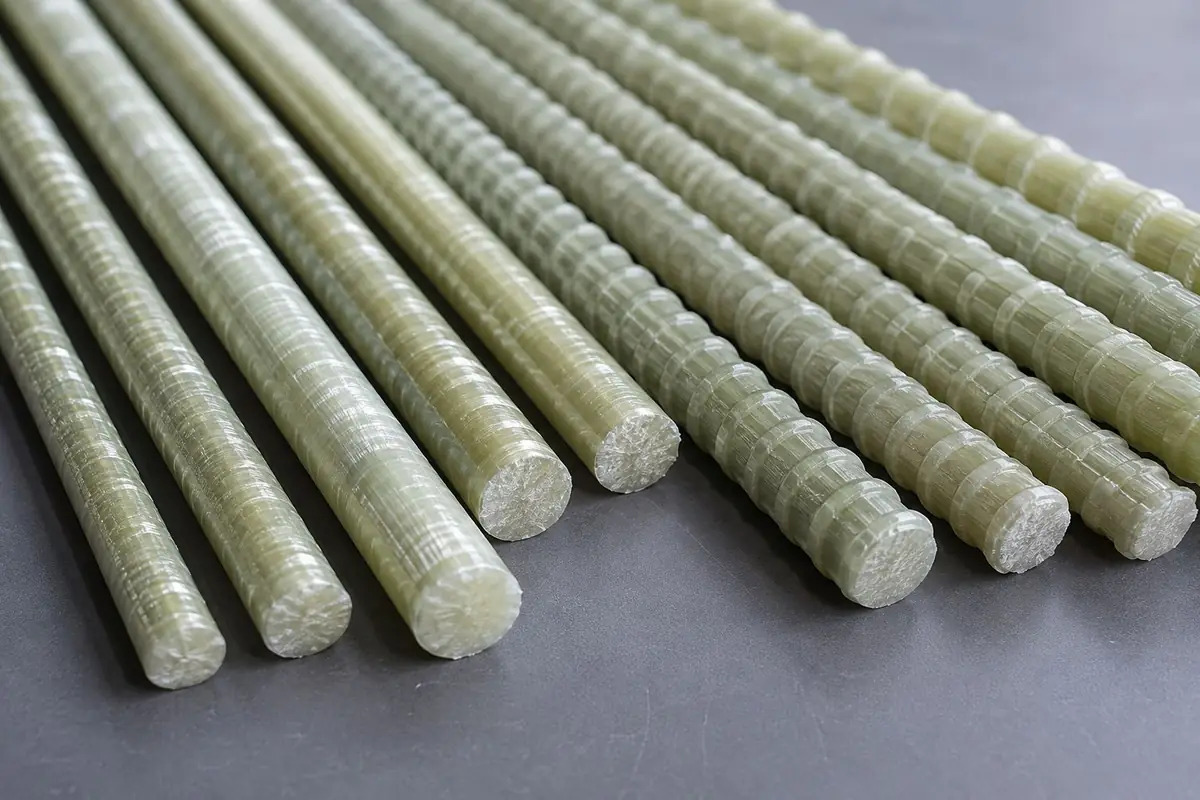
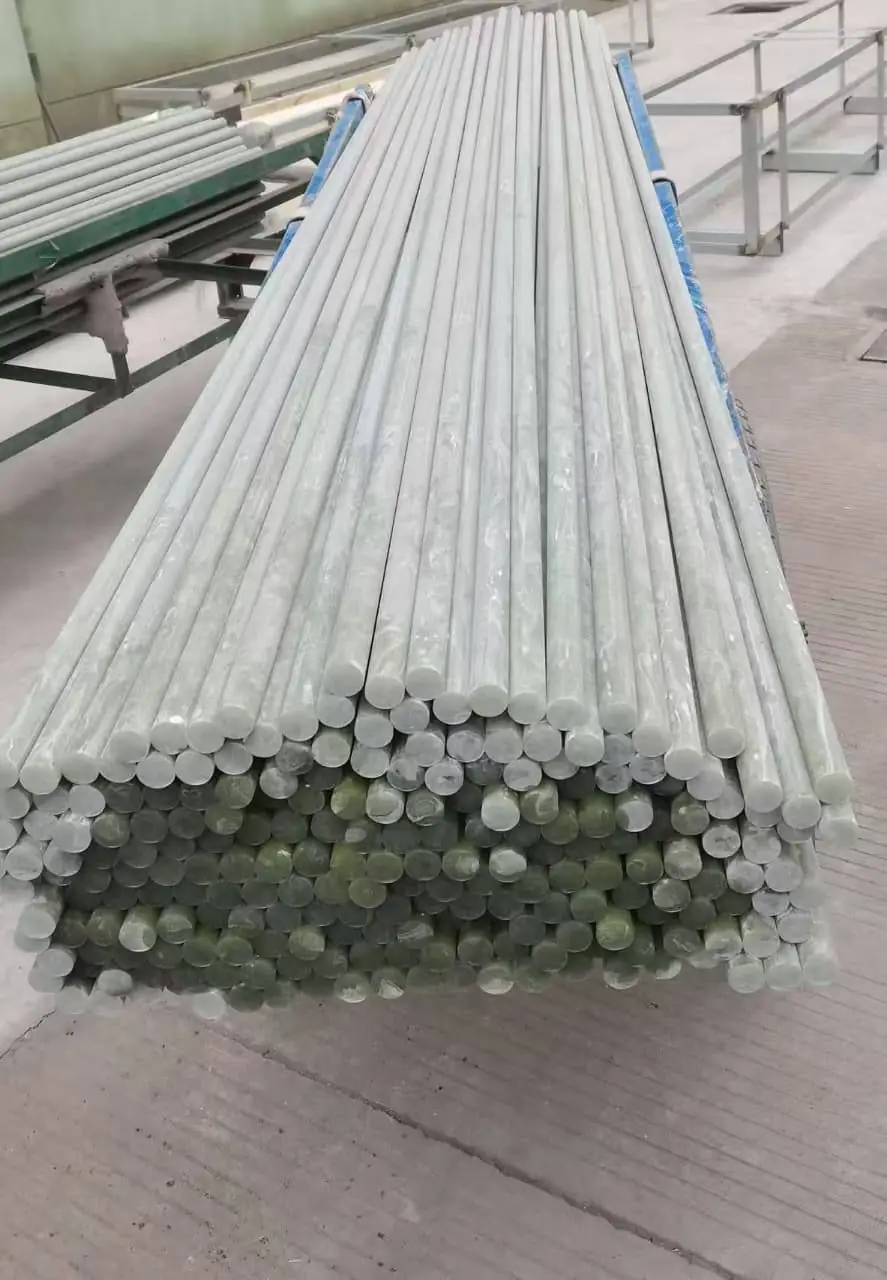
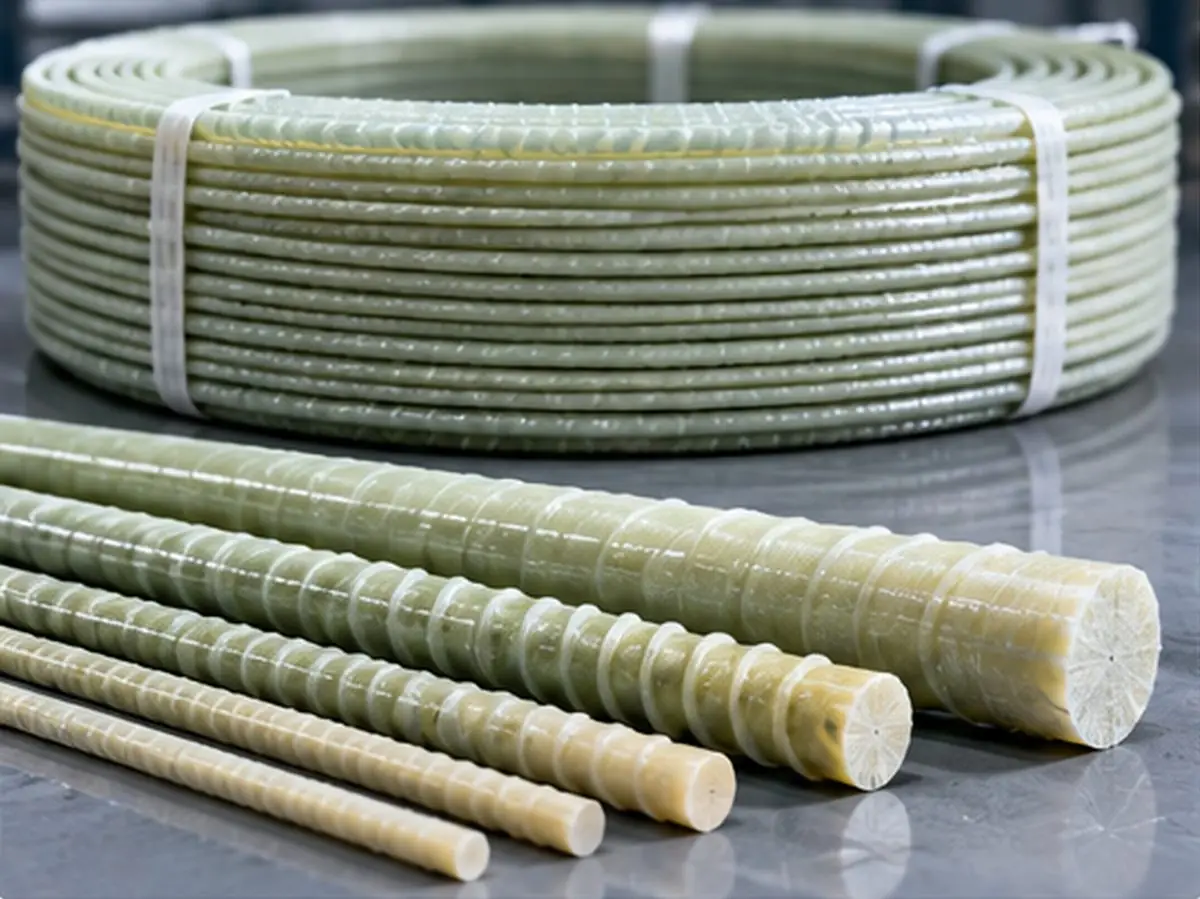
Composite wire, also known as fiberglass wire, fiberglass rod, composite rebar and GFRP rebar (glass fiber reinforced polymer), is a solid round section produced by pultrusion from thousands of parallel strands of glass fiber and thermoset resin. In market usage, small diameters supplied in coils are usually called "wire" and larger diameters supplied in straight lengths are called "rebar"; but both are the same product with the same intrinsic properties.
Nabak composite rods are produced with vinyl ester resin and a glass fiber weight fraction of more than 80 percent. This combination gives the highest level of mechanical properties among pultruded products and excellent resistance to corrosion, moisture and alkaline environments. The main applications of composite wire are: stone stitching, concrete reinforcement in corrosive environments, tree and vineyard stakes, tool handles, antennas and light masts, insulating elements in the electrical industry, and spring-like parts.
Summary table of Nabak composite rebar technical specifications
The cards below summarize the most important technical information on composite wire, and each group of properties is then given in a separate table with its test standard:
Mechanical properties of composite wire
The table below shows the mechanical test results for composite wire:
| Feature | Test standard | Unit | Value (longitudinal) |
|---|---|---|---|
| Tensile strength at break | ASTM D3916 | MPa | Min. 1200 |
| Tensile strength at 1% elongation | ASTM D3916 | MPa | Min. 400 |
| Elongation at break | ASTM D3916 | % | Min. 2.5 |
| Tensile modulus | ASTM D3916 | GPa | Min. 50 |
| Flexural strength at break | ASTM D4476 | MPa | Min. 1200 |
| Flexural modulus | ASTM D4476 | GPa | Min. 50 |
| Minimum bend diameter (without damage) | Factory test | — | Wound around a cylinder 40 times the wire diameter |
Engineering interpretation of mechanical properties
A tensile strength of 1200 MPa means composite wire is two to three times as strong in tension as ordinary steel rebar (yield stress about 400 MPa). This figure agrees fully with the rule of mixtures prediction for a composite with about 65 to 70 percent glass fiber by volume (see predicting the properties of polymer composites). ASTM D3916 and ASTM D4476 were developed specifically for tensile and flexural testing of pultruded rods, and in them the specimen ends are held with special grips so the rod is not crushed at the grip.
A tensile modulus of 50 GPa is about a quarter of steel's (200 GPa), so under the same load composite wire stretches about four times as much. This is an advantage in applications such as stone stitching and plant stakes where flexibility is desirable, but must be accounted for in crack width and deflection control when designing concrete reinforcement.
Physical properties of composite wire
| Feature | Test standard | Unit | Value |
|---|---|---|---|
| Density | ASTM D792 | g/cm³ | 2.15 |
| Hardness | ASTM D2583 | Barcol | 50 |
| Water absorption (24 hours) | ASTM D570 | % | Max. 0.10 |
| Fiber weight fraction | ISO 1172 | % | Min. 80 |
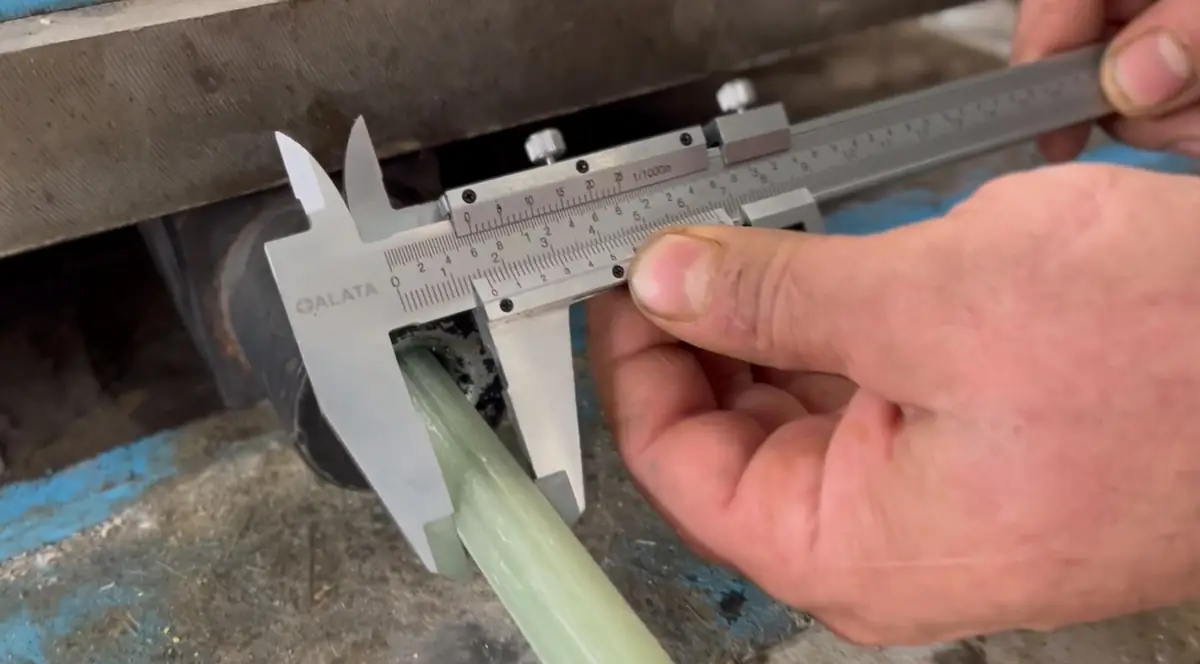
| Ovality tolerance | — | mm | Max. 0.05 |
| Diameter tolerance | — | % | ±5 |
| Color and appearance | — | — | White, free of cracks and surface irregularities |
A density of 2.15 means composite wire weighs about 27 percent as much as steel of the same diameter. This is higher than the density of ordinary pultruded profiles (about 1.8 to 1.9) because the fiber content of wire is much higher. A Barcol hardness of 50 indicates full resin cure and is the quickest quality control test on the production line. Very low water absorption, thanks to the dense vinyl ester matrix, ensures the wire's durability in wet and submerged environments. Precise dimensional tolerances on diameter and ovality also matter for applications such as stone stitching and precision fittings; more details are in the article dimensional tolerances of pultruded products.
Electrical properties of composite wire
The electrical properties table gives the technical information needed to use fiberglass wire in the electrical industry:
| Feature | Test standard | Unit | Average value |
|---|---|---|---|
| Dielectric strength | ASTM D149 | kV/mm | 5 |
| Dielectric constant (50 Hz) | ASTM D150 | — | 5 |
| Dissipation factor (50 Hz) | ASTM D150 | — | 0.05 |
| Volume resistivity | ASTM D257 | Ω | 1013 |
| Surface resistivity | ASTM D257 | Ω | 1012 |
| Arc resistance | ASTM D495 | s | 120 |
An electrical resistance of around 1013 ohms places fiberglass wire among electrical insulators, whereas steel is a conductor. This is why composite rebar is used in electrical substation foundations, MRI room floors, urban rail track beds (to prevent stray currents) and insulating elements of electrical equipment. Arc resistance of 120 seconds shows that the wire surface resists forming a conductive carbon track under an electric arc. Note that surface electrical properties decrease with surface contamination and moisture, so in high-voltage applications keeping the surface clean and providing sufficient creepage distance are essential.
Thermal properties of composite wire
| Feature | Test standard | Unit | Value |
|---|---|---|---|
| Longitudinal coefficient of thermal expansion | ASTM D696 | K⁻¹ | 8 × 10⁻⁶ |
| Effect of temperature on mechanical properties | Factory test | — | After 120 hours at 100 °C while wound around a reel 100 times the wire diameter, the specimens remained intact without degradation |
A thermal expansion coefficient of 8 × 10⁻⁶ is close to that of concrete (about 10 × 10−6) and many natural stones. That is why composite wire creates no significant thermal stress at the interface in concrete or in stone backing stitches. The factory thermal stability test combines high temperature with sustained bending stress: the wire was held bent for 120 hours at 100 °C without cracking or fiber separation; this test demonstrates the vinyl ester resin's resistance to thermal creep.
Durability: resistance to sunlight and corrosive environments
Resistance to sunlight (ultraviolet radiation)
The resin used in Nabak composite wire contains materials that protect against ultraviolet (UV) radiation. However, for extra protection in long-term outdoor and unroofed applications, the surface can be sprayed with a special UV-resistant polymer coating. Wire embedded in concrete, behind stone or underground needs no UV protection.
Resistance in corrosive environments
Composite wire specimens remained intact without degradation after 120 hours in water at 80 °C while wound around a reel 100 times the wire diameter. This accelerated test simulates a severe combination of moisture, high temperature and stress. Vinyl ester resin has excellent resistance to water, the alkaline environment of concrete, seawater and many dilute acids; for specific chemical environments, a separate corrosion resistance table by chemical, concentration and temperature can be provided.
Composite wire weight and tensile capacity table by diameter
Using the intrinsic properties above, the practical specifications for each diameter are calculated. Weight per meter comes from W = ρ·π·d²/4 and ultimate tensile capacity from F = σt·A with a minimum strength of 1200 MPa:
| Diameter (mm) | Cross-section (mm²) | Composite wire weight (g/m) | Weight of steel of same diameter (g/m) | Minimum ultimate tensile force (kN) | Minimum bend diameter (mm) |
|---|---|---|---|---|---|
| 3 | 7.1 | 15 | 55 | 8.5 | 120 |
| 4 | 12.6 | 27 | 99 | 15.1 | 160 |
| 5 | 19.6 | 42 | 154 | 23.6 | 200 |
| 6 | 28.3 | 61 | 222 | 33.9 | 240 |
| 8 | 50.3 | 108 | 395 | 60.3 | 320 |
| 10 | 78.5 | 169 | 617 | 94.2 | 400 |
| 12 | 113.1 | 243 | 888 | 135.7 | 480 |
| 16 | 201.1 | 432 | 1578 | 241.3 | 640 |
Comparing composite rebar with steel rebar
| Feature | GFRP composite rebar (Nabak) | Ordinary steel rebar |
|---|---|---|
| Tensile strength | Min. 1200 MPa | Yield about 400, ultimate about 600 MPa |
| Tensile modulus | Min. 50 GPa | approx. 200 GPa |
| Density | 2.15 | 7.85 |
| Behavior to failure | Linear elastic, no yield | Yield and plastic deformation |
| Corrosion and rusting | None | Yes; needs adequate concrete cover or galvanizing |
| Electrical and magnetic conductivity | Insulating and non-magnetic | Conductive and magnetic |
| Longitudinal thermal expansion | 8 × 10⁻⁶ | approx. 12 × 10−6 |
| Bending on site | Not possible; bends are made at the factory | Possible |
Handling, storing and cutting composite wire
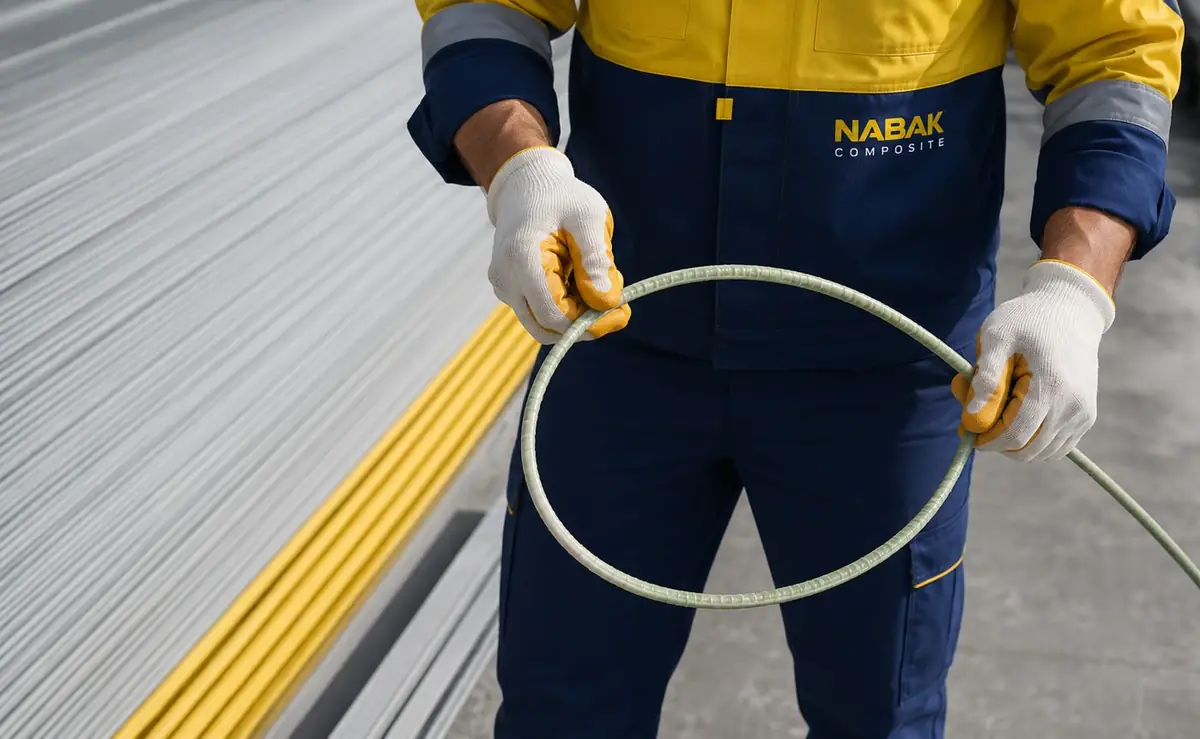
- Coils are packed with an inside diameter larger than the minimum bend diameter; when uncoiling, restrain the free end of the wire, because stored elastic energy makes it spring.
- Store straight lengths on flat, level supports away from prolonged direct sunlight.
- For cutting, use a diamond disc, bolt cutters or a fine-tooth hacksaw, and wear a mask and gloves; details in the article cutting composites.
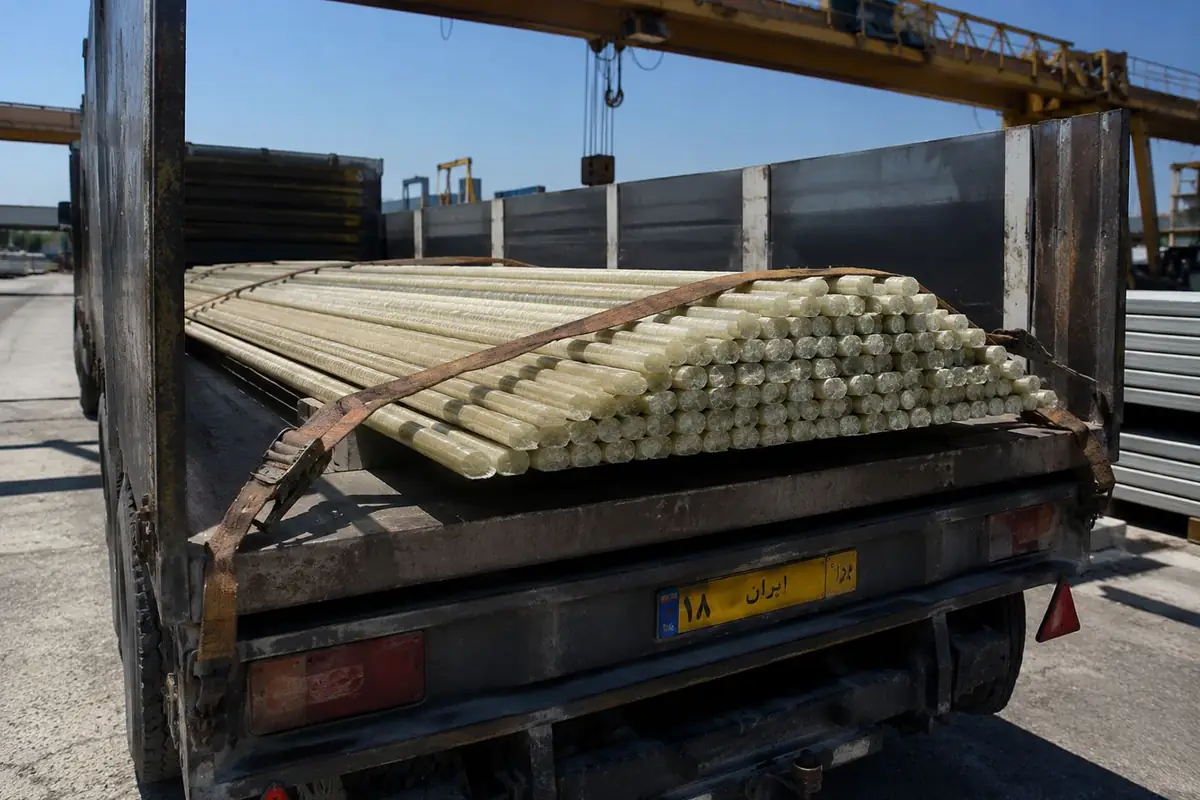
- When loading, use fabric slings (not chains) to avoid damaging the wire surface.
Nabak composite wire
Nabak Composite produces composite wire and rebar with continuous glass fiber, vinyl ester resin and continuous quality control. Each production batch is checked for diameter, ovality, Barcol hardness and appearance, and tensile, flexural and density test reports are provided on request. For available diameters, surface type (smooth or ribbed) and prices, contact the Nabak team.
Frequently asked questions about composite wire properties
What is the tensile strength of composite wire?
The longitudinal tensile strength of pultruded composite wire made with glass fiber and vinyl ester resin is at least 1200 MPa according to ASTM D3916 — about two to three times the yield strength of ordinary steel rebar.
How much does one meter of composite rebar weigh?
With a density of about 2.15 g/cm³, the weight per meter is 2.15 × π × d² / 4 grams; for example 4 mm wire weighs about 27 g and 10 mm rebar about 169 g per meter — about a quarter of steel of the same diameter.
Is fiberglass wire an electrical insulator?
Yes. The volume resistivity of composite wire is about 10 to the power 13 ohms and its surface resistivity about 10 to the power 12 ohms, and its dielectric strength has been measured at about 5 kV/mm.
What is the minimum bend diameter of composite wire?
Nabak composite wire can be wound without damage around a cylinder 40 times the wire diameter; for example 4 mm wire around a 160 mm cylinder. Composite rebar cannot be permanently bent on site after cure.
What is the difference between composite wire and composite rebar?
Both are the same pultruded product of glass fiber and resin; small diameters supplied in coils are usually called composite or fiberglass wire, and larger diameters supplied in straight lengths are called composite or GFRP rebar.
Summary
The technical specifications of Nabak GFRP composite rebar give a clear picture of a very strong, light, insulating and corrosion-resistant material: tensile and flexural strength of at least 1200 MPa, modulus of at least 50 GPa, density 2.15, fiber content over 80 percent, electrical resistance of 1013 ohms and thermal expansion close to concrete and stone. A proper understanding of these properties of composite wire — especially its elastic behavior to failure, lower modulus than steel and minimum bend diameter — is the key to using it correctly in stone stitching, reinforced concrete, the electrical industry and agriculture. For the official datasheet, test reports and technical advice, contact the Nabak Composite team.

This article was prepared by the technical team of Nabak Composite, a manufacturer of composite wire and GFRP rebar by pultrusion.