Why does a composite profile datasheet matter?
The datasheet, or technical specification sheet, is the design engineer's main reference for calculating structures, selecting sections and comparing FRP composite profiles with steel, aluminum and timber. Unlike metals, the properties of polymer composites depend on the direction of loading, so a complete datasheet must give properties separately in the longitudinal direction (along the profile and the roving fibers) and the transverse direction (perpendicular to it).
The tables in this article give the properties of composite profiles produced by pultrusion from isophthalic polyester (iso) resin and glass fiber. These values are intrinsic material properties and do not depend on part dimensions, so they apply to all composite shapes such as angles, channels, box sections, I-beams, flat bars and tubes.
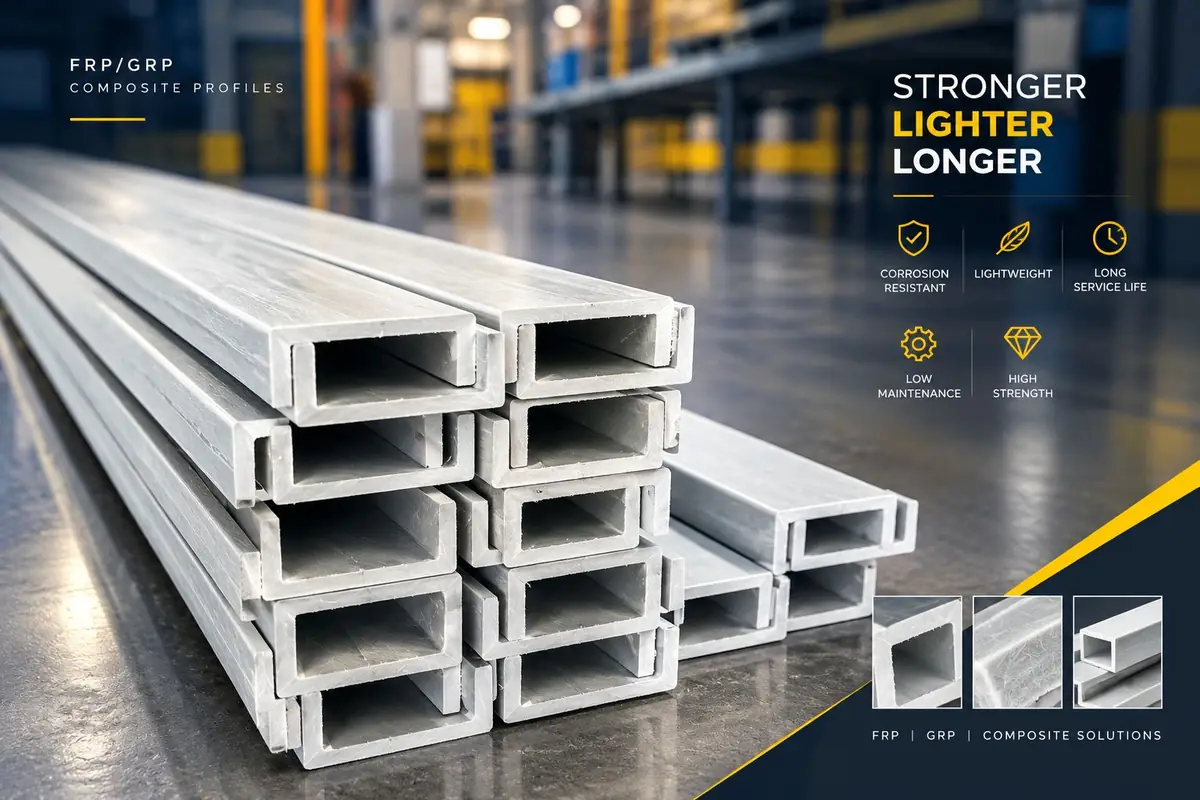
Summary of Nabak composite profile technical specifications (longitudinal)
Mechanical properties of FRP composite profiles
The table below shows the mechanical properties of pultruded polymer composites in both the longitudinal and transverse directions, with the test standard for each property:
| Feature | Test standard | Unit | Longitudinal | Transverse |
|---|---|---|---|---|
| Tensile strength at break | ASTM D638 | MPa | 400 | 150 |
| Tensile modulus | ASTM D638 | GPa | 25 | 10 |
| Flexural strength at break | ASTM D790 | MPa | 400 | 180 |
| Flexural modulus | ASTM D790 | GPa | 20 | 10 |
| Compressive strength at break | ASTM D695 | MPa | 350 | 200 |
| Compressive modulus | ASTM D695 | GPa | 20 | 10 |
| Interlaminar shear strength (ILSS) | ASTM D2344 | MPa | 30 | 30 |
| Shear modulus | ASTM D5379 | GPa | 4 | |
| Poisson's ratio | ASTM D3039 | — | 0.33 | 0.15 |
| Izod impact strength | ASTM D256 | kJ/m² | 200 | 80 |
| Bearing strength | ASTM D953 | MPa | 170 | 80 |
Engineering interpretation of mechanical properties
Anisotropy: the ratio of longitudinal to transverse properties in composite profiles is about 2 to 3. The reason is the fiber layout in pultrusion: longitudinal rovings carry the main load along the profile, and the transverse properties come from mat layers and resin (see types of fiber in composites). So in design, the profile should be oriented so that the main load acts along its length.
Strength vs stiffness: the 400 MPa tensile strength of FRP profiles rivals structural steel, but their 20 to 25 GPa modulus is about one eighth to one tenth that of steel. As a result, in bending members such as beams and channels, deflection, not strength, governs design (the article composite grating load capacity table illustrates this with an example).
Low shear modulus: a shear modulus of 4 GPa makes the shear deformation contribution to the deflection of short, deep beams significant; that is why Timoshenko beam theory is used in precise calculations.
Bearing strength and ILSS: these two figures are vital for designing bolted and bonded joints. A longitudinal bearing strength of 170 MPa determines how much bolt pressure the hole wall can take (see cutting and machining composites).
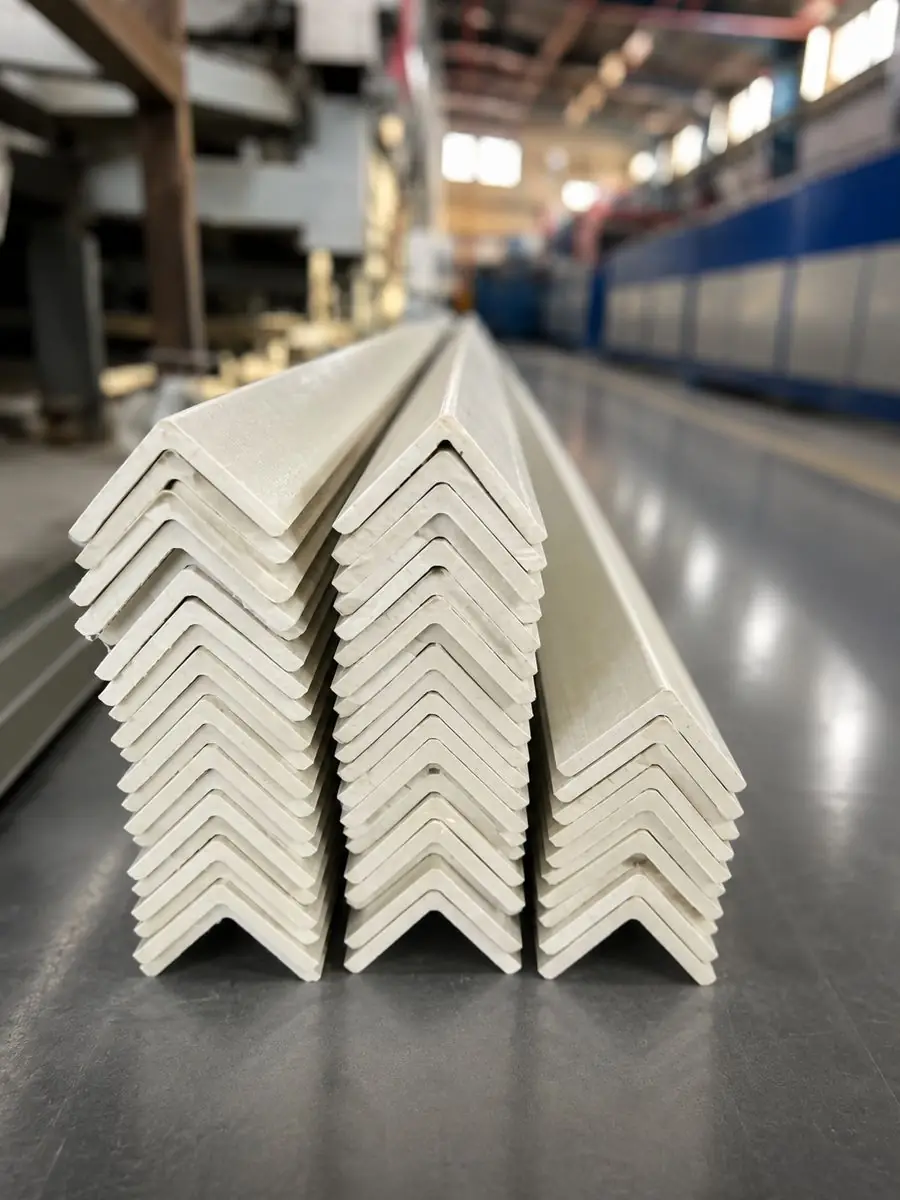

Physical properties of polymer composites
The physical properties table gives the basic information for calculating weight and for quality control:
| Feature | Test standard | Unit | Average value | |
|---|---|---|---|---|
| Density | ASTM D792 | g/cm³ | 1.85 | |
| Hardness | ASTM D2583 | Barcol | 40 | |
| Water absorption (24 hours) | ASTM D570 | % | 0.5 | |
| Fiber weight fraction | ISO 1172 | % | 50 to 65 | |
A density of 1.85 means a composite profile weighs about a quarter as much as steel and two thirds as much as aluminum. The weight per meter of any section is given by the simple relation W (kg/m) = A (cm²) × 0.185. A fiber weight fraction of 50 to 65 percent, given the densities of glass fiber and resin, corresponds to a volume fraction of about 35 to 50 percent (the conversion method is in the article predicting the properties of polymer composites). A Barcol hardness of 40 indicates full cure of the polyester resin and is measured continuously in production line quality control.
Electrical properties of composite profiles
One of the most distinctive properties of polymer composites is their electrical behavior, shown in the table below:
| Feature | Test standard | Unit | Average value | |
|---|---|---|---|---|
| Dielectric strength | ASTM D149 | kV/mm | 5 | |
| Dielectric constant (50 Hz) | ASTM D150 | — | 5 | |
| Dissipation factor (50 Hz) | ASTM D150 | — | 0.05 | |
| Volume resistivity | ASTM D257 | Ω | 1012 | |
| Surface resistivity | ASTM D257 | Ω | 1012 | |
| Arc resistance | ASTM D495 | s | 120 | |
Electrical insulation is one of the most important advantages of polymer composites over metals. An electrical resistance of 1012 ohms makes FRP profiles the standard choice for insulating ladders, cable trays and ladders, substation structures, insulating arms and work platforms near live equipment. In high-voltage applications, keeping the surface clean and preventing build-up of moisture and contamination is important, because surface resistivity depends on surface condition.
Thermal properties and the effect of temperature on composite properties
| Feature | Test standard | Unit | Longitudinal | Transverse |
|---|---|---|---|---|
| Coefficient of thermal expansion | ASTM D696 | K⁻¹ | 11 × 10−6 | 25 × 10−6 |
| Thermal conductivity | ASTM C177 | W/m·K | 0.3 | |
A longitudinal coefficient of thermal expansion of 11 × 10−6 is almost equal to that of steel and concrete, so composite profiles create no significant thermal stress alongside metal and concrete structures. A thermal conductivity of 0.3 W/m·K is about one 200th that of steel and one 700th that of aluminum; this makes FRP profiles ideal for high thermal performance window frames and for eliminating thermal bridges in facades, and means that, unlike metal, their surface does not feel hot or freezing to the touch in sun or cold.
Effect of temperature on mechanical properties
The table and chart below show how the properties of polymer composites change as service temperature rises:
| Service temperature | Percentage of mechanical properties retained |
|---|---|
| Up to 50 °C | 100% |
| 65 °C | 95% |
| 85 °C | 90% |
| 95 °C | 85% |
Percentage of mechanical properties retained by isophthalic polyester composite profiles versus service temperature
Profiles can also be used above 95 °C, but as the resin's glass transition temperature is approached, the likelihood of permanent deformation and loss of properties increases. For high-temperature applications, the service temperature can be raised with special resin formulations (such as novolac vinyl ester or phenolic). In design, a temperature reduction factor should be applied to both strength and modulus.
Durability: resistance to fire, sunlight and corrosive environments
Fire resistance
Nabak products are self-extinguishing; that is, they stop burning once the flame source is removed. At the customer's request, for applications with strict fire requirements (such as tunnels, offshore platforms and public buildings), the raw material formulation is modified with flame-retardant additives such as aluminum trihydroxide to produce fire-resistant parts. Details of fire behavior and firefighting are given in the article safety in composite products.
Resistance to sunlight (ultraviolet)
The resins used to produce the profiles contain UV-protective materials, and the surface veil layer also keeps the surface resin-rich and protected. However, prolonged UV exposure over the years can dull the surface. For extra UV protection and unroofed environments, the surface can be sprayed with a special polymer coating (aliphatic polyurethane).
Resistance in corrosive environments
In general, isophthalic polyester resin has good resistance in acidic environments, but vinyl ester resin resists both acids and bases (alkaline environments) and is chosen for harsher chemical conditions:
| Environment | Isophthalic polyester | Vinyl ester |
|---|---|---|
| Water, humidity and seawater | Suitable | Very suitable |
| Dilute acids | Suitable | Very suitable |
| Alkaline and basic environments | Limited | Suitable |
| Strong organic solvents | Unsuitable | Limited; needs checking |
| Recommended application | General structures, handrails, cable trays | Petrochemicals, treatment plants, chemical industries |
Note: a surface layer damaged by ultraviolet light opens a path for corrosive substances, so UV protection is doubly important in outdoor chemical environments. A separate corrosion resistance table for polymer composites can be provided for any specific chemical, concentration and temperature.
Comparing composite profile properties with steel and aluminum
| Feature | FRP composite profile | Structural steel | Aluminum |
|---|---|---|---|
| Density (g/cm³) | 1.85 | 7.85 | 2.7 |
| Longitudinal tensile strength (MPa) | 400 | Yield about 240 to 360 | About 150 to 300 |
| Tensile modulus (GPa) | 25 | 200 | 70 |
| Specific strength (strength/density) | approx. 216 | About 30 to 46 | About 55 to 110 |
| Thermal conductivity (W/m·K) | 0.3 | approx. 50 | approx. 200 |
| Electrical conductivity | Insulating | Conductive | Conductive |
| Corrosion | None | Requires coating | Moderate |
Nabak composite profiles
Nabak Composite produces FRP composite profiles with isophthalic polyester resin, vinyl ester or special flame-retardant formulations. The properties in this datasheet apply to all our pultruded products:
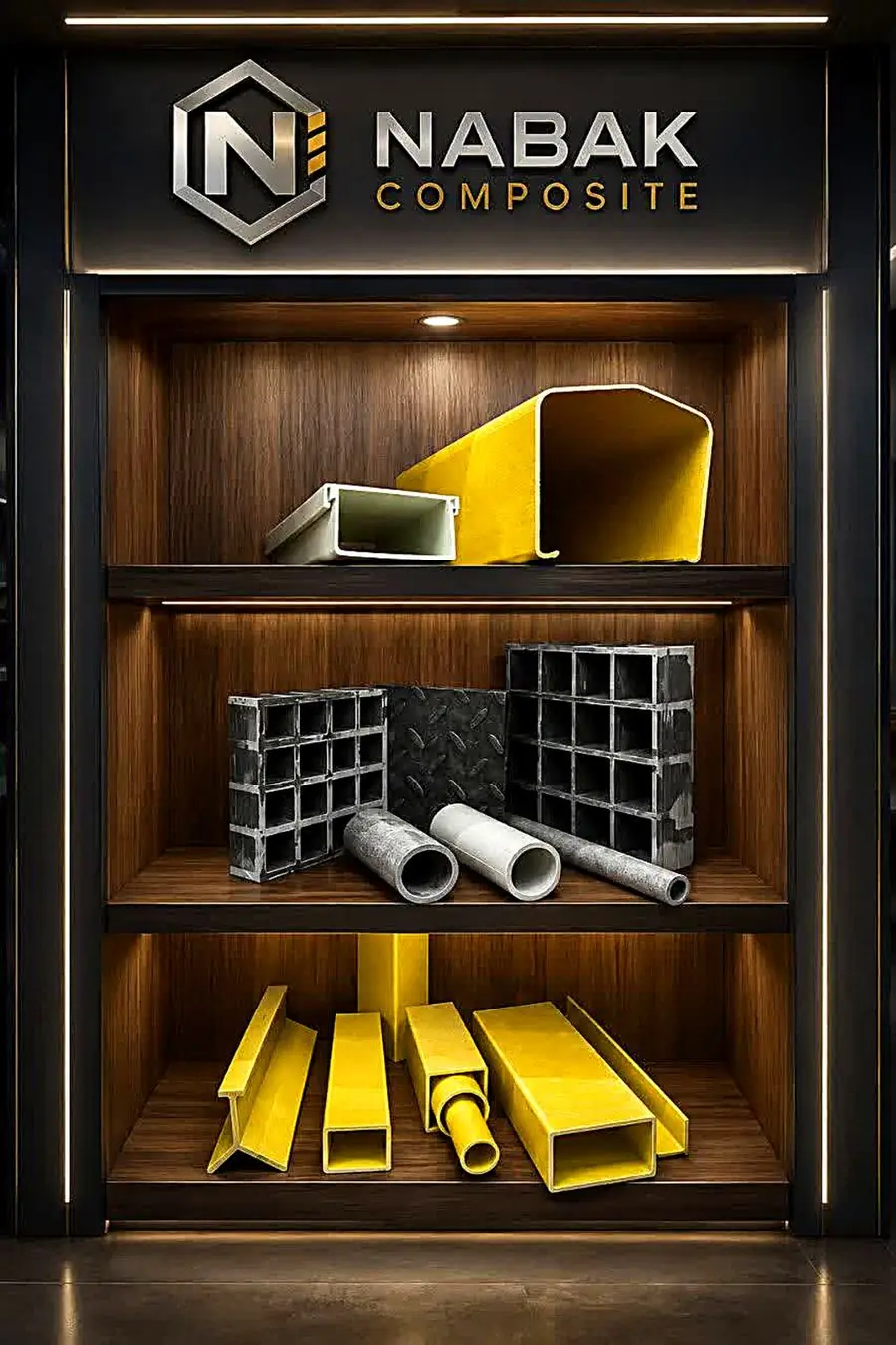
From fiberglass angles and composite channels to composite beams, composite flat bars, polymer rods, composite wire and cable trays, every product undergoes quality control before shipment, and test reports are provided on request.
Frequently asked questions about the properties of polymer composites
In this section we answer the most common questions about the properties table for polymer composites:
What is the tensile strength of FRP composite profiles?
The tensile strength of pultruded composite profiles made with polyester resin and glass fiber is about 400 MPa longitudinally and about 150 MPa transversely, according to ASTM D638.
Why do the properties of polymer composites differ longitudinally and transversely?
Because in a pultruded profile most of the glass fiber lies lengthwise as roving, and transverse properties come mainly from mat layers and resin; this characteristic is called anisotropy.
Up to what temperature can composite profiles be used?
Isophthalic polyester profiles retain all their mechanical properties up to 50 °C, and about 95, 90 and 85 percent of their properties at 65, 85 and 95 °C respectively; special resin formulations are needed for higher temperatures.
Are Nabak composite profiles fire-resistant?
Nabak products are self-extinguishing and, on request, are produced with a special flame-retardant formulation for fire-resistant applications.
What is the difference in chemical resistance between isophthalic polyester and vinyl ester resin?
Isophthalic polyester has good resistance in acidic environments, but vinyl ester resists both acids and alkaline (basic) environments and is chosen for harsher chemical conditions.
Summary
The FRP composite profile datasheet shows that the properties of pultruded polymer composites are a unique combination of high strength (400 MPa longitudinally), low weight (density 1.85), electrical and thermal insulation and corrosion resistance. On the other hand, a lower modulus than steel, anisotropy and sensitivity to high temperature must be taken into account in design. With a proper understanding of these properties and the right choice of resin (isophthalic polyester, vinyl ester or flame-retardant), composite profiles can be a lighter, more durable and lower life-cycle-cost alternative to metals. For the official datasheet, test reports and technical advice, contact the Nabak Composite team.

This article was prepared by the technical team of Nabak Composite, a manufacturer of FRP composite profiles and pultruded products.