
FRP/GFRP Fiberglass Tent Pole – Technical Datasheet | Nabak Composite
دیتاشیت محصولات

FRP/GFRP Fiberglass Tent Pole – Technical Datasheet | Nabak Composite

مقاله1405/08/12English
مشاهده‌ی آنلاین سند

Fiberglass (FRP) Tent Pole Technical Datasheet — FRP and GFRP Composite Tent Poles by Nabak Composite

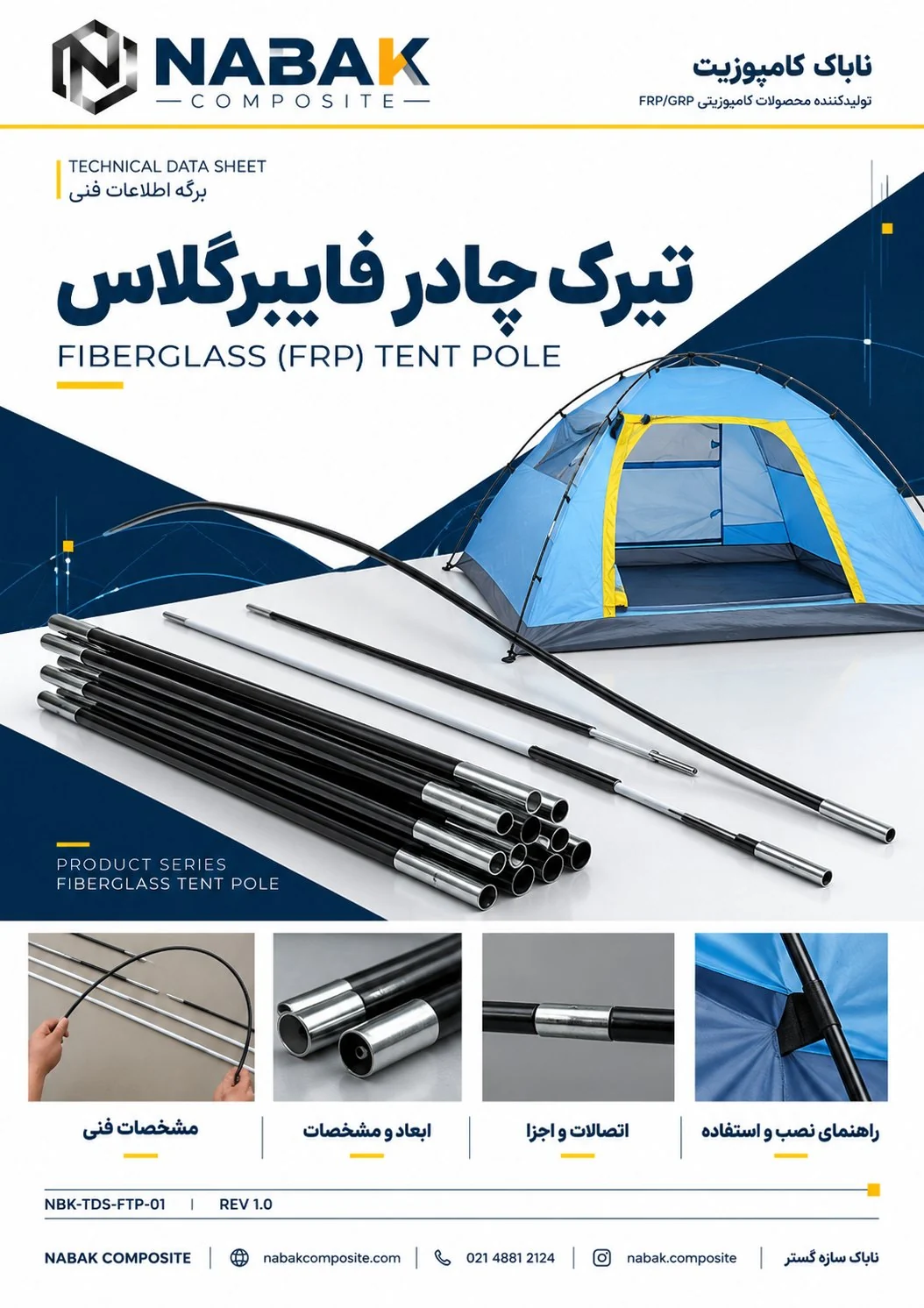
Cover of the fiberglass tent pole technical datasheet by Nabak Composite - Fiberglass (FRP) Tent Pole, code NBK-TDS-FTP-01
TECHNICAL DATA SHEET

Fiberglass (FRP) Tent Pole

Solid rod and hollow tube specifications, ferrule and shock cord components, bend radius, arch geometry and buckling formulas, and a set-up guide for fiberglass tent poles

NBK-TDS-FTP-01-ENRev 1.0  ·  2026
FRP / GFRP Fiberglass Tent Pole – Technical DatasheetIntroduction, Components & Types  |  Page 1 of 5

The Nabak Composite fiberglass tent pole (Fiberglass / FRP Tent Pole) is made of pultruded GFRP composite rod and tube with a high glass-fiber content: a flexible, lightweight, moisture- and corrosion-proof, electrically insulating pole that, together with aluminum ferrules and an internal shock cord, forms the frame of dome, tunnel, family and children's tents and canopies.

6.9 – 12.7 mmsolid rod diameter
70–80%glass fiber by weight
≈ 900 MPaflexural strength of GFRP rod
75 – 253 g/mweight per metre of rod

What Is a Fiberglass Tent Pole (Composite Tent Rod)?

The fiberglass tent pole, also known as fiberglass tent rod, composite tent pole, fiberglass rod, tent wand or spring and FRP Tent Pole, is a composite member produced by the pultrusion process: continuous strands of glass fiber are drawn through a polyester or epoxy resin bath and cured in a heated die into a solid rod or hollow tube. Because all the fibers run along the length of the rod, a GFRP rod combines very high flexural strength with great flexibility; this is what has made the fiberglass tent pole the main choice for dome and arched tents.

FRP is the generic name for fiber-reinforced polymers, and GFRP (or GRP) is FRP composite reinforced with glass fiber; the word “fiberglass” in everyday use usually refers to this same GFRP composite. After pultrusion, surface grinding, painting or UV-protective coating, cutting to piece length and ferrule fitting, the fiberglass tent rods of Nabak Composite are supplied as tent pole sets.

Components of a Fiberglass Tent Pole Set

GFRP rod or tubeThe composite body of the tent pole; solid for flexibility and low cost, hollow for lighter weight and higher stiffness.
FerruleAluminum or plated-steel bushing that joins two pole sections together.
Shock cordElastic cord inside the tubes that holds the pole sections together and makes assembly fast.
End tipMetal or plastic tip that seats in the tent's grommet, pin or pocket.

Types of Nabak Composite Fiberglass Tent Poles

Solid fiberglass rodEconomical, highly flexible GFRP rod for children's tents, mosquito nets and dome tents
Hollow fiberglass tubeLighter composite tube with higher stiffness for family tents and canopies
Shock-corded pole setTubular sections with an internal shock cord; fast set-up and take-down of the tent pole
Straight upright poleThick FRP rod for tent entrances, canopies and standing poles
Greenhouse arch rodFiberglass rod for agricultural tunnels and small greenhouses
Colored and coatedBlack, white, gray or colored tent poles with a glossy UV-protective coating

Advantages of Fiberglass Tent Poles

  • High flexibility: a fiberglass tent rod forms the tight arches of a dome tent without permanent bending and returns straight when the tent is packed away.
  • Moisture- and rust-proof: GFRP composite does not rust or blacken in rain, coastal humidity or salt water.
  • Economical: the composite tent pole is the cheapest option for mass production of travel and family tents.
fiberglass tent pole | tent rod | FRP composite tent polenabakcomposite.com  |  +98 21 4881 2124  |  @nabak.composite
FRP / GFRP Fiberglass Tent Pole – Technical DatasheetDimensions, Specifications & Fittings  |  Page 2 of 5

Dimension Table of Solid Fiberglass Tent Rod

Table 1 — Specifications of solid GFRP tent pole rod (E = 40 GPa, ρ = 2.0 g/cm³, allowable strain 1.5%)
Diameter (mm)Cross-section area (mm²)Moment of inertia I (mm⁴)Bending stiffness EI (N·m²)Weight (g/m)Min. bend radius (mm)Suggested use
6.937.41114.475230Children's tents, mosquito nets
7.949.01917.7982651 to 2 person tents
8.556.725610.31132852 to 3 person dome tents
9.570.940016.01423203 to 4 person dome tents
11.095.071928.8190370Family and tunnel tents
12.7126.7127751.1253425Canopies, entrance poles, greenhouses

Dimension Table of Hollow Fiberglass Tent Tube

Table 2 — Specifications of shock-corded GFRP tent pole tube
Outer × inner diameter (mm)Cross-section area (mm²)Moment of inertia I (mm⁴)Bending stiffness EI (N·m²)Weight (g/m)Min. bend radius (mm)Suggested use
11 × 844.851820.790370Light dome tents
12.7 × 9.555.887735.11124254 to 6 person family tents
14 × 1158.9116746.7118470Large tunnel tents
16 × 1288.0219988.0176535Canopies, group tents

Values are calculated with the formulas on page 4 and the typical properties of pultruded GFRP composite. The Ø11×8 fiberglass tube, at about 90 g/m, is stiffer than the Ø9.5 solid rod at 142 g/m; this is the main advantage of a hollow tent pole.

Ferrules, Shock Cord & Connecting Components

Table 3 — Components of a fiberglass tent pole set
ComponentMaterialTypical specificationDescription
Ferrule (connecting bushing)Aluminum 6061 / plated steelLength 50 – 80 mm; inner diameter = rod diameter + 0.1 to 0.2 mmFixed to the GFRP rod with epoxy adhesive or by pressing
Shock cordNatural rubber with polyester sheathDiameter 3 – 5 mmCord length 25 to 30 percent shorter than the pole
End tipPlated steel / aluminum / plasticPin head or ball headMatched to the grommet or corner pocket of the tent
Section length—450 – 750 mmMost common: 550 and 650 mm for the tent bag
Total pole length—2000 – 5500 mmNumber of sections = total length ÷ effective length of each section

Color and Surface of Composite Tent Poles

Fiberglass tent poles by Nabak Composite are supplied in black, white, gray and custom colors with a glossy or matte finish. In addition to appearance, the paint or polyurethane coating protects the glass fibers from UV radiation and abrasion and prevents fibers from protruding and creating glass splinters on the surface of the composite rod.

Table 4 — Common fiberglass tent pole sets by tent type
Tent typeSuggested rod or tubeTotal length of each pole (mm)Number of polesSection length (mm)
Children's tents and mosquito netsSolid Ø6.92000 – 28002450 – 550
2-person dome tentSolid Ø7.9 / Ø8.53400 – 38002 + 1 roof550
4-person dome tentSolid Ø9.5 / tube 11×84200 – 48002 to 3600 – 650
Family and tunnel tentsSolid Ø11 / tube 12.7×9.54500 – 55003 to 4650 – 750
fiberglass tent rod | fiberglass tube | pultruded GFRP rodnabakcomposite.com  |  +98 21 4881 2124  |  @nabak.composite
FRP / GFRP Fiberglass Tent Pole – Technical DatasheetMechanical Properties & Comparison  |  Page 3 of 5

Mechanical and Physical Properties of GFRP Tent Rod

Table 5 — Reference properties of pultruded GFRP composite in fiberglass tent poles
PropertyTest standardUnitSolid rodHollow tube
Glass fiber weight fractionASTM D2584%75 – 8065 – 75
DensityASTM D792g/cm³2.0 – 2.11.9 – 2.0
Longitudinal tensile strengthASTM D3916MPa700 – 1000500 – 700
Flexural strengthASTM D4476MPa800 – 1100500 – 700
Longitudinal modulus of elasticityASTM D3916GPa38 – 4530 – 40
Strain at break—%2 – 2.51.8 – 2.2
Shear strengthASTM D2344MPa35 – 5030 – 45
Barcol hardnessASTM D2583—50 – 6045 – 55
Water absorption, 24 hASTM D570%≤ 0.2≤ 0.3
Longitudinal coefficient of thermal expansionASTM D69610⁻⁶ /°C5 – 76 – 8
Service temperature range—°C−40 to +80

ASTM D3916 and D4476 are common test standards for tensile and flexural testing of pultruded rods. The values are reference ranges for the FRP and GFRP composite industry and are not Nabak Composite's own laboratory results.

Fiberglass Tent Pole vs Aluminum, Carbon and Steel

Table 6 — Fiberglass tent pole compared with other materials
PropertyGFRP fiberglassAluminum 7001-T6CFRP carbonSteel
Density (g/cm³)2.02.81.5 – 1.67.85
Modulus of elasticity (GPa)38 – 45≈ 71100 – 140200
Allowable bending strainHigh (very flexible)MediumLowLow
Behavior under overloadLarge flex, then fracturePermanent bendingSudden fracturePermanent bending
Corrosion and rustNoneLowNoneYes
Electrical conductivityInsulatorConductiveConductiveConductive
PriceEconomicalMedium to highHighEconomical
Main useFamily, children's, beach and greenhouse tentsLightweight mountaineering tentsUltralight tentsHeavy standing poles

Selection note: a fiberglass tent pole holds its shape under large flexing and returns completely straight when the load is removed, unlike an aluminum pole, which bends permanently under overload. If carrying weight is not the most important criterion and price, durability in humidity and electrical insulation matter, GFRP composite tent rod is the best choice.

Table 7 — Behavior of the composite tent pole under environmental conditions
ConditionBehavior of GFRP rodRecommendation
Sunlight and UV exposureLong-term dulling of the surface resinChoose a painted or UV-protective coated pole
Severe cold (down to −40 °C)Strength retained; slight loss of flexibilityBend more slowly during set-up
Humidity, rain and salt waterNo rusting; negligible water absorptionDry the metal ferrules before storage
Heat above 80 °CResin softens and stiffness dropsKeep away from heaters and heat sources
tent pole specifications | GFRP composite rod | fiberglass tent polenabakcomposite.com  |  +98 21 4881 2124  |  @nabak.composite
FRP / GFRP Fiberglass Tent Pole – Technical DatasheetSection, Arch & Bending Formulas  |  Page 4 of 5

Section Formulas for Fiberglass Rod and Tube

1. Moment of inertia of solid rod and tube
I = π d⁴64 ,   I = π (D⁴ − di⁴)64

Ø9.5 rod: π × 9.5⁴ / 64 ≈ 400 mm⁴  |  11×8 tube: ≈ 518 mm⁴

2. Weight per metre of GFRP tent rod
w = ρ · A   [g/m]

ρ in g/cm³ and A in mm². Ø9.5 rod: 2.0 × 70.9 ≈ 142 g/m

3. Bending stiffness of the pole
Kb = E · I

Ø9.5: 40 000 × 400 = 1.6×10⁷ N·mm² = 16 N·m². Stiffness grows with the fourth power of the diameter; a 16% increase in diameter makes the stiffness about 80% higher.

4. Minimum allowable bend radius
Rmin = d2 εa = E d2 σa

εa is the allowable strain (1.5%, about 60% of the strain at break). Ø9.5: 9.5 / 0.03 ≈ 317 mm

Dome Arch Geometry and Stress in the Pole

5. Width and height of a tent with a semicircular arch
L = π W2   ⟹   W = 2Lπ ,   H = R = W2

L is the total length of the tent pole, W the span between the two feet, H the height at the centre. A 4000 mm pole → W ≈ 2546 mm and H = R ≈ 1273 mm

6. Strain, bending stress and safety factor of the pole in the arch
ε = d2R ,   σ = E · ε ,   FS = σuσ
Example — Ø9.5 fiberglass tent rod, 4 m long, in a semicircular arch: ε = 9.5 / (2 × 1273) ≈ 0.37 % σ = 40 000 × 0.0037 ≈ 149 MPa  →  FS = 900 / 149 ≈ 6.0 When pitched, the tent pole uses only a small fraction of the capacity of the GFRP composite; a strength reserve remains for wind, snow and impact. The main risk is sharp local bends during set-up and near the ferrule, which reduce the radius below Rmin.
7. Arch height of a tent or greenhouse tunnel (chord and sagitta formula)
h = R − √( R² − (c/2)² )

c is the tunnel span (chord), R the arc radius, h the arch height. Example: R = 1500 mm and c = 2400 mm → h = 1500 − √(1500² − 1200²) = 600 mm (a low arch; for more height a smaller R or a longer pole is needed).

8. Flexibility test: deflection of a cantilevered pole tip
δ = F L³3 E I

Quality control of fiberglass tent rod: a Ø9.5 piece with a free length of 500 mm and a 10 N force at the tip: δ = 10 × 500³ / (3 × 40 000 × 400) ≈ 26 mm. A deflection greater than the calculated value indicates a lower modulus or a lower fiber content.

tent pole calculation | fiberglass rod | FRP and GFRP compositenabakcomposite.com  |  +98 21 4881 2124  |  @nabak.composite
FRP / GFRP Fiberglass Tent Pole – Technical DatasheetBuckling, Connections & Usage Guide  |  Page 5 of 5

Formulas for Upright Poles, Ferrules and Shock Cord

9. Buckling load of an upright pole (Euler)
Pcr = π² E I(K L)²

2 m entrance pole, pinned at both ends (K = 1): Ø11 rod → Pcr ≈ 71 N; 16×12 tube → ≈ 217 N. For an upright pole, a thick fiberglass tube or rope bracing is recommended.

10. Adhesive capacity of the ferrule on the rod
F = τa · π · d · Lb

Ø9.5 rod, bond length Lb = 30 mm, epoxy adhesive τa ≈ 10 MPa: F ≈ 9 kN. The ferrule bond length should be at least 3 times the rod diameter.

11. Length of the internal shock cord
Lc = Lp · (1 − s)

s = 0.25 – 0.30. 4000 mm pole: Lc ≈ 2800 – 3000 mm; a shorter cord holds the sections together more firmly.

12. Number of pole sections
n = ⌈ Lpls − lo ⌉

ls is the length of each section, lo the overlap length in the ferrule. A 4000 pole with 550 sections and 30 overlap: n = ⌈4000/520⌉ = 8

13. Wind force on each tent pole
Fw = ½ ρ V² · Cd · Anp

ρ = 1.225 kg/m³. Wind 15 m/s, Cd ≈ 1.2, tent side area 4 m², two poles: Fw ≈ (138 × 1.2 × 4) / 2 ≈ 330 N per pole; guy ropes and pegs are essential for transferring this force to the ground.

Set-Up and Usage Guide for Fiberglass Tent Poles

  1. Unfold: pull the pole sections apart from the middle toward both ends and let the internal shock cord draw them together.
  2. Seat the ferrule: push each section fully into the ferrule; a half-seated ferrule is the main cause of tent rod breakage.
  3. Pass through the tent sleeve: push the pole, do not pull it; pulling separates the joints.
  4. Bend evenly: place both ends of the pole in the grommets at the same time so that a uniform arch forms.
  5. Guy out: secure the tent with pegs and ropes so that wind force is not transferred to the composite pole.
  6. Pack and store: start from the middle of the pole, separate the sections, and keep them dry and out of sunlight.

Safety: if the surface of a fiberglass tent pole cracks or glass fibers protrude, work with gloves and replace the piece. For a repair on the trail, use an aluminum Repair Sleeve over the break. Although GFRP rod is electrically insulating, pitch the tent in a safe place during thunderstorms.

Is a fiberglass tent pole better than an aluminum one?

Fiberglass tent poles are cheaper, more flexible, electrically insulating and corrosion-proof, and suit family, children's, beach and greenhouse tents. Aluminum poles are stiffer at equal weight and are used for lightweight mountaineering tents.

What diameter of fiberglass tent rod is suitable?

A diameter of 6.9 to 7.9 mm is suggested for children's tents and mosquito nets, 8.5 to 9.5 mm for 2 to 4 person dome tents, and 11 to 12.7 mm or hollow tube for family tents and canopies.

Why do fiberglass tent poles break?

A fiberglass pole usually breaks because it was bent beyond the allowable bend radius, because the ferrule was not fully seated, because of impact, or because the surface was degraded by UV radiation. Observing the bend radius in Table 1 and seating the joints fully prevents breakage.

How can a broken fiberglass tent pole be repaired?

For a repair on the trail, place an aluminum Repair Sleeve over the break and replace the piece at the first opportunity. If the pole cracks or glass fibers protrude, work with gloves.

What is the minimum bend radius of a fiberglass tent rod?

The minimum allowable bend radius is about 33 times the rod diameter (based on an allowable strain of 1.5%); for a Ø9.5 rod this is about 320 mm. Sharper bends, especially near the ferrule, raise the risk of breakage.

How long should the internal shock cord of a tent pole be?

The internal shock cord is normally chosen 25 to 30 percent shorter than the pole; for a 4000 mm pole this is about 2800 to 3000 mm. A shorter cord holds the sections together more firmly.

Request a quote for fiberglass tent poles: state the diameter, solid or hollow, section length and total length, ferrule and shock-cord type, color and number of sets.
Nabak Sazeh Gostar  |  nabakcomposite.com  |  +98 21 4881 2124  |  Instagram @nabak.composite

Disclaimer: the information in this datasheet is prepared from general and common data of the FRP and GFRP composite industry and is provided for guidance. Nabak Composite reserves the right to modify the technical specifications of fiberglass tent poles without prior notice.

© Nabak Composite — fiberglass tent poles and FRP composite tent rodsnabakcomposite.com  |  +98 21 4881 2124  |  @nabak.composite
‹ بازگشت به مرکز اسناد فنی