What is stone stitching and why is it needed?
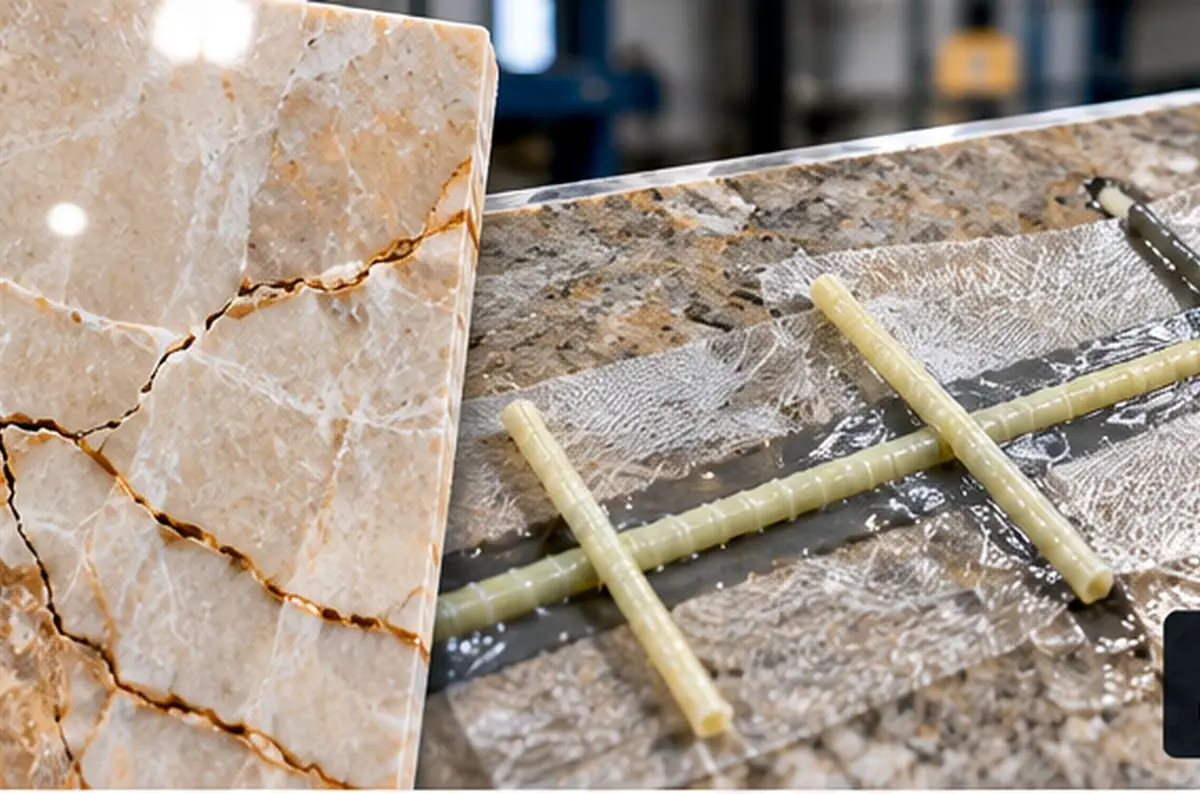
Stone stitching is a repair and preventive method for natural stone with veins, cracks or fractures. In this method, narrow grooves are cut in the back of the stone perpendicular to the crack path, then a composite wire (fiberglass rod) is placed in the groove and fully covered with epoxy adhesive and a layer of glass fiber mat or mesh. The result is a permanent "stitch" that holds the two sides of the crack together, just as a surgical suture holds the two edges of a wound.
Decorative stones such as marble, marbleized limestone, onyx, travertine and some granites naturally have veins and fine and coarse fissures. These veins are what make the stone beautiful, but from an engineering standpoint they are the stone's planes of weakness. Under stresses from cutting, transport, installation, temperature changes and substrate settlement, veins gradually open up and become through-cracks. Stone stitching prevents this process by reinforcing the back of the slab and extends the life of the stone several times.
Why does stone crack? An engineering view
Natural stone is a brittle material: its compressive strength is high (for example 60 to 150 MPa for marble) but its tensile and flexural strength is very low (usually about 7 to 20 MPa for marble and less for onyx and porous travertine). When a 2 cm slab bends during handling, one face goes into tension, and because veins consist of coarse calcite, clay or filled impurities, stress concentrates in them and cracks start there. The main causes of crack initiation and growth in stone are:
- Bending stresses during cutting, lifting and transporting large slabs;
- Thermal stress from the temperature difference between the sunlit face and the back of the stone on facades;
- Freeze-thaw cycles of water that has penetrated veins and pores;
- Settlement or unevenness of the substrate under flooring and countertops;
- Impact and concentrated loads during installation and service.
The mechanics of stone stitching
The basic idea of stone stitching is similar to reinforcing concrete: the stone carries compression, and the composite rod placed on the tension face (the back of the stone) carries the tensile force across the crack. The epoxy adhesive transfers force from the stone to the wire. As long as the wire is sufficiently "anchored" in the adhesive on both sides of the crack, the crack cannot open.
Composite wire: the best material for reinforcing the back of stone
Composite wire, also known as fiberglass wire, fiberglass rebar, fiberglass rod and GFRP rod, is a solid rod of continuous glass fiber and thermoset resin (polyester, vinyl ester or epoxy). It is produced by pultrusion: thousands of parallel glass fiber strands are impregnated with resin, pulled through a heated die and cured. The fiber weight fraction of composite wire is usually 70 to 80 percent, the highest level among composite products, giving very high tensile strength.
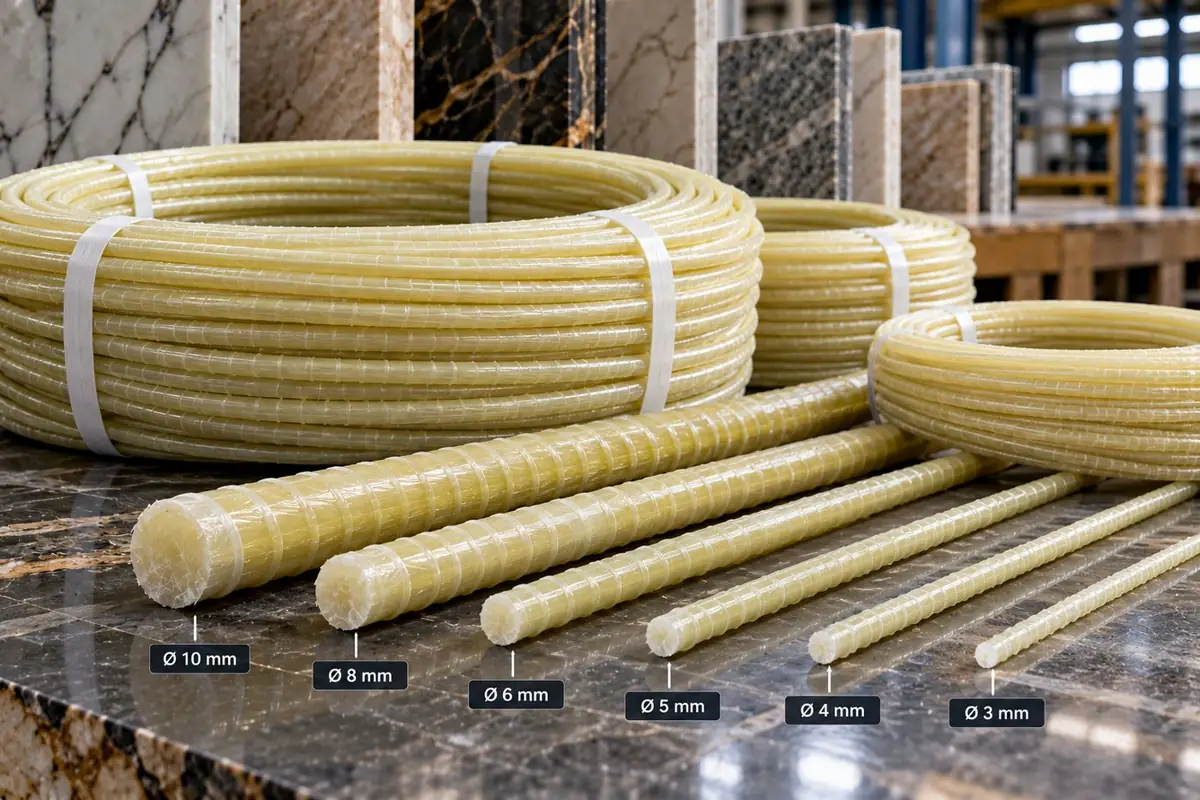
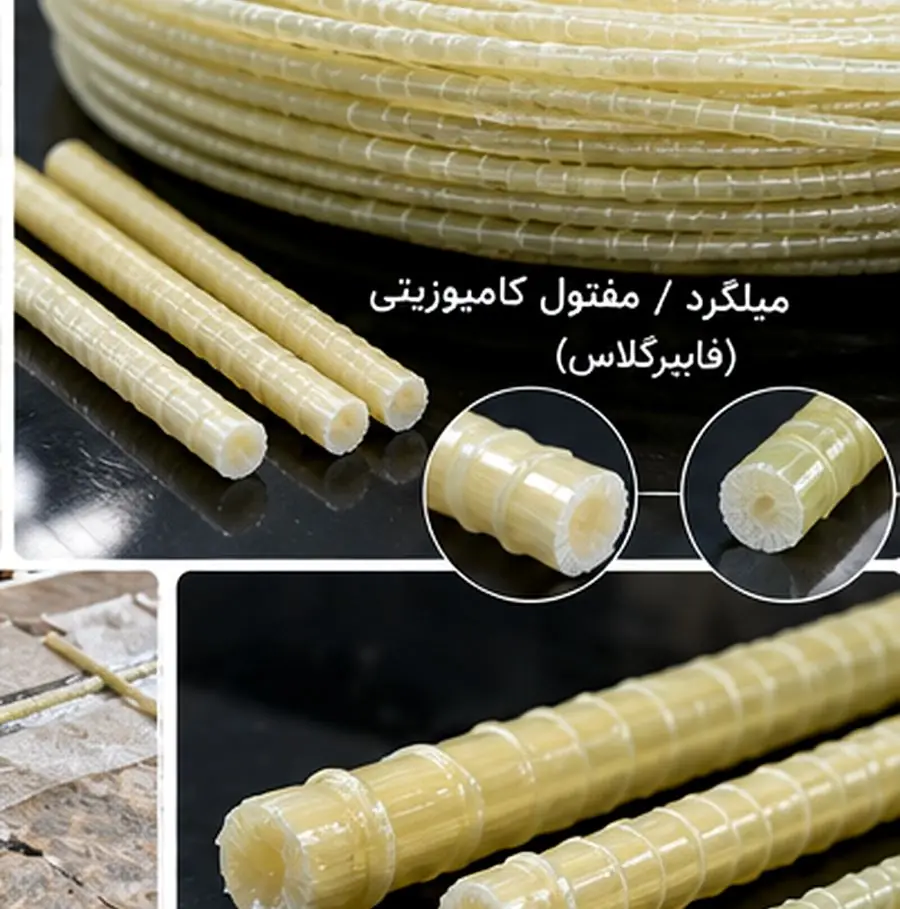
That is why composite rebar and fiberglass rods have replaced metal wire in the stone repair industry in recent years, and today stone processing plants carry out almost all repairs of veined stone with these products.
Composite wire surface types
- Smooth surface: adhesion only through chemical bonding with the adhesive; less recommended for stone stitching unless the surface is sanded.
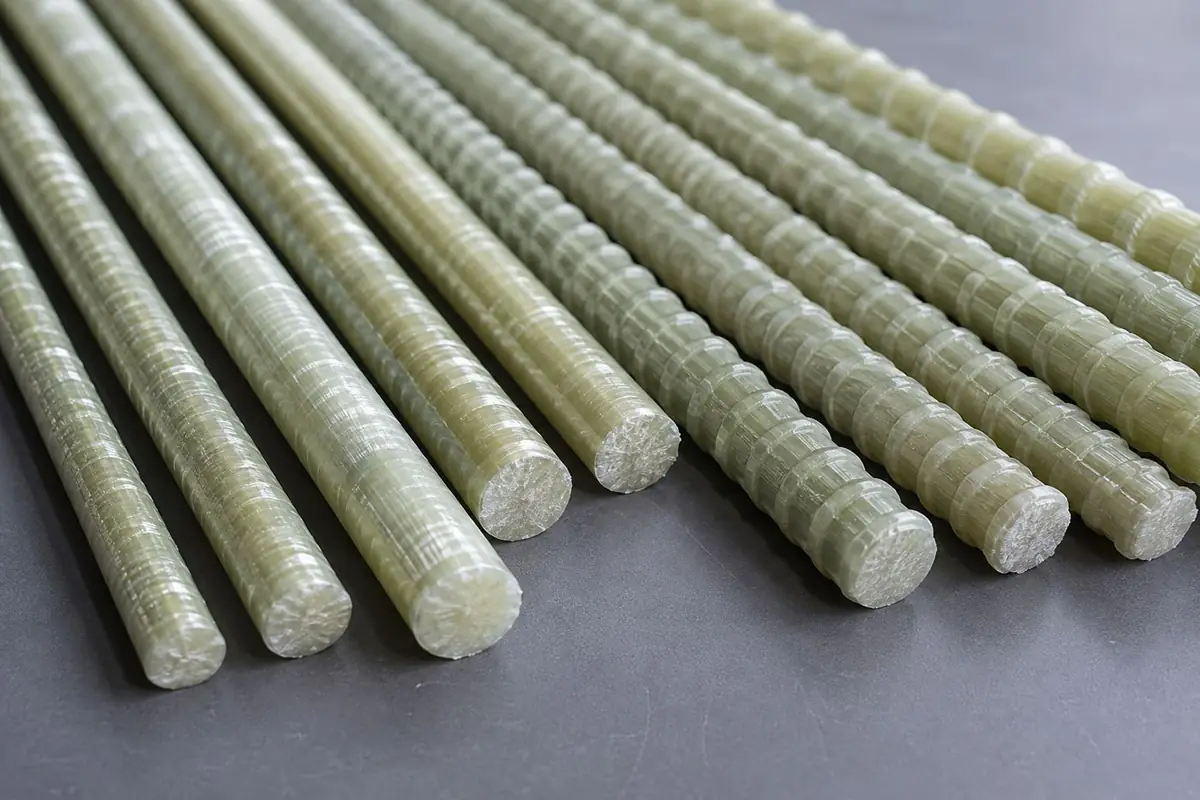
- Ribbed or helical wrap surface: a fiber strand is wound helically around the rod, creating ribs that, like the ribs on steel rebar, lock mechanically into the adhesive. The best option for stitching the back of stone.
- Sand-coated surface: high roughness and excellent adhesion; used mostly in structural composite rebar for concrete.
Advantages of fiberglass rods for stone repair
- No rust or corrosion: composite wire never rusts or stains in moisture, the alkaline environment of mortar, or even saline and coastal environments.
- Very high tensile strength: the tensile strength of fiberglass rods is usually 600 to over 1000 MPa — higher than ordinary structural steel.
- Thermal expansion close to stone: the longitudinal expansion coefficient of fiberglass rods is about 6 to 10 µm/m/°C, close to that of natural stones, so temperature changes create no extra stress at the interface.
- Excellent adhesion with epoxy and polyester: because the wire's own matrix is resin, it is fully chemically compatible with stone adhesives.
- Light weight: a density of about 2 g/cm³, about a quarter of steel; no extra weight is added to the slab.
- Easy cutting: cut to any length with bolt cutters, a grinder or a saw.
- Light, translucent color: does not cast dark shadows in translucent stones such as onyx.
- Electrically insulating and non-magnetic.
Stone stitching procedure: step-by-step instructions
The quality of stone stitching depends above all on attention to application details. The standard steps for stitching the back of stone are:
- Inspection: identifying and marking veins and cracks on the back of the stone
- Drying: making sure the stone is completely dry
- Grooving: cutting a groove with a grinder perpendicular to the crack
- Cleaning: removing dust with compressed air
- Adhesive: filling the bottom of the groove with epoxy adhesive
- Placement: laying the composite wire in the groove
- Covering: filling the groove completely and bonding mesh or mat
- Curing: curing the adhesive before handling
1. Inspection and marking
Place the stone face down on a flat, clean surface. With raking light, or by temporarily wetting the back of the stone and letting it dry, veins and hairline cracks are easier to see. Mark the path of each crack with a marker and set out the stitch positions perpendicular to it. In a network of tangled veins, lay out the stitches in a zigzag or crosswise pattern so that all veins are crossed.
2. The stone must be dry
Moisture is the main enemy of epoxy adhesion. Freshly cut stone (especially after wet cutting) must be completely dry; otherwise the adhesive cures on a thin film of water and forms a weak bond. In stone processing plants, slabs are placed in a drying tunnel at about 40 to 60 °C before resin treatment and stone stitching.
3. Cutting a groove with a grinder
With a grinder and diamond disc, cut a groove perpendicular to the crack. The groove dimensions play a key role in the success of stone stitching:
| Groove parameter | Practical recommendation | Engineering reason |
|---|---|---|
| Groove width | Wire diameter + about 1 to 2 mm | Room for a layer of adhesive around the wire |
| Groove depth | Wire diameter + about 1 to 2 mm; at most about one third to 40 percent of the stone thickness | Full coverage of the wire without overly weakening the stone section |
| Stitch length | At least about 10 cm on each side of the crack (total length 20 to 30 cm) | Provides enough anchorage length to transfer force from the adhesive to the wire |
| Stitch spacing | About 10 to 20 cm along the crack | Even distribution of force along the crack |
| Angle to the crack | Perpendicular (90 degrees); for curved cracks, perpendicular to the local tangent | Maximum tensile efficiency of the wire in the crack-opening direction |
4. Cleaning the groove
Stone dust at the bottom of the groove acts like a release layer. Clean the groove thoroughly with compressed air and a brush. In stone contaminated with oil or wax, cleaning with a suitable solvent (such as acetone) and waiting for it to evaporate completely is essential.
5 and 6. Applying adhesive and placing the composite wire
First fill the bottom of the groove with a layer of epoxy adhesive, then press the composite wire, cut to length, into the groove so it is fully embedded in the adhesive with no air pockets beneath it. The wire should not touch the bottom or walls of the groove directly; ideally it is surrounded by a layer of adhesive all round.
7. Filling the groove and covering with glass fiber mat or mesh
Fill the groove with adhesive up to the back surface of the stone and smooth it. On sensitive slabs, place a strip of fiberglass mesh, light fabric or glass fiber mat over the stitch and the area around the crack and wet it with adhesive. This layer provides two-way reinforcement and stops small pieces of stone breaking away along the crack. On very fragile slabs, the whole back of the stone is covered with glass fiber fabric or mesh and resin (meshing), and the stitches combined with this layer complete the repair. To learn more about mat and mesh types, read the article types of fiber in composites.
8. Curing
Common epoxies harden within a few hours at 20 to 25 °C, but reaching full strength takes about 24 hours (sometimes up to 7 days). During this time the stone must not be moved or bent. Below 10 °C, epoxy cure slows dramatically and may remain incomplete; in cold workshops use heaters or a heated tunnel.
Choosing the right adhesive for stone stitching
The adhesive is the link between the stone and the composite rod, and choosing the wrong one makes the stitch ineffective even with the best wire. The two main groups of adhesives in stone repair are:
| Feature | Two-part epoxy adhesive | Polyester stone adhesive (mastic) |
|---|---|---|
| Bond strength to stone | Very high | Moderate |
| Shrinkage during cure | Very low (less than 1 to 2 percent) | High (about 6 to 8 percent) |
| Moisture resistance | Excellent | Moderate |
| Cure time | Slower (hours) | Fast (minutes) |
| Yellowing in light | Low in UV-stable grades | Usually greater |
| Cost | Higher | Lower |
| Recommended application | Facade stone, onyx, high-value slabs and outdoor use | Quick indoor, non-structural repairs |
Comparing metal wire, plastic wire and composite wire
There are three options on the market for stone stitching: metal wire (steel or galvanized), plastic wire (PVC, nylon or polypropylene) and composite wire. The table below compares them from an engineering standpoint:
| Criterion | Metal wire | Plastic wire | Composite wire (fiberglass rod) |
|---|---|---|---|
| Tensile strength (MPa) | About 400 to 600 | About 30 to 80 | About 600 to 1000 and more |
| Elastic modulus (GPa) | approx. 200 | About 1 to 3 | About 40 to 50 |
| Coefficient of thermal expansion (×10⁻⁶/°C) | approx. 12 | About 50 to 100 | About 6 to 10 |
| Rust and staining | Yes; brown iron oxide stains | No | No |
| Creep under sustained load | Negligible | High | Low |
| Adhesion with epoxy | Medium (rust and grease must be removed) | Poor (smooth, non-polar surface) | Excellent |
| Weight (g/cm³) | 7.85 | About 1 to 1.4 | approx. 2 |
| Durability outdoors and in moisture | Poor | Medium (UV-sensitive) | Excellent |
| Verdict for stone stitching | Not recommended | Only light non-structural cases | Best choice |
Why is metal wire unsuitable for stitching the back of stone?
Steel rusts in contact with moisture and oxygen, and the volume of rust (iron oxide) is about 2 to 6 times that of the original steel. This volume increase inside the groove creates severe expansive pressure and breaks the stone from within — exactly the phenomenon the stitch was meant to prevent. In addition, water carrying iron oxide reaches the face through veins and pores and causes brown stains that cannot be removed from light stones such as white marble, crystal marble and onyx. The difference in thermal expansion between steel and stone also creates cyclic stress on sunny facades. For these reasons, metal wire is not recommended for stone stitching.
Why is plastic wire not enough?
Plastic wire is made only of polymer with no fiber. Its elastic modulus is about 20 to 40 times lower than composite wire; that is, before it carries any significant force, it stretches so much that the crack has already opened. Very high thermal expansion, creep under sustained load and poor adhesion to epoxy make plastic wire ineffective for stone repair. Composite rebar, by contrast, combines continuous glass fiber and resin, and this combination provides strength equal to or greater than steel without any of its drawbacks.
Stone stitching rods: choosing the right composite wire diameter
The most common diameters of stone stitching rods are 3, 4 and 5 mm. The choice of diameter depends on stone thickness, slab size and crack severity:
| Composite wire diameter | Suitable stone thickness | Cross-section (mm²) | Recommended application |
|---|---|---|---|
| 3 mm | 1.5 to 2 cm | approx. 7.1 | Onyx, thin and translucent stones, hairline cracks |
| 4 mm | 2 cm | approx. 12.6 | Marble and marbleized limestone slabs, countertops and floors |
| 5 mm | 3 cm and over | approx. 19.6 | Facade stone, large slabs, through-cracks and fractures |
| 6 mm and above | Thick and block stones | 28 and more | Steps, columns, three-dimensional elements and restoration of stone heritage |
A simple practical rule is that the composite wire diameter should not exceed about one fifth of the stone thickness, so the groove depth stays within the allowable range.
Which stones need stitching?
| Stone type | Need for stitching | Considerations |
|---|---|---|
| Onyx | Very high | Brittle and heavily veined; because it is translucent, use light-colored wire and clear, non-yellowing epoxy. |
| Marble and crystal marble | High | Calcite veins; sensitive to rust staining. |
| Marbleized limestone | Medium to high | Clay veins and filled cavities. |
| Travertine | Moderate | High porosity; fill the pores with resin before stitching. |
| Granite | Low to medium | Usually for fractures and large slabs with open veins. |
Common mistakes in stone stitching
- Groove parallel to the crack: in this case the wire plays no part in preventing the crack from opening; the stitch must be perpendicular to the crack.
- Groove too deep: weakens the stone section and creates a new crack.
- Short anchorage length: very short wires pull out of the adhesive before taking load.
- Stitching wet or dusty stone: the main reason stitches come loose after a while.
- Using metal wire: rust, staining and internal fracture in the long term.
- Moving the stone before the adhesive has fully cured.
- Using poor-quality composite rods: wires with low fiber content or incomplete resin cure reduce the durability of the repair; use fiberglass rods made by industrial pultrusion.
- Using cheap polyester adhesive on onyx: yellowing and high shrinkage at the stitch.
Nabak Composite composite wire for stone stitching
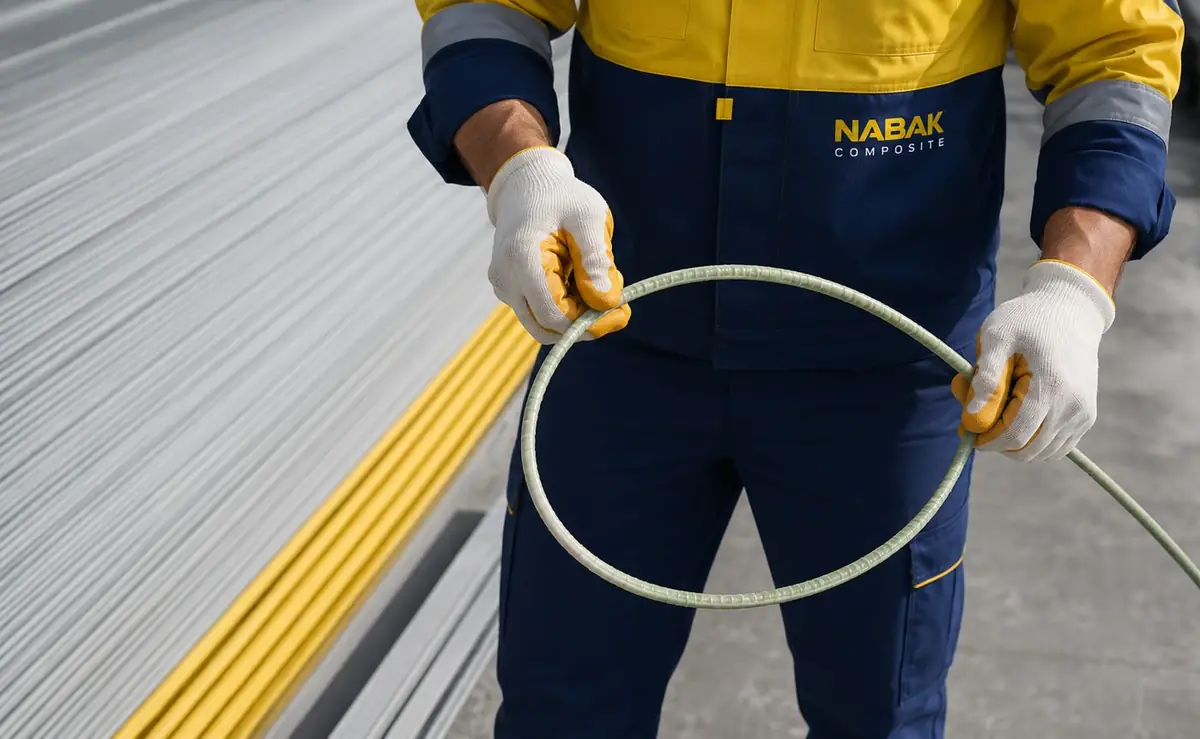
Nabak Composite produces composite wire and fiberglass rods by pultrusion, with continuous glass fiber and quality resin, in various diameters. Smaller diameters are supplied in coils and larger diameters in straight lengths cut to any length. A helical ribbed surface, high fiber content and dimensional quality control make Nabak wire a reliable choice for stone processing plants, facade contractors and stone repair workshops.
Frequently asked questions about stone stitching
What is stone stitching?
Stone stitching is a method of repairing and preventing cracks in veined stone, in which grooves are cut in the back of the stone perpendicular to the crack and composite wire (fiberglass rod) is set in them with epoxy adhesive.
What wire diameter is used for stone stitching?
Composite wire of 3, 4 or 5 mm diameter is usually used to stitch the back of stone: 3 mm for thin stones and onyx, 4 mm for 2 cm slabs and 5 mm for thicker stones and large slabs.
Why shouldn't metal wire be used for stone stitching?
Metal wire rusts over time; the volume increase from rust cracks the stone from within, and brown iron oxide stains appear on light and translucent stones. Fiberglass rods never rust.
What is the difference between plastic wire and composite wire?
Plastic wire is made only of polymer and has little strength and stiffness, whereas composite wire is made of continuous glass fiber and resin and its tensile strength is many times higher.
What is the best adhesive for stone stitching?
Two-part epoxy adhesive is the best choice for stone stitching because of its excellent adhesion, very low shrinkage and moisture resistance — especially for facade stone and translucent stones.
Summary
Stone stitching is a simple but very effective engineering solution for increasing the durability of veined natural stone. In this method, composite wire acts as the tension member on the back of the stone, and epoxy adhesive transfers force from the stone to it. Keeping the stitch perpendicular to the crack, correct groove dimensions, sufficient anchorage length, a dry and clean surface and choosing a low-shrink adhesive are the keys to successful stone stitching. Among the available options, fiberglass rods are the best choice for reinforcing the back of stone because of their high strength, freedom from rust, thermal expansion close to stone and excellent adhesion, and they have made composite rebar today's standard in stone repair. For advice and supply of suitable composite wire, contact the Nabak Composite team.

This article was prepared by the technical team of Nabak Composite, a manufacturer of composite wire and fiberglass rods by pultrusion.