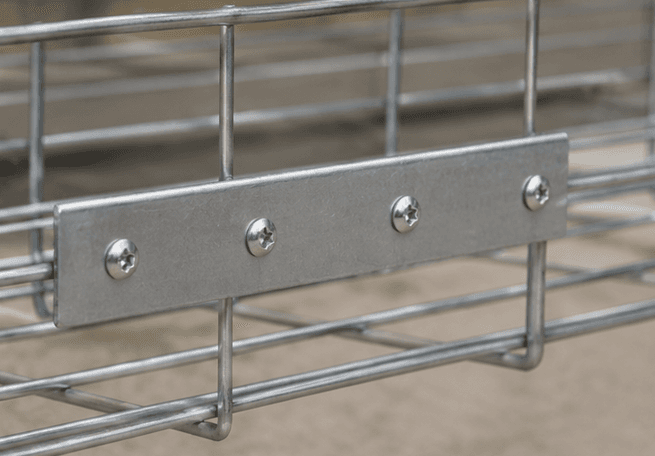
Standard splice plate for FRP/GRP cable tray
The stainless steel splice plate is an important part of an FRP/GRP cable tray installation, used to join two cable tray sections mechanically and form a continuous, rigid cable route.
It is usually made from stainless steel 304 or 316 and, thanks to stainless steel’s high corrosion resistance, suits projects in harsh conditions such as oil and gas, petrochemical, power plants, marine and chemical environments.
By joining two tray sections accurately, splice plates transfer mechanical loads, keep the route aligned, strengthen the system and stop the tray from shifting or deforming over time.
What a splice plate does
Cable trays are produced in standard lengths and joined on site. The splice plate:
- Joins two cable tray sections mechanically
- Keeps the two sections aligned
- Increases joint strength under cable load
- Stops the joint opening under vibration
- Creates a continuous, strong path for cables
Splice plate types
Straight splice plate
The most common type, joining two tray sections on a straight run; used on long cable runs, industrial halls, power plants and infrastructure projects.
Angle splice plate
For joining sections with a change of angle or special installation conditions.
Internal splice plate
Fitted inside the tray side wall for a cleaner, more integrated look.
External splice plate
Fitted on the outside of the tray side wall; suited to joints that need more mechanical strength.
Material
Stainless steel 304 (SS304)
For normal industrial and humid environments, food processing and industrial buildings. Good rust resistance, good mechanical strength and more economical than 316.
Stainless steel 316 (SS316)
For coastal areas, oil and gas, petrochemical plants and environments with chlorides and chemicals. Very high corrosion resistance, better resistance to salts and chemicals and a longer life in harsh conditions.
Technical data
| Property |
Details |
| Material |
Stainless steel 304 / 316 |
| Thickness |
To system design (typically 2–5 mm) |
| Finish |
Polished or industrial matte |
| Corrosion resistance |
Very high |
| Fixing |
Stainless steel nuts and bolts |
| Compatibility |
FRP, GRP and metal cable trays |
| Service life |
Long, even in harsh environments |
Benefits with FRP/GRP cable trays
- Excellent corrosion resistance: FRP trays with stainless splice plates form a highly corrosion-resistant system for refineries, acid units, treatment plants and jetties.
- No weak point at the joint: loads from cable weight, equipment vibration and temperature changes are transferred evenly.
- Easy installation: standard hole patterns allow fast bolted installation with no welding or hot work.
Bolts and fixings
Splice plates are usually fixed with SS304 or SS316 nuts and bolts and stainless flat and spring washers. In highly corrosive environments, all joint components should be the same stainless grade to reduce the risk of galvanic corrosion.
Applications
- Joining FRP/GRP cable trays
- Joining FRP cable ladders
- Oil and gas projects and refineries
- Petrochemical plants
- Power plants
- Marine industry
- Mines
- Chemical plants
- Tunnels and urban infrastructure
Selection notes
- Cable tray width and height
- Weight of the cables carried
- Support spacing
- Site environment
- FRP tray resin type
- Corrosion and humidity levels
- Cable system design standard
Summary
The stainless steel splice plate is a key component of a professional FRP/GRP cable tray installation, giving a secure, strong and durable joint for the long-term performance of the cable network. SS304 and SS316 allow use in the harshest industrial environments, and combined with FRP cable trays they give a long-life, low-maintenance engineered solution.
Fittings are made to match Nabak FRP cable trays and FRP cable ladders. Send your cable routing drawing through the contact form and our engineers will propose the full list of fittings with quantities and prices.