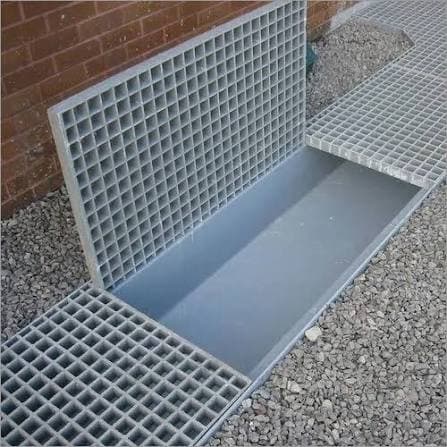
Product overview
FRP/GRP trench cover grating is designed specifically to cover utility trenches, surface-water collection channels, process fluid channels, cable trenches and drainage routes in industrial sites. It forms a safe cover over the channel while letting water, air and fluids pass through, and it prevents falls, keeps foreign objects out and protects the equipment inside.
On many industrial projects, steel or concrete slabs used as trench covers are heavy, corrode, are hard to lift and costly to maintain. With its low weight, high strength and long service life, FRP trench grating is an engineered and economical alternative to these traditional covers.
Advantages
Quick access to underground services
A key reason to use grating as a trench cover is that it can be lifted and replaced quickly for repairs, inspection and servicing of equipment in the trench. Its low weight means maintenance can be done faster and without heavy lifting equipment.
Resistant to corrosion and moisture
Industrial trenches are usually exposed to water, humidity, chemicals, corrosive vapors or process effluent. FRP/GRP grating does not rust or rot and keeps performing in these conditions for many years.
Lets water, air and fluids through
The open mesh drains surface water quickly, ventilates the trench naturally and prevents ponding, which reduces flooding, improves safety and makes operation easier.
Lower load on the structure
Being much lighter than steel or concrete covers, FRP grating is easier to transport and install and reduces the dead load on the structure, an important benefit in expansion and refurbishment projects.
Safer industrial walkways
With an anti-slip (gritted) surface, it improves foot safety in wet, rainy or oily areas and reduces the risk of slips.
Electrically insulating and non-magnetic
Over power, control and instrumentation cable trenches, FRP/GRP covers are a safer choice than metal because they are non-conductive and non-magnetic.
Applications
Surface-water channels
- Drainage channels in industrial yards
- Rainwater channels
- Water discharge channels in factories
Cable trenches
- Power cable trenches
- Control cable trenches
- Instrumentation trenches
- Cable tunnels in power plants and substations
Utility trenches
- Service pipe routes
- Mechanical services trenches
- Access channels for maintenance and inspection
Oil, gas and petrochemical plants
- Fluid collection channels
- Around process units
- Tank farms and equipment areas
Water and wastewater treatment plants
- Water transfer channels
- Collection pits
- Drainage and access routes
Food, pharmaceutical and manufacturing plants
- Wash-down channels
- Effluent discharge lines
- Underground utility routes
Why use grating as a trench cover?
On most industrial projects, a trench cover has to do more than close the opening: easy access, drainage, ventilation and safety matter too. That is why FRP grating has clear advantages over solid plates:
- lets water through and prevents trench flooding
- ventilates the trench and reduces trapped humidity
- gives quick access for inspection, servicing and repairs
- lighter covers that are easy to move
- no build-up of dirt or water on the surface
- safer walking with an anti-slip surface
- lower maintenance costs in corrosive environments
For these reasons, FRP trench grating is replacing steel, cast-iron and concrete covers on many new projects.
Custom features
FRP/GRP trench cover grating can be produced in custom sizes, different depths and mesh sizes, with an anti-slip surface, in industrial colors, and with accessories such as lifting handles, hold-down plates and locking systems, so each cover matches the operating conditions of your project.
Send us your channel widths, lengths and expected loads through the contact form for a quotation.