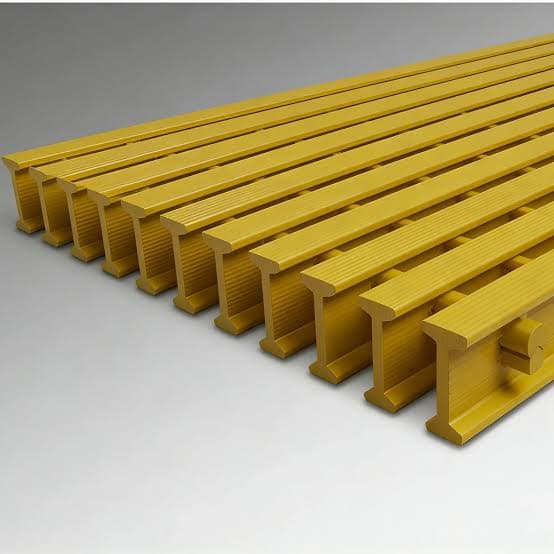
Product overview
Pultruded FRP/GRP grating is an engineered grating with high load capacity, assembled from pultruded bearing bars held together by cross rods. Unlike molded grating, which is a one-piece grid, pultruded grating places most of the glass fibers in the main load direction. This fiber layout greatly increases bending strength, longitudinal strength and load capacity, making it ideal for long spans, heavy loads and structural uses.
It is produced with engineering resins such as polyester or vinyl ester, or other resins chosen for the service environment. It stays lightweight while offering very high resistance to corrosion, moisture, chemicals and harsh industrial conditions, so it is a reliable and economical choice wherever structural strength and load capacity come first.
Advantages
High load capacity over long spans
Its key feature is the use of pultruded bearing bars with fibers aligned to carry the load. It carries heavy loads with less deflection than molded grating and reduces the need for intermediate supports on long spans.
Higher bending and longitudinal strength
Concentrating fibers in the load direction increases bending strength and structural stiffness, which is important on industrial platforms, access bridges, equipment routes and heavily loaded floors.
Light weight, lower dead load
Despite its strength, pultruded FRP grating is much lighter than steel, which cuts transport and installation costs and reduces the load on the main structure.
Excellent corrosion resistance
It resists acids, alkalis, salt water, humidity, corrosive vapors and many chemicals, making it an excellent choice where metal grating rusts and deteriorates.
Electrically insulating and non-magnetic
It does not conduct electricity or create magnetic interference, so it is safer than metal grating in power plants, substations, electronics plants and sensitive facilities.
Choice of surfaces
It can be produced with a smooth, concave or gritted (anti-slip) surface to match the safety and performance needs of each area.
Applications
Oil, gas and petrochemical plants
- Heavily loaded process platforms
- Equipment access bridges
- Walkways in process units
- Maintenance platforms
Power plants
- Heavy equipment platform floors
- Turbine access routes
- Walkways in electrical facilities
Mining and metals
- Machinery platforms
- Access routes for extraction equipment
- Connecting bridges in processing plants
Marine sites and jetties
- Jetty access bridges
- Loading platforms
- Coastal and offshore facilities
Water and wastewater treatment plants
- Long-span access bridges
- Equipment platforms
- Walkways in corrosive areas
Manufacturing plants
- Heavily loaded industrial flooring
- Service equipment routes
- Machinery maintenance platforms
Pultruded vs molded grating
From an engineering point of view, the choice between pultruded and molded grating depends on the load type and project conditions.
Pultruded FRP/GRP grating is designed for projects where heavy loads, long spans and minimal deflection matter. Its pultruded bearing bars carry the load, giving it a higher load capacity than molded grating.
Molded grating, with its one-piece grid, is better for multi-directional loads, complex layouts and projects where flexible cutting and installation matter more.
- Pultruded grating: heavy loads, long spans and structural applications.
- Molded grating: general use, multi-directional loads and standard walkways.
Send us your span, load and panel sizes through the contact form; see also our pultruded grating datasheets.