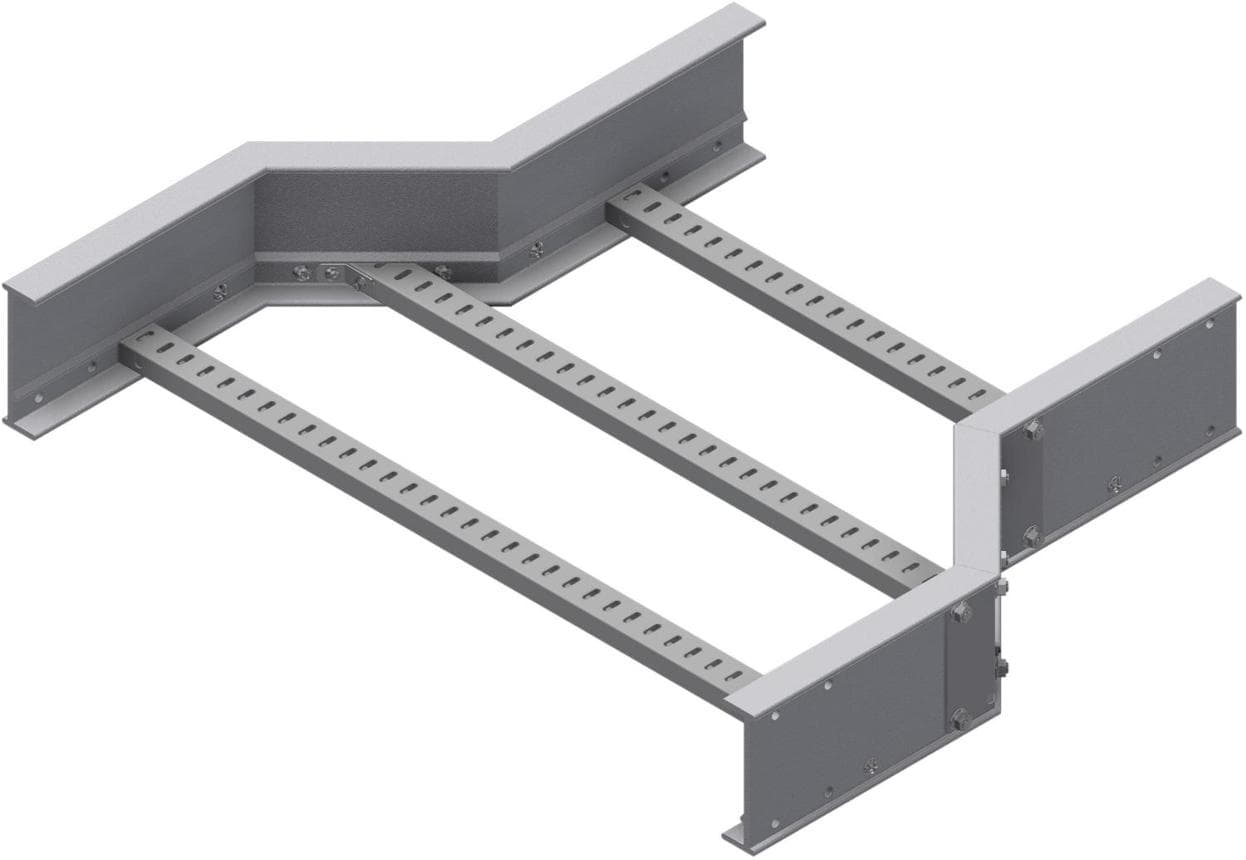
FRP/GRP cable ladder straight reducer
The FRP/GRP cable ladder reducer is a specialist cable management fitting used to change the width of a cable ladder along the route. It is used where a wider main run connects to a narrower one, or where fewer cables need less space.
It is made from glass-fiber reinforced polymer and durable industrial resins and gives a standard connection between two different FRP/GRP ladder sizes.
Using a standard reducer instead of narrowing or cutting the ladder on site keeps the structure strong, respects cable bend radius and makes the system more reliable.
Why reducers matter in electrical design
For electrical consultants and cable system designers, routes are rarely one constant width. On many industrial projects:
- The main route leaving an electrical room or substation carries many cables
- Further along, the number of cables drops
- Some branches run to specific equipment or sub-distribution boards
- Installation space is tighter at some points
A cable ladder reducer changes route size without stress, sudden loss of capacity or problems at the supports.
Key advantages
- Standard connection between two ladder widths: for example 600 to 450 mm, 450 to 300 mm or 300 to 150 mm, depending on the design
- Keeps mechanical capacity: the fitting design keeps the route strong at the change of width
- Protects cables: a gradual change of width prevents cable crowding and keeps cables neatly laid
- For power and control cables: low-voltage, medium-voltage, control and instrumentation cables
- Excellent corrosion resistance: for refineries, petrochemical plants, power plants, marine industry and chemical environments
- Faster installation: no cutting, modifying or fabricating fittings on site
Industrial applications
Oil, gas and petrochemical
- Reducing route width after leaving main units
- Connecting main routes to branch routes
- Process equipment cabling
Power plants and substations
- Changing route capacity after leaving the electrical room
- Connecting main cable racks to equipment routes
Mining and steel
- Reducing route width on production lines
- Connecting machinery cable routes
Water and wastewater
- Routes with changing cable density
- Humid, corrosive environments
Cable ladder reducer vs cable tray reducer
FRP/GRP cable ladder reducer
- For power cables and high-capacity routes
- For large, heavy cables
- Keeps cables ventilated
- For main industrial routes
- Higher load capacity
FRP/GRP cable tray reducer
- For lighter cables
- For control, instrumentation and network cables
- A continuous base to support cables
- More mechanical protection for sensitive cables
Design notes for electrical consultants
- Number and diameter of cables: the new width must still leave room for the cables and future expansion.
- Cable bend radius: the change of width must not cause sharp bends or side pressure on cables.
- Support spacing: because the route geometry changes, support positions must be checked.
- Load class: check cable weight on both sides of the reducer.
- Environment: in corrosive areas, the right resin (such as vinyl ester) matters.
Summary
The FRP/GRP cable ladder reducer is an engineered fitting for optimizing industrial cable routes, changing ladder width without loss of strength, cable stress or poor workmanship. It plays an important role in professional cable management design for oil, gas, petrochemical, power, mining and infrastructure projects.
Complete your system with matching FRP cable ladders and splice plates and hold-down clamps. For sizes, load classes and a quotation, see our technical documents or use the contact form.
For the complete technical specifications, dimensions and engineering tables of this product, see FRP/GFRP Composite Cable Tray — Technical Datasheet.