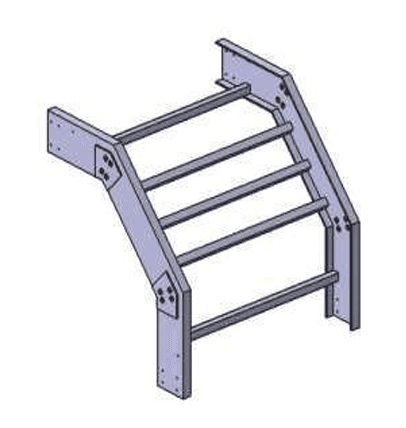
FRP/GRP cable ladder 90° vertical inside bend
The FRP/GRP cable ladder 90° vertical inside bend is an important specialist fitting in composite cable ladder systems, used to turn cable runs 90° in the vertical plane, from horizontal to vertical or the reverse.
It is used where the route must move between elevations, such as from floor level to upper floors, from cable racks to equipment, or past structures and obstacles. The inside-bend design makes the change of height on the inside of the structure, reducing the space taken up at the installation.
It is made from fiberglass reinforced polymer profiles and engineering resins and is designed for industrial cable systems in harsh environments.
Why a 90° vertical inside bend matters
A vertical change of direction is one of the critical points in cable routing design, because cables there are affected by:
- The cable’s own weight on the vertical run
- The allowable bend radius
- Pulling forces during cable installation
- Limited installation space
- The need for access for future maintenance
A standard 90° bend changes the route without an abrupt break and without damaging the cable sheath or insulation.
Key advantages
- Fast, standard vertical change of direction: takes the route from horizontal to vertical at one defined point, simplifying installation
- For power and heavy cables: suits low-voltage (LV), medium-voltage (MV), motor, control and instrumentation cables
- Keeps cable bend radius: standard geometry guides cables at the right angle and prevents point pressure on insulation
- High resistance in corrosive environments: FRP/GRP resists moisture, chemicals, corrosive vapors and marine conditions, replacing galvanized or painted steel systems
- Electrically insulating and non-magnetic: no electrical conduction and no magnetic field issues in sensitive areas
- Lower maintenance costs: no corrosion, no coating repairs and a long life
Industrial applications
Oil, gas and petrochemical
- Moving cables between levels of process structures
- Power and control equipment cable routes
- Units with chemical and corrosive environments
Power plants
- Connecting cable routes between plant floors
- Generator, switchboard and control equipment cable routes
- Areas with high cable density
Mining and steel
- Routing cables up tall structures
- Industrial machinery cable routes
- Dusty, humid areas
Marine and coastal
- Platforms and port facilities
- Areas with salt and high corrosion
Treatment plants
- Pump and electrical equipment cable routes
- Humid, chemical environments
Cable ladder vs cable tray vertical inside bend
FRP/GRP cable ladder vertical inside bend
- For heavy power and medium-voltage cables
- Higher load capacity
- Better ventilation and lower cable temperature
- For main cable routes, long spans and heavy industrial projects
FRP/GRP cable tray vertical inside bend
- For lighter control, instrumentation and network cables
- A closed base gives more mechanical protection to sensitive cables
- For branch routes and lighter building services
In industrial design terms: cable ladder carries large volumes of power cables; cable tray organizes and protects lighter cables.
Design notes for electrical consultants
- Cable bend radius: especially for MV and single-core power cables.
- Cable restraint on the vertical run: use suitable cleats and clamps so cable weight is not transferred to the fitting.
- Load capacity: include cable weight before and after the bend in the design.
- Support positions: points near the bend need proper supports to avoid extra stress on the fitting.
- Environment and resin:
- Polyester for general conditions
- Vinyl ester for highly corrosive environments
Summary
The FRP/GRP cable ladder 90° vertical inside bend is an engineered fitting for vertical changes of direction in cable ladder systems. Combining mechanical strength, low weight, chemical resistance, electrical insulation and long life, it is a core component of professional cable routes in oil and gas, petrochemical, power, mining, marine and infrastructure projects.
Complete your system with matching FRP cable ladders and splice plates and hold-down clamps. For sizes, load classes and a quotation, see our technical documents or use the contact form.
For the complete technical specifications, dimensions and engineering tables of this product, see FRP/GFRP Composite Cable Tray — Technical Datasheet.