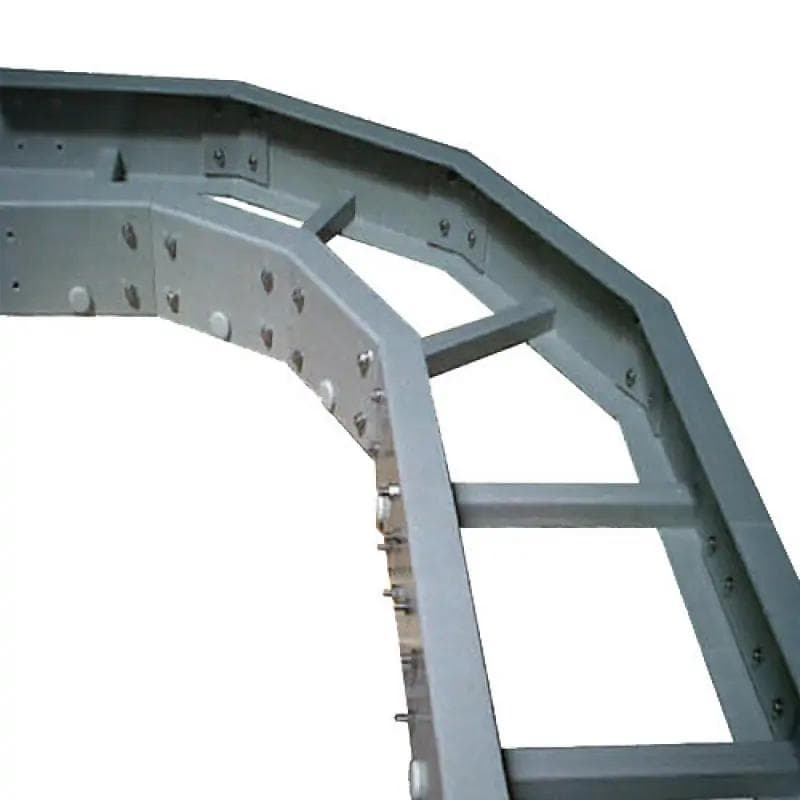
FRP/GRP cable ladder 90° horizontal bend
The FRP/GRP cable ladder 90° horizontal bend is one of the main fittings in composite cable ladder systems, used to turn cable runs through 90° in the horizontal plane. It changes the route without an abrupt break, keeping the ladder structure and the correct cable bend radius.
It is made from glass-fiber reinforced FRP/GRP profiles and is designed for power, medium-voltage, control, instrumentation and telecom cables on industrial projects. The open ladder structure keeps cables ventilated through the turn, reduces heat build-up and gives easy access for installation and maintenance.
As an engineered fitting, it plays an important role in complex cable routes in power plants, oil and gas, petrochemical and large industrial projects.
Key advantages
- Standard 90° change of direction: complex routes without cutting, welding or improvised changes on site
- For heavy cables and main routes: the ladder structure gives high load capacity for power and multi-layer cables
- Keeps cable bend radius: prevents over-bending and damage to cable insulation and sheath
- Excellent ventilation through the turn: unlike enclosed routes, the open ladder keeps air flowing and helps control cable temperature
- Outstanding corrosion resistance: resists moisture, chemical vapors, acidic and alkaline environments and marine conditions
- Lower maintenance costs: no rust, no anti-corrosion coating and a long service life
- Light with high structural strength: lower load on supports and easier handling and installation
Cable ladder vs cable tray 90° bend
Consulting engineers should note the difference when designing cable management systems:
FRP/GRP cable ladder 90° bend
- For heavy power cables, medium-voltage and large-diameter cables on main routes
- Higher load capacity and suited to long spans between supports
- Fully open structure for better ventilation and heat dissipation
- Cables can enter or leave the route at any point, making future expansion easy
- Best choice for refineries, power plants, steel, mining and heavy industry
FRP/GRP cable tray 90° bend
- For lighter control, instrumentation and telecom cables
- A continuous base gives more mechanical protection to cables
- Better where cables need cover and a tidier layout, such as buildings and electrical rooms
On large industrial projects, main high-capacity routes are usually built with cable ladder and branch routes for more sensitive cables with cable tray, optimizing both load capacity and cable protection.
Industrial applications
Oil, gas and petrochemical
- Power cable routes for process equipment
- Instrumentation and control cables
- Units with corrosive and hazardous environments
Power plants
- Cable routes for generators, transformers and control equipment
- Electrical rooms and main cable routes
Mining and steel
- Heavy machinery cabling
- Production lines and industrial equipment
Marine and coastal
- Jetties and port facilities
- Areas with high humidity and salt
Treatment plants and chemical industry
- Cable routes in humid and chemical environments
Engineering selection notes
When selecting an FRP/GRP cable ladder 90° horizontal bend, check:
- Cable ladder width
- Side rail height
- Total cable weight and load class
- Support spacing
- Cable bend radius
- Site environment
- Resin type: polyester for normal environments, vinyl ester for more corrosive ones
Getting these right ensures a long system life, lower repair costs and reliable long-term performance of the industrial power network.
Complete your system with matching FRP cable ladders and splice plates and hold-down clamps. For sizes, load classes and a quotation, see our technical documents or use the contact form.
For the complete technical specifications, dimensions and engineering tables of this product, see FRP/GFRP Composite Cable Tray — Technical Datasheet.