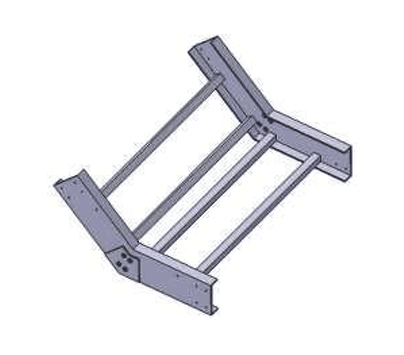
FRP/GRP cable ladder 45° vertical inside bend
The FRP/GRP cable ladder 45° vertical inside bend is a specialist fitting for composite cable ladder systems, used to turn cable runs 45° in the vertical plane, toward the inside of the structural route.
It is used where a ladder run must move from one elevation to another, but gradually and at a gentle slope. The 45° design guides cables from a lower to a higher route without sudden pressure, kinks or loss of the allowable bend radius.
Made from glass-fiber reinforced composite profiles and durable industrial resins, it is a strong replacement for metal fittings wherever corrosion resistance, low weight and long-term performance matter.
Why a 45° vertical inside bend matters
In real projects, cable routes rarely stay at one elevation. Switchboards, steel structures, pipelines, mechanical equipment and different floor levels all force the route to change height. A 45° vertical inside bend lets the route:
- Continue without sharp bends
- Keep the cable bend radius
- Reduce mechanical stress on cables
- Look orderly and engineered
Key advantages
- Gradual change of elevation: a 45° angle gives a smoother transition than steep vertical turns and suits large-diameter power cables
- Keeps cable bend radius: power and medium-voltage cables have minimum bend radius limits; a standard bend protects their insulation and inner layers
- For heavy cables: suits power, motor, medium-voltage, control and instrumentation cables
- High corrosion resistance: ideal where metals corrode quickly: refineries, petrochemical plants, marine industry, mines and treatment plants
- Electrically insulating and non-magnetic: no stray current paths and no magnetic effects in sensitive areas
- Lower maintenance costs: no rust, no anti-corrosion paint and a long life
Industrial applications
Oil, gas and petrochemical
- Moving cables between structure levels
- Routing cables around process equipment
- Vertical routes in industrial units
Power plants
- Connecting cable routes between turbine floors and auxiliary equipment
- Power and control equipment cable routes
Mining and steel
- Changing cable route height on production lines
- Routing cables through steel structures and heavy equipment
Marine and coastal
- Jetties
- Industrial platforms
- Humid, salt-laden areas
Water and wastewater treatment
- Pump cable routes
- Electrical equipment at different heights
Cable ladder vs cable tray vertical inside bend
FRP/GRP cable ladder vertical inside bend
- For heavy power and medium-voltage cables
- Higher load capacity
- Better ventilation and lower cable temperature
- For main cable routes, long spans and heavy industrial projects
FRP/GRP cable tray vertical inside bend
- For lighter control, instrumentation and network cables
- A closed base gives more mechanical protection to sensitive cables
- For branch routes and lighter building services
In industrial design terms: cable ladder carries large volumes of power cables; cable tray organizes and protects lighter cables.
Design notes for electrical engineers
- Cable bend radius: especially for medium-voltage and multi-core cables.
- Cable weight on vertical runs: design suitable cable restraint and supports.
- Support spacing: support positions before and after the bend are important.
- Environment and resin:
- Polyester for general conditions
- Vinyl ester for highly corrosive environments
Summary
The FRP/GRP cable ladder 45° vertical inside bend changes cable route elevation at a controlled slope. Combining mechanical strength, low weight, chemical resistance, electrical insulation and long life, it is a dependable choice for professional cable routes in oil and gas, petrochemical, power, mining and infrastructure projects.
Complete your system with matching FRP cable ladders and splice plates and hold-down clamps. For sizes, load classes and a quotation, see our technical documents or use the contact form.
For the complete technical specifications, dimensions and engineering tables of this product, see FRP/GFRP Composite Cable Tray — Technical Datasheet.